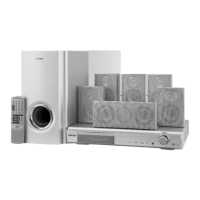
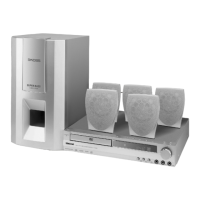
Need help?
Do you have a question about the Koss KS4102 and is the answer not in the manual?
Covers warnings, caution symbols, and basic safety instructions to prevent hazards like electric shock and fire.
Details Class 1 Laser Product information and warnings regarding invisible laser radiation exposure.
Provides guidelines on installation, cleaning, ventilation, power cord protection, and proper use to ensure user safety.
Offers advice on handling discs, warnings about product damage, and instructions for required servicing.
Explains DVD disc zoning for distribution and discusses anti-copy protection devices.
Provides essential instructions for installing the unit on a stable surface and avoiding adverse environmental conditions.
Details different DVD disc types, features like titles and chapters, and proper cleaning methods.
Provides a detailed description of each button on the remote control and its corresponding function.
Explains the use of numeric keys (0-9) for direct selection of titles, chapters, tracks, and tuner channels.
Identifies and describes the functions of the buttons and indicators located on the front panel of the unit.
Details connections for FM and AM antennas to ensure proper radio reception.
Explains how to connect audio and video signals from external sources like VCRs and TVs.
Describes connections for outputting audio and video signals to external recording devices like VCRs.
Covers connections for component video and progressive outputs for enhanced picture quality.
Details connections for digital coaxial and optical audio inputs and outputs for high-quality sound.
Explains S-Video and standard composite video output connections for TV display.
Guides on connecting the included subwoofer, surround, and front speakers to the unit.
Information regarding the connection of the power cord for the unit.
Illustrates the various video connection options for integrating the DVD player with a TV or VCR.
Shows how to connect audio sources, including digital and analog inputs, to the home theater system.
Provides diagrams and instructions for connecting all speakers, including impedance and polarity.
Offers advice on optimal speaker placement within a room for the best surround sound experience.
Guides users through the initial power-on process, connecting to TV, and inserting the first disc.
Explains the meaning of a specific symbol displayed on-screen indicating unavailable or disallowed actions.
Introduces the importance of proper setup for enhanced sound, picture quality, and features.
Explains how to use navigation keys and menus to select options and configure settings on the unit.
Details the functions for playing discs and selecting different playback modes.
Guides users on setting a password and controlling content based on parental rating levels.
Illustrates how parental control levels affect disc playback and explains the meaning of different levels.
Covers selecting TV image aspect ratios (4:3, 16:9) and output signal formats (PAL/NTSC).
Explains how to enable Progressive Scan for enhanced picture resolution and minimize distortion.
Details settings for Dynamic Range Compression (DRC), Digital Output, and speaker setup.
Describes the five standard Pro Logic II sound modes for tailored surround processing.
Guides on customizing soundfield effects using Dimension, Panorama, and Center Width controls.
Allows selection of the default language for player menus from available options.
Enables setting default languages for disc menus, audio tracks, and subtitles.
Explains how to select different input sources such as AV, TUNER, OPTICAL, ANALOG, and COAXIAL.
Details how to adjust the master volume and mute the audio output.
Lists and describes various surround output modes like Dolby Pro Logic II, 3 Stereo, Stadium, Stage, Hall, Disco, Live.
Explains the six available EQ modes for tailoring audio output, including FLAT, ROCK, POP, CLASSIC, JAZZ.
Describes Dolby Digital Surround, Dolby Pro Logic II Surround, and 3 Stereo audio systems.
Details how to tune into radio stations and understand the display indicators for AM/FM.
Explains automatic tuning and manual tuning methods for finding radio stations.
Guides on how to store favorite stations and select them using preset numbers.
Instructions for setting the system's clock to either 12-hour or 24-hour format.
Details how to set the unit to turn on or off automatically at a specified time.
Explains how to set a sleep timer for automatic standby and display the current time.
Covers checking remaining sleep time and cancelling the sleep timer function.
Covers loading a disc, basic playback, pause, slow motion, skip, and fast search functions.
Details quick keys, stop/resume functions, and active navigation for disc menus.
Explains audio output modes, repeat options (standard, program, random, A-B repeat), and index functions.
Details options available when a DVD disc is stopped, including resume play and play modes.
Guides on creating a custom playback program by adding titles and chapters in a specific order.
Explains how to edit DVD program lists, including deleting previously selected items.
Covers the process of loading and playing music CDs on the unit.
Details playback controls like pause, skip, fast search, stop/resume, and numeric track selection.
Covers active navigation for menus and special playback features like repeat options.
Explains options when a CD is stopped, including resume play, and playback modes like Standard, Random, Program.
Guides on creating custom programs for music CDs by selecting and adding tracks.
Demonstrates how to edit a music CD program list, specifically how to delete the last selected item.
Explains how to play discs containing MP3, WMA, and JPEG files individually.
Details how the player handles MP3 files when played alongside JPEG files.
Explains the logic governing playback order for MP3/WMA files and JPEG slideshows.
Covers stop/resume, quick keys (rotate, menu, zoom), and active navigation during playback.
Describes the menu options that appear when a multimedia disc is stopped.
Allows selection of playback order for multimedia files, including Standard, Random, and Program modes.
Guides on creating a program list for multimedia files by adding folders and tracks.
Demonstrates how to edit a multimedia program list by deleting previously added items.
Addresses issues related to no power, unit not responding to the remote control, and battery inspection.
Covers problems like no picture, distorted picture, no color, no sound, and digital audio output issues.
Discusses issues with discs not playing, forgotten passwords, stuck discs, and general function disturbance.
Lists compatible disc formats including DVD-Video, DVD-R/RW, VCD, and Audio CDs.
Details compatibility with discs containing MP3, WMA, and JPEG files, including format recommendations.
 General
| Brand | Koss |
|---|---|
| Model | KS4102 |
| Category | Home Theater System |
| Language | English |

 To Next Page