-85- v2.9
Sensors
7.1.1. Pulse and Oxygen in Blood (SPO2)
7.1.1.1. Sensor features
Description: Pulse oximetry a noninvasive method of indicating the arterial oxygen saturation of functional
hemoglobin.
Oxygen saturation is dened as the measurement of the amount of oxygen dissolved in blood, based on the
detection of Hemoglobin and Deoxyhemoglobin. Two dierent light wavelengths are used to measure the actual
dierence in the absorption spectra of HbO2 and Hb. The bloodstream is aected by the concentration of HbO2
and Hb, and their absorption coecients are measured using two wavelengths 660 nm (red light spectra) and 940
nm (infrared light spectra). Deoxygenated and oxygenated hemoglobin absorb dierent wavelengths.
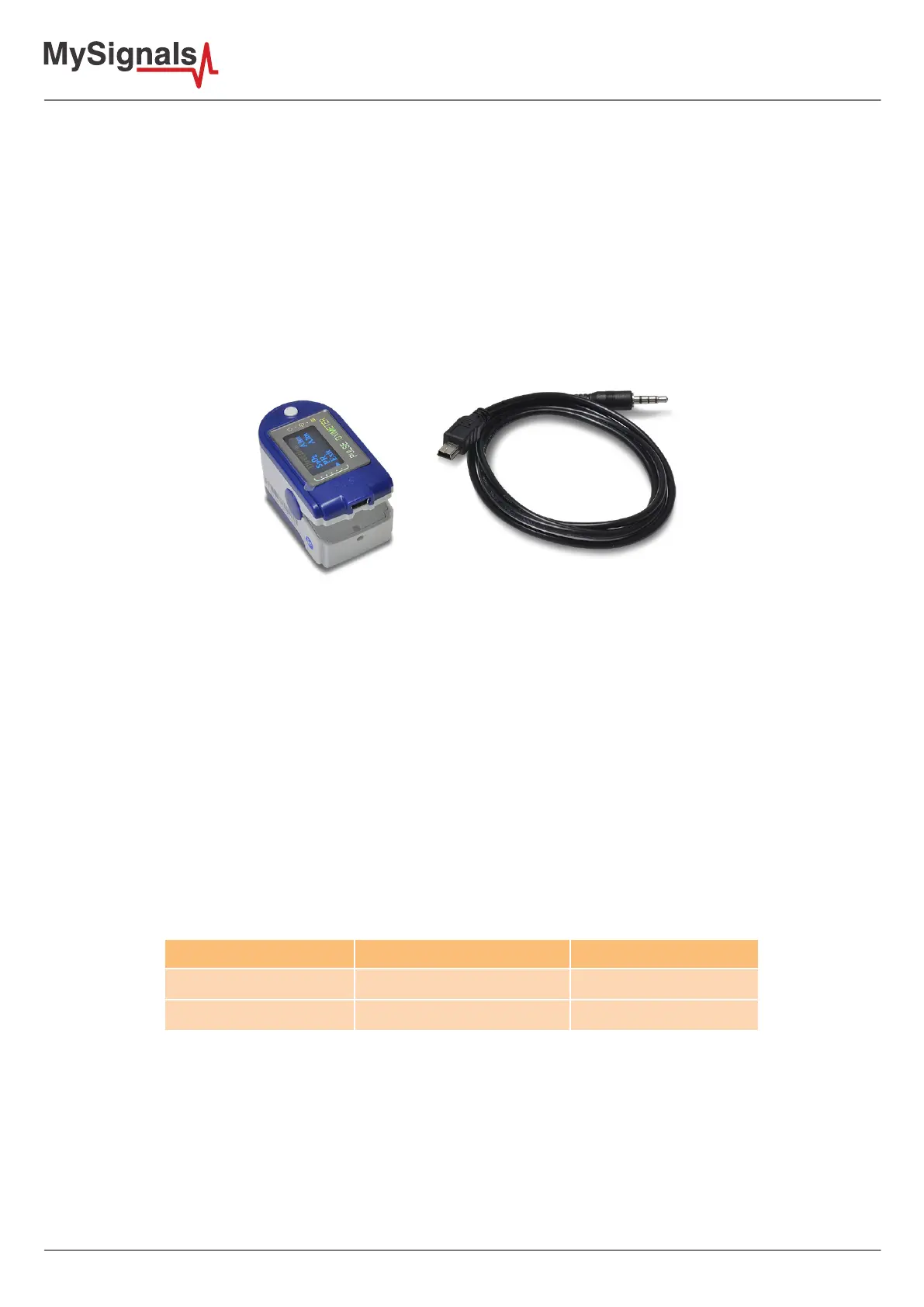
Figure: Pulse and Oxygen in Blood (SPO2)
Deoxygenated hemoglobin (Hb) has a higher absorption at 660 nm and oxygenated hemoglobin (HbO2) has a
higher absorption at 940 nm . Then a photo-detector perceives the non-absorbed light from the LEDs to calculate
the arterial oxygen saturation.
A pulse oximeter sensor is useful in any setting where a patient's oxygenation is unstable, including intensive care,
operating, recovery, emergency and hospital ward settings, pilots in unpressurized aircraft, for assessment of any
patient's oxygenation, and determining the eectiveness of or need for supplemental oxygen.
Acceptable normal ranges for patients are from 95 to 99 percent, those with a hypoxic drive problem would
expect values to be between 88 to 94 percent, values of 100 percent can indicate carbon monoxide poisoning.
The sensor needs to be connected to the specic SPO2 jack connector in MySignals board and it works with direct
connector power supply.
Measurement:
Parameter Unit Range
Pulse ppm 25~250 ppm
SPO2 % 35-100%


 To Next Page