03-09-05 8
The accuracy is high; the error is normally less than 0.2% of the measurement
range.
Sampling frequency and bandwidth.
Sampling frequency and bandwidth are related but not identical quantities. The
sampling frequency tells how often the sensor evaluates the raw analog signal by
performing an A/D conversion. The bandwidth value tells how that analog signal
is conditioned before the A/D conversion. In order to avoid certain signal
processing problems, the bandwidth has to be lower than the sampling frequency
(it may not exceed 50% of the sampling frequency), and for that reason the signal
is put through an analog filter stage before the A/D conversion. Although it is not
a theoretically correct way to express it, one might say that the bandwidth
determines how fast a measurement signal may change, and have the change
detected by the sensor.
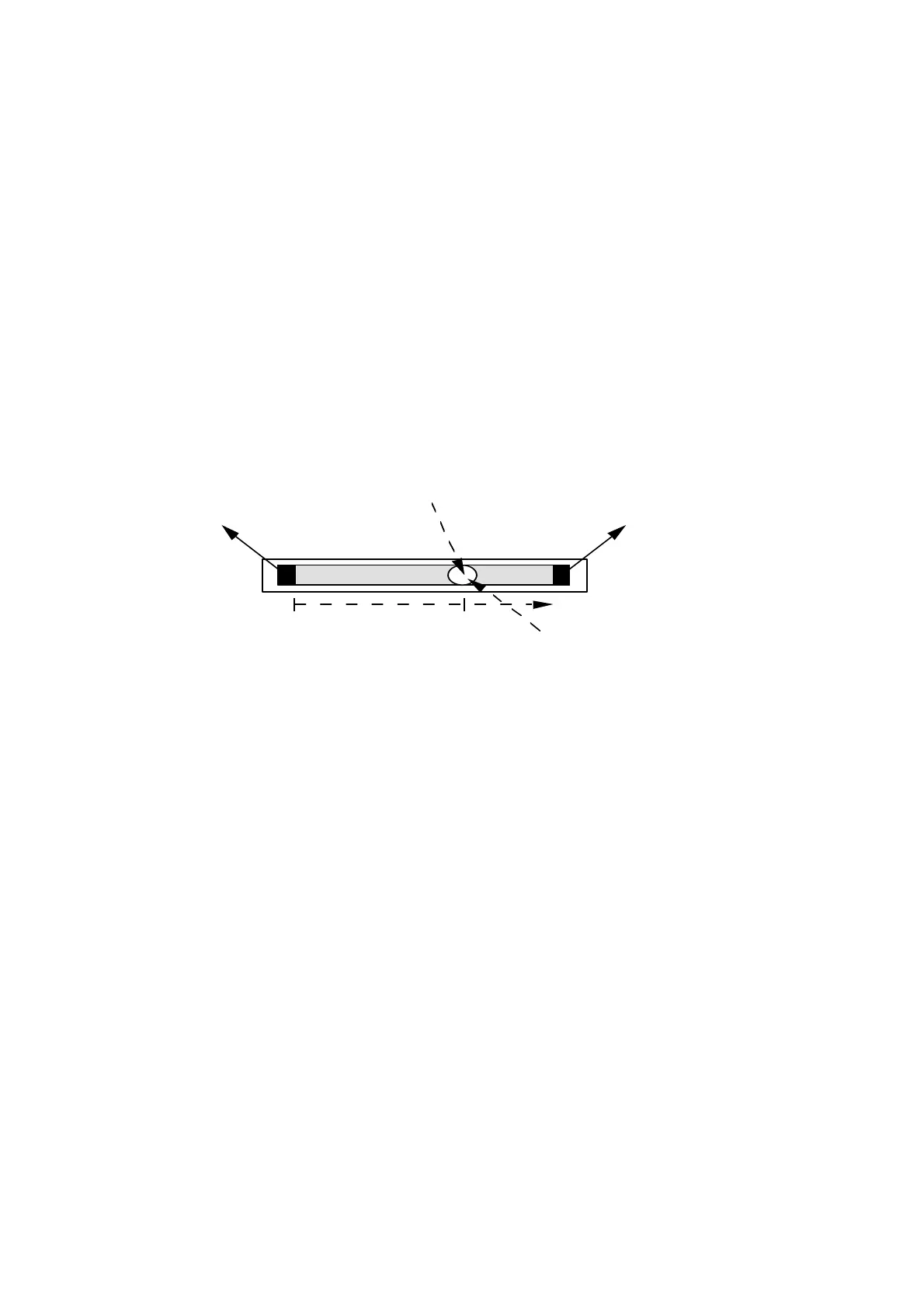
The analog position sensitive detector
1
2
Incoming light
X
Light spot
I1 I2
0
Typical size of the detector is 1*10 mm
Figure 5: The analog position sensitive detector
The detector current, generated by the light spot is divided into two parts: I1 and
I2.
The distances between the light spot and the electrodes 1 and 2 give the ratio
between the currents.
2.1.1.1 Advantages
Advantages:
1 Fast. Rise time 10-90 % (typical) = 0.2 µsec.
2 High suppression of ambient light.
3 Very high resolution. Limited only by the following Analogue-to-Digital
converter.
The technique also enables fast regulation of the output laser power. This fast
regulation makes measurement of almost any material or surface possible and
allows for fast and big variations of measured surfaces color and reflectiveness.



 To Next Page