03-09-05 33
2. Surface texture.
3. Temperature of the material.
4. The geometry of the material.
Material
5.1.1.1 General group. Mat surfaces.
There is a bulk of different materials that falls into the general group, i.e. easily
measured on for the SLS sensor. Generally these materials have a mat type of
surface.
Examples from this group are paper, hot rolled steel, concrete, gypsum etc.
5.1.1.2 Fibrous material
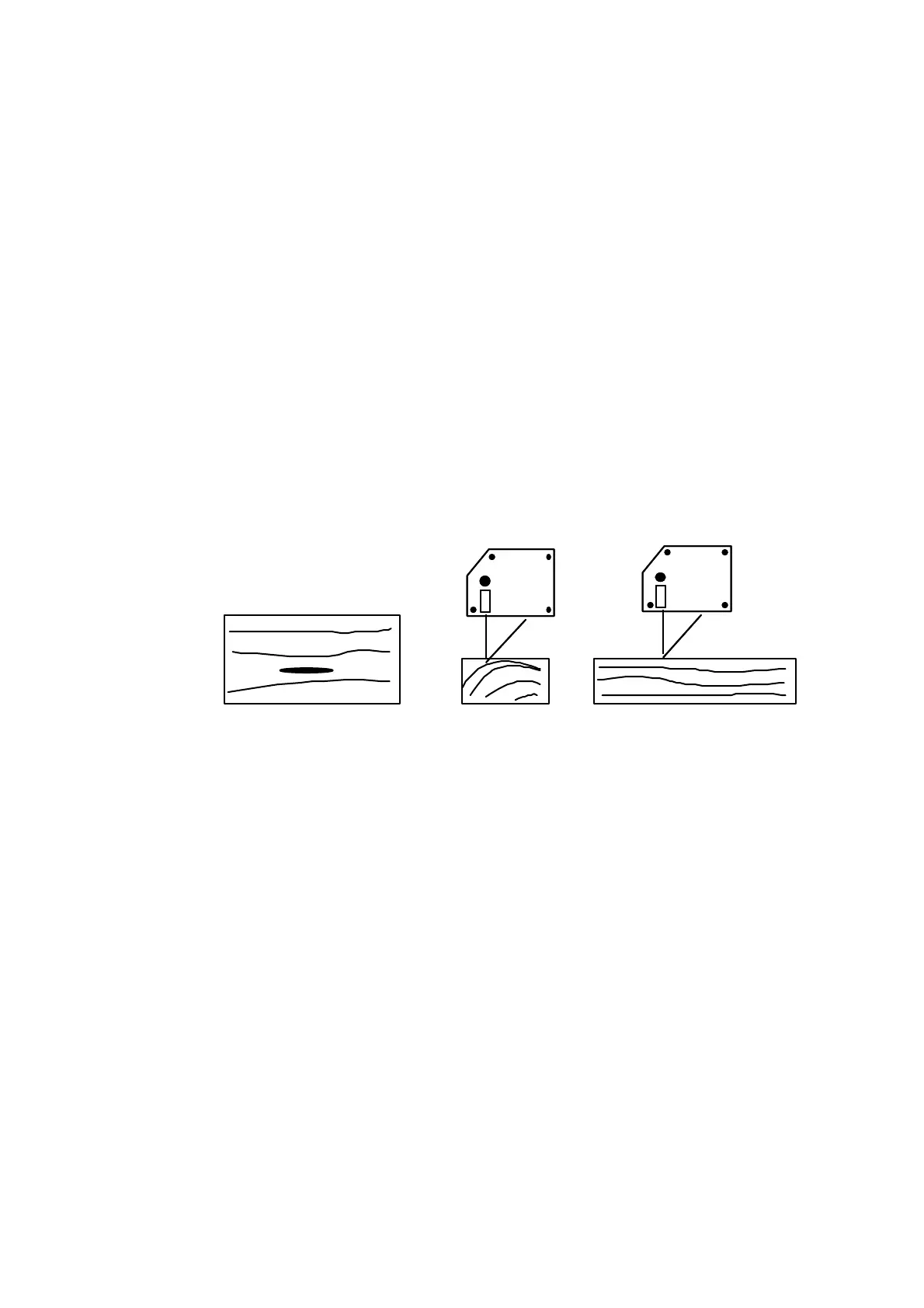
The obvious example in this group is any kind of wood: logs, sawn boards,
parquet blocks, etc. When the laser light meets this type of surface it is spread
somewhat along the fibers. The center of gravity of the spot can then move out of
the expected position and the result will be an error in the output data. This will
occur if the optical triangle is oriented parallel to the direction of the fibers.
Top view
"The light spot
is spread along
the fibres"
Side view
along the board
"Optical triangle
perpendicular to the fibres"
Side view
across the board
"Optical triangle
parallell to the fibres"
SLS5000SLS5000
SLS5000SLS5000
Figure 25: Fibrous material
Advise: Mount the sensor with the optical triangle perpendicular to the direction
of the fibers.
5.1.1.3 Shiny materials. Black and shiny materials.
Stainless steel, molten metal and other mirror like surfaces. They scatter very little
light back to the detector due to the fact that most of the light is reflected
according to optical law of reflections. The amount of light scattered in the
direction of the receiving lens can vary rapidly over time and with a wide range of
magnitude.
Black materials scatter only a small part of the incident light. Black materials in
combination with a shiny appearance, like fresh extruded rubber or wet asphalt,
require a very powerful light control.
It is important to use an SLS sensor specially designed for measurement on this
type of surface.



 To Next Page