03-09-05 18
Stand Off
SO
NOHD
Aperture
SLS Laser
Exposure exceeds MPE
Exposure does
Not exceed MPE
Beam divergence
Irradiance or Radiant Exposure equals MPE
Stand Off
SO
NOHD
Aperture
SLS Laser
Exposure exceeds MPE
Exposure does
Not exceed MPE
Beam divergence
Irradiance or Radiant Exposure equals MPE
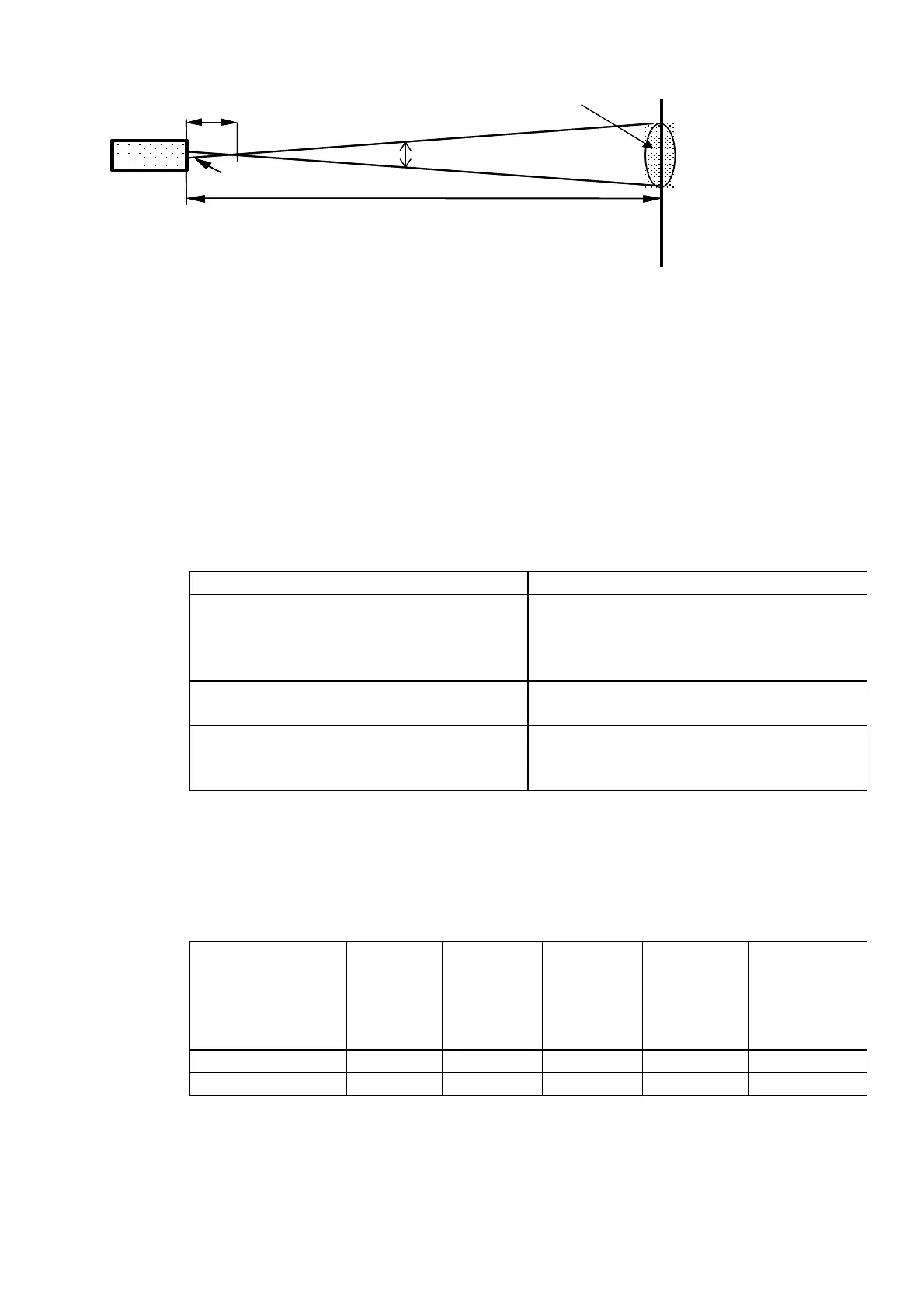
The NOHD is depending on Stand Off and working power and can be found in
the Quality record that comes with each sensor delivered. See appendix G-
Quality Record for the actual NOHDof your sensor and actual parameters for
your SLS in order to calculate MPE and NOHD.
Figure 10: The concept of nominal ocular hazard distance
Calculation of MPE and NOHD
MPE
See section 13 in the IEC80825-1. Parameters necessary to be able to calculate the
MPE are exposure time base, max pulse power, wavelength, pulse repetition
frequency and pulse duration. These parameters can be found as follows.
Parameter
Exposure time base Time base for MPE is 10 s for invisible
(see example A.4-2 in the IEC 60825-1 ed.
1.2) and for Visible 0,25 s (example A.4-
1).
Max pulse power, wavelength and pulse
duration
Explanatory label affixed to the product
Pulse repetition frequency Same as the term “Sampling frequency”
found in the Q-record.
16000 Hz for all SLS
4.1.1.5 MPE values for SLS.
The MPE values as well as the results of the calculation of each of three
requirements of 13.3 in IEC 80625 are stated in the table.
Wavelength 13.3 a
J/m
2
13.3.b
J/m
2
13.3.c
J/m
2
Most
restrictive
J/m
2
Most
restrictive
corresponds
to MPE
W/m
2
655 nm (visible) 7,52E-03 1,59E-03 9,46E-04 9,46E-04
30,3
780 nm (NIR) 1,09E-02 9,14E-04 5,44E-04 5,44E-04
17,4
NOHD
See Annex A, section A.5 in the IEC standard and TR 60825-10. Parameters



 To Next Page