03-09-05 31
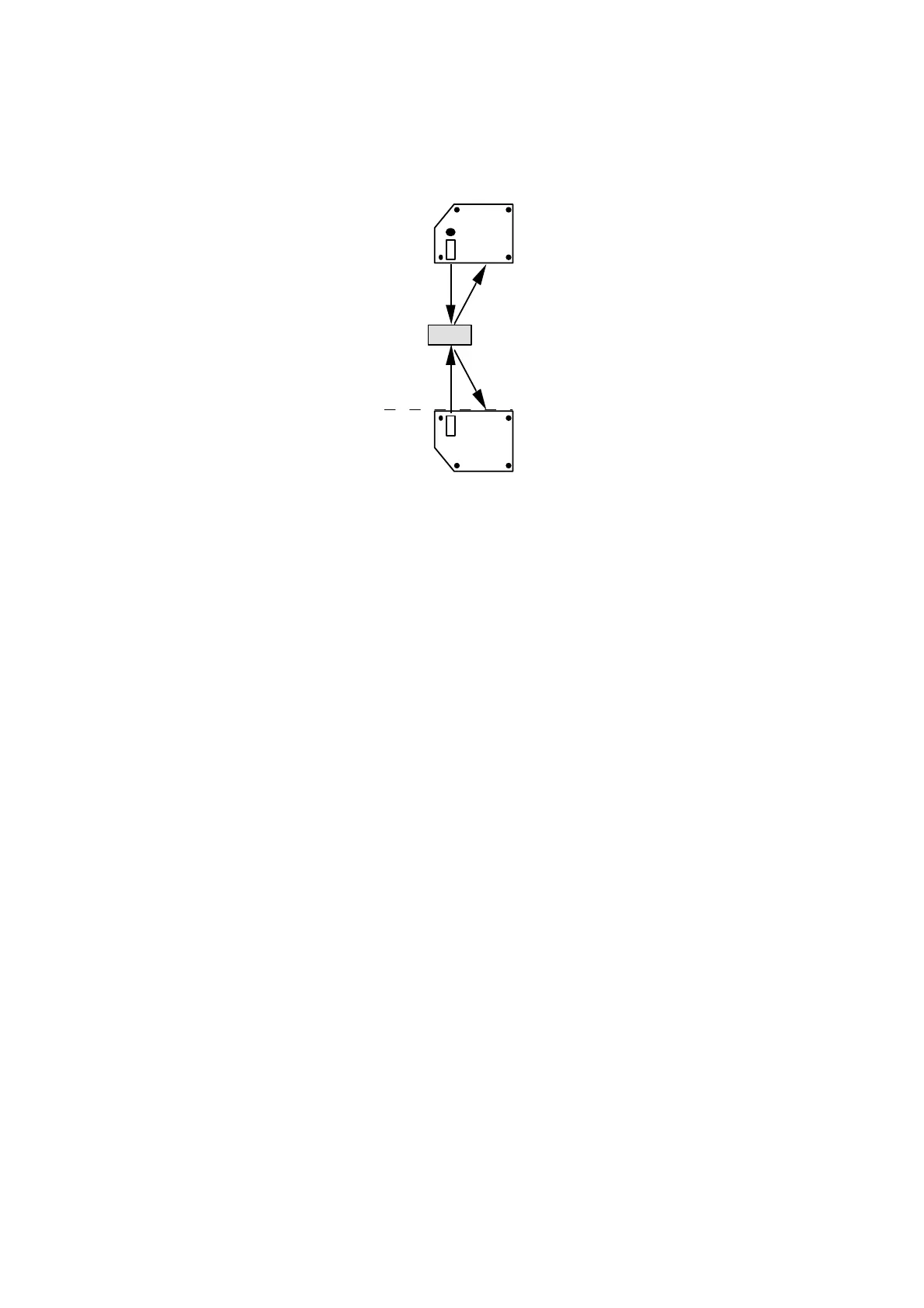
1. Sensor 1 is mounted in its fixed position. Use the horizontal sprit level. Make
sure that the mechanical flap in front of the laser aperture is in the closed
position.
Start by making this
plane horizontal
Sensor 2
Sensor 1
Figure 22: Illustration of how to mount the sensor
2 Sensor 2 should be loosely mounted, not fixed. The sensor should be turned
off with the mechanical flap open.
3 Turn sensor 1 on. Cover the receiver aperture of sensor 1 to make the sensor
output maximum laser intensity. Open the mechanical flap.
4 Adjust sensor 2. The light spot from sensor 1 must fall on the laser aperture of
sensor 2 as concentricity as possible.
5 Turn sensor 1 off and leave the mechanical flap open.
6 Secure the position of sensor 2 (not finally).
7 Cover the receiver aperture of sensor 2 to make the sensor output maximum
laser intensity.
8 Turn sensor 2 on. Adjust sensor 2 by tilting it only. The light spot from sensor
2 must fall on the laser aperture of sensor 1 as concentricity as possible.
Sensor 2 can be tilted by carefully loosening some bolts and placing thin
shims between the SLS sensor and the mounting surface.
9 Turn sensor 2 off. Fix its position finally.
10 Remove the covers for the receiver apertures.
The sensors should now be correctly mounted. The following control procedure
can be used to verify that an installation is correctly made or to check for
mechanical changes in the mounting structure:
1. Cover the receiver apertures of sensor 1 and 2 to make the sensor output
maximum laser intensity.
2. Turn sensor 1 and 2 on.
3. Put the piece of cardboard paper in the measurement range. Make sure by
moving the paper along the laser beams that they coincide everywhere
between the sensors. If an infrared (820 nm) laser is used, the IR-viewer is
necessary to see the light spots. A near infrared (780 nm) laser can be seen
without the help of an IR-viewer (especially on a blue color).
Since the cardboard paper is semi transparent for infrared light, the light
control circuits of the two SLS sensors will interfere. This is noted as a
variation in the light intensity of the spot on the paper. This phenomenon will



 To Next Page