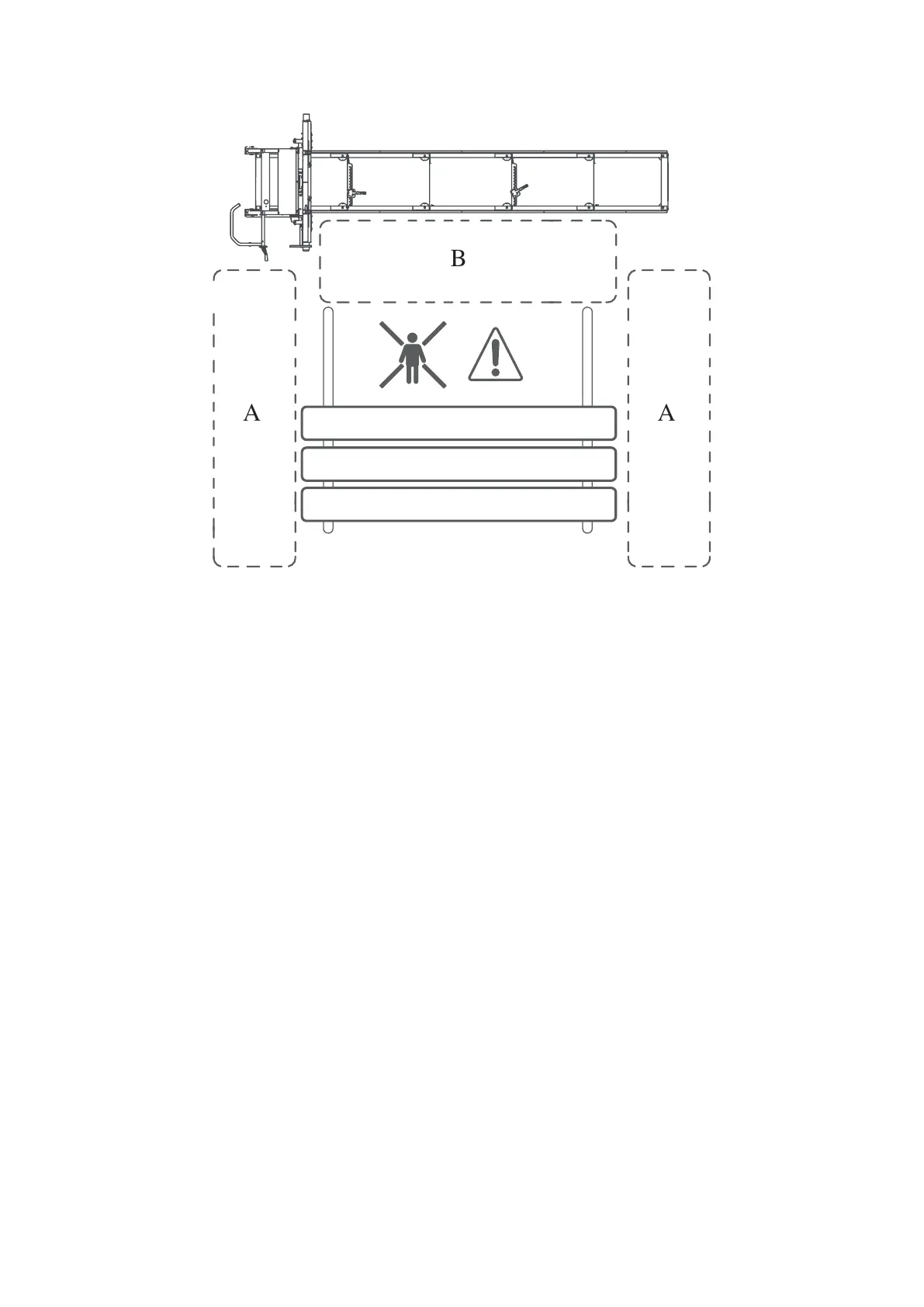
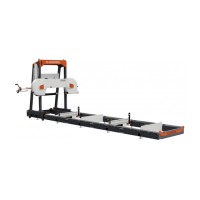
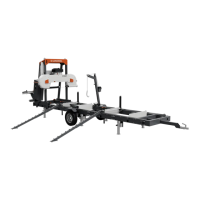
When loading a log:
1. Place the saw carriage as far back on the rail as possible (its starting position).
2. The log supports must be raised to their top position when loading logs from the operator’s side. The log
supports must be moved over to the opposite side of the rail (the operator’s side) and mounted in their top
position when loading logs from the left side of the band sawmill. The log supports are moved back to the
left side of the band sawmill when the log is stable on the rail.
3. If the log table comes with a detachable ramp, t it so that there is no gap between the log table and the
band sawmill.
4. Disconnect the locking device for the front logs on the log table.
5. Roll out a log.
6. Secure the logs at the very front of the log pile.
7. Carefully roll the log onto the log supports of the band sawmill. Use a log turner. Centre the log laterally
over the crossbars of the log bed.
8. Adjust the log supports so that they support the log but do not come into contact with the saw blade. Lock
the log supports in position.
9. Adjust the log clamps so that they are in the middle of the log supports on opposite sides of the log. Adjust
the height of the log clamps to lock the log in place. However, ensure that the log clamps cannot come into
contact with the bandsaw blade.
ADJUSTING THE CUT
You can adjust the position of the sawhead in steps to set the depth of cut.
The band sawmill is equipped as standard with 1”, 1 1/2”, 1 3/4” and 2” scales with kerf compensation.
The depth of cut is set by using the crank on the sawhead. Crank the sawhead down until the mark on the
desired scale comes in level with the pointer.
USER MANUAL
101


 To Next Page