4D-Nucleofector™ Manual – Bioscience Solutions 15
2.9 4D-Nucleofector™ X Unit
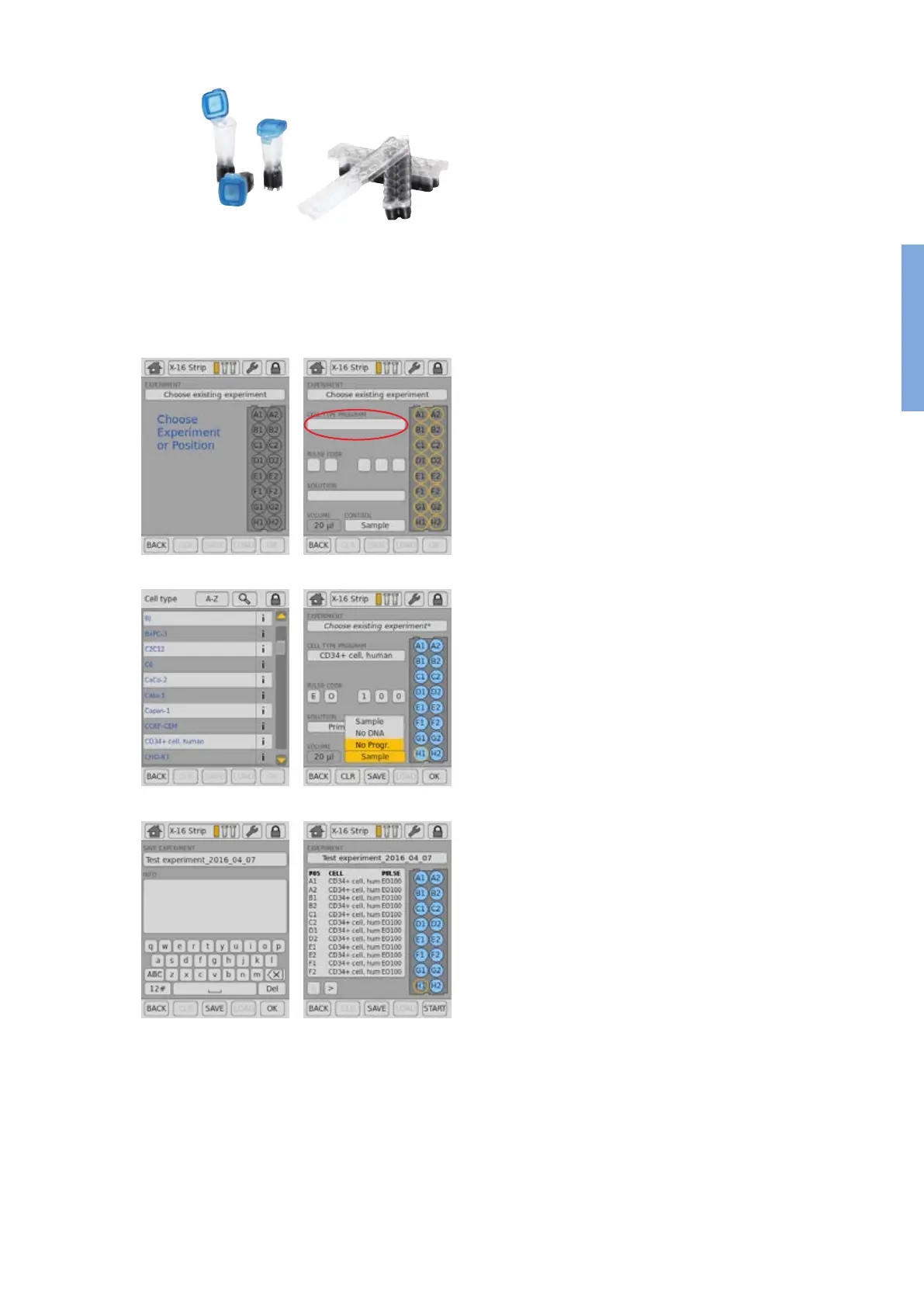
The 4D-Nucleofector™ X Unit can handle two types of vessels:
– 16-well 20 µL Nucleocuvette™ Strips for cell numbers from 2 x 10
4
to
1 x 10
6
cells
– Single 100 µL Nucleocuvette ™ Vessels for cell numbers from 2 x 10
5
to 2 x 10
7
cells
2.9.1 Dening a New Experiment
1. After unit and vessel type selection (see chapter 2.8.2) a screen
appears with the message “Choose Experiment or Position” (gure
2.13, A). You can now either select a predened experiment (see
chapter 2.8.4) or dene an experiment from the beginning.
By tapping on a position you can select one or multiple samples/wells
(e.g. A1 and A2) that should be dened with the same parameters.
The selected positions are highlighted with an orange frame (gure
2.13, B).
NOTE: For the 16-well Nucleocuvette™ Strips, you can select a whole
column by double clicking on the top or bottom well. Wells can
be de-selected by tapping on the position again. The orange frame
will disappear.
2. Upon well selection the fields “CELL TYPE PROGRAM”, “CUSTOM
PROGRAM”, “PULSE CODE”, “SOLUTION” and “CONTROL” will be activated
(gure 2.13, B). For further explanation about parameters, please refer
to chapter 2.8.3.
3. Press the field “CELL TYPE PROGRAM” to choose predefined
Nucleofection conditions from a cell type list (gure 2.13, C). Use the
search (magnifying glass symbol) or the sort list functions (A-Z) to
nd conditions more quickly.
a. Select the desired cell type code by tapping on the appropriate
line of the cell list. The cell type selected will be highlighted. For
additional information about the cell type selected press “i”.
b. To conrm your selection press “OK”.
c. If required, modify pulse code by pressing the letter or number
code elds. A keyboard will appear, enabling you to change
settings. The solution code can be modied via a selection list.
NOTE: Instead of dening solution and program code via the CELL TYPE
PROGRAM, both parameters can also be selected manually, e.g.
in case no predened cell type program is available. For adding
new cell type programs, please refer to chapter 2.7.4.
4. Define control options for the selected vessel by choosing
(gure 2.13, D)
5. Optional: At this stage (or at step 7) you can save your dened
experiment for future use by pressing the “SAVE” button. A keyboard
will appear allowing you to dene a name (max. length: 26 characters).
You may enter further information about your experiment by touching
the “Info” eld and typing in your text (gure 2.13, E).
6. Conrm and save the experiment parameters by pressing “OK” (saves
the experiment and opens the drawer) or “SAVE” (saves the experiment
for later use).
7. A summary of the dened settings will be displayed (gure 2.13, F).
Please check for correctness before loading samples (see chapter
2.9.2) and starting the experiments by pressing “START” (see chapter
2.9.3)
A
DC
FE
B
Figure 2.13: Experiment denition (X Unit; example: 16-well
Nucleocuvette™ Strips)
Figure 2.12: Vessel types for 4D-Nucleofector™ X Unit
2


 To Next Page