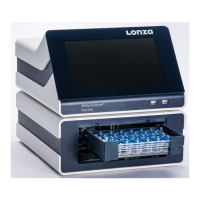
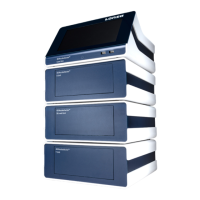
4D-Nucleofector™ Manual – Bioscience Solutions 3
Content
1 The Nucleofector™ Technology 4
2 Operating Instructions 6
2.1 Restrictions 6
2.2 Maintenance 6
2.3 Safety Instructions – Please Read Carefully 7
2.4 Waste Disposal 7
2.5 4D-Nucleofector™ System Components 8
2.6 Set-up Instructions 9
2.7 General Use Instructions 10
2.7.1 Turning on the 4D-Nucleofector™ System 10
2.7.2 Adjusting the Position of the Touch Screen 10
2.7.3 Operating Software 11
2.7.4 Turning o the 4D-Nucleofector™ System 11
2.8 General Instructions for Running a Nucleofection Experiment 12
2.8.1 Overview 12
2.8.2 Unit and Vessel Selection 13
2.8.3 Experiment Parameters - Overview 13
2.8.4 Using a Predened Experiment 14
2.9 4D-Nucleofector™ X Unit 15
2.9.1 Dening a New Experiment 15
2.9.2 Loading Samples 16
2.9.3 Running the Experiment 17
2.10 4D-Nucleofector™ Y Unit 18
2.10.1 Dening a New Experiment 18
2.10.2 Loading Samples 19
2.10.3 Running the Experiment 19
2.11 4D-Nucleofector™ LV Unit 20
2.11.1 Using the 1 mL Nucleocuvette™ Cartridge
(Fixed Volume) 21
2.11.1.1 Dening a New Experiment 21
2.11.1.2 Loading Samples 22
2.11.1.3 Running the Experiment 22
2.11.2 Using the LV Nucleocuvette™ Cartridge
(Scalable Volume) 23
2.11.2.1 Mounting an LV Nucleocuvette™
Cartridge 23
2.11.2.2 Dening a New Experiment 25
2.11.2.3 Running the Experiment 27
2.12 Additional Settings and Options 28
2.12.1 Experiments 28
2.12.2 Results 29
2.12.3 Custom Programs 29
2.12.4 Synchronize 30
2.12.5 Cleaning the Nucleofection Vessel Tray
(X or Y Unit) 30
2.12.6 Lonza Programs 30
2.12.7 Firmware Update 30
2.13 PC Editor Software 31
2.14 96-well Shuttle™ Mode 33
3 Troubleshooting 33
3.1 Suboptimal Transfection Results 33
3.2 Rescue of Samples (X and Y Unit) 34
4 Error Codes of the
4D-Nucleofector™ System 35
4.1 Arc Discharge Correction 35
5 Purchaser Notication 37
6 Technical Specications 38


 To Next Page