EasyManua.ls Logo

Lonza 4D-Nucleofector - User Manual

Lonza 4D-Nucleofector
44 pages
Print Icon
To Next Page IconTo Next Page
Loading...
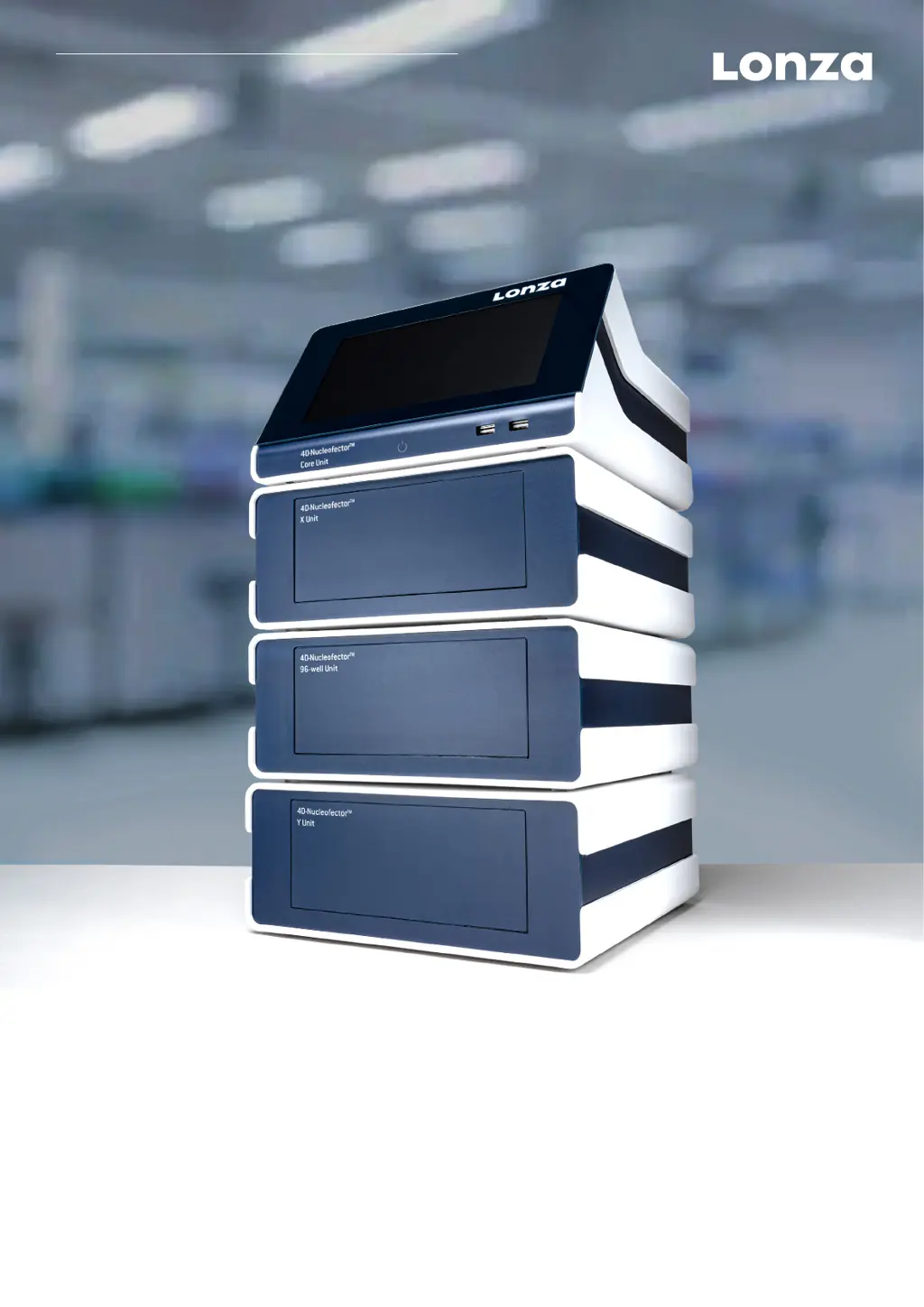
4D-Nucleofector
®
Manual
Your guide to setup and usage of
the 4D-Nucleofector
®
System
For research use only
Enabling a Healthier World

Table of Contents

Other manuals for Lonza 4D-Nucleofector

Questions and Answers

  • D
    Diane CabreraAug 1, 2025
    What to do if Lonza 4D-Nucleofector system is unable to start?
    • S
      Seth GarciaAug 1, 2025
      If your Lonza Laboratory Equipment system is unable to start, it's possible that the buffer battery is too low. If the device is not used for longer periods, it will require occasional recharging to avoid battery discharge and ensure functionality.
  • M
    Michael RodriguezAug 5, 2025
    What to do if I reuse Nucleocuvettes Vessels with Lonza 4D-Nucleofector Laboratory Equipment?
    • S
      Scott JohnsonAug 5, 2025
      It is strongly recommended to use the Nucleofection® Vessels only once with Lonza Laboratory Equipment, because the high voltage pulses that are applied drastically affect their physical integrity.
  • E
    Eric HansenAug 9, 2025
    How to improve DNA quality for Lonza Laboratory Equipment?
    • E
      Elizabeth LangAug 9, 2025
      To improve DNA quality for Lonza Laboratory Equipment, ensure that the DNA used for Nucleofection® Experiments is of high purity. It is strongly recommended to use endotoxin-free preparation of the DNA. Avoid procedures involving phenol/chloroform treatment.
  • K
    Kenneth GarciaAug 13, 2025
    What if DNA amount is too low for Lonza 4D-Nucleofector?
    • C
      colemadisonAug 13, 2025
      If both, transfer efficiency and cell mortality are low, the DNA amount could be increased when using Lonza Laboratory Equipment.
  • S
    Stephanie DaviesAug 17, 2025
    What happens if cell number is too high or too low in Lonza Laboratory Equipment?
    • J
      jeffreybensonAug 17, 2025
      Please use the cell numbers recommended in the dedicated optimized protocol of Lonza Laboratory Equipment.
  • D
    derek13Aug 22, 2025
    How to avoid buffer battery discharge in Lonza Laboratory Equipment?
    • A
      Amber BensonAug 22, 2025
      If Lonza Laboratory Equipment is not used for longer periods, it will require occasional recharging to avoid battery discharge and ensure functionality.
  • M
    Mrs. Dawn Robinson DDSOct 26, 2025
    Why am I getting suboptimal transfection results with my Lonza 4D-Nucleofector Laboratory Equipment?
    • I
      ijohnsonOct 26, 2025
      Suboptimal transfection results with Lonza Laboratory Equipment can stem from several factors. Your cell culture conditions might be suboptimal; ensure cells are viable and have been cultured for several passages, and avoid excessive cell densities or confluencies, which can decrease cell viability after the Nucleofection® Procedure. Poor DNA quality can also cause issues, so use high-purity, endotoxin-free DNA and avoid phenol/chloroform treatments. The DNA amount might be too low; increase it if both transfer efficiency and cell mortality are low. Ensure you are using the cell numbers recommended in the dedicated optimized protocol, as having too high or too low a cell number in the Nucleofection® Sample can cause problems. Finally, if the device isn't used for extended periods, occasion...

Summary

Nucleofection Technology Explained

Core Principles and Components

Explains the core components and principles of Nucleofector® Technology.

Versatile Transfection Applications

Highlights broad applicability for cells, substrates, and optimized protocols.

4 D-Nucleofector System Overview

Key Platform Features

Describes the system's development and key features like flexibility and scalability.

Operating Instructions and Safety

Restrictions, Maintenance, and Safety Precautions

Covers usage limitations, maintenance, and critical safety warnings.

Waste Disposal Guidelines

System Components Identification

4 D-Nucleofector Core Unit

Describes the central unit of the modular 4D-Nucleofector® System.

Functional Unit Types

Lists the available functional units (X, Y, 96-well, LV) connecting to the Core Unit.

System Setup and Initial Power-On

General Software Operation

Powering On;Off and Software Navigation

Explains powering on/off and navigating the touch screen software.

Nucleofection Experiment Workflow

Outlines the general workflow, unit/vessel selection, and parameter definition.

Experiment Parameter Definition

Explains defining parameters like sample type, cell code, pulse, and solution.

Utilizing Predefined Experiments

Guides on loading and modifying existing or template experiments.

X Unit: Defining a New Experiment

X Unit: Loading and Running Samples

Explains loading samples and running/monitoring experiments on the X Unit.

Y Unit: Defining a New Experiment

Y Unit: Loading and Running Samples

Details loading samples and running/interpreting results for Y Unit experiments.

96-well Unit: Defining a New Experiment

96-well Unit: Loading and Running Samples

Explains loading samples and running/interpreting results for 96-well unit experiments.

LV Unit Consumables

1 mL Nucleocuvette Cartridge Components

Lists the parts of the 1 mL Nucleocuvette® Cartridge.

LV Nucleocuvette Cartridge and Reservoir Components

Lists the parts of the LV Nucleocuvette® Cartridge and associated reservoir.

Weldable Tubing Cartridge Components

Lists components of the LV Nucleocuvette® Cartridge with weldable tubing.

LV Unit (1 mL Fixed Volume): Defining Experiment

LV Unit (1 mL Fixed Volume): Sample Loading and Running

Explains loading samples and running/interpreting results for the 1 mL LV Unit.

LV Unit (Scalable Volume): Overview

LV Unit (Scalable Volume): Defining Experiment

Guides on setting up a new experiment for the scalable LV Unit, including volume and bubble detection settings.

LV Unit (Scalable Volume): Mounting Cartridge

Details the steps for mounting the LV Nucleocuvette® Cartridge.

LV Unit (Scalable Volume): Loading Samples

Explains how to load samples into the scalable LV Unit cartridge.

LV Unit (Scalable Volume): Running the Experiment

Guides on running, monitoring, and interpreting results for the scalable LV Unit.

System Settings and Options

Accessing and Configuring System Settings

Accesses and details system settings like time, date, brightness, and network.

Vessel Tray Cleaning and Unit Version Information

Covers cleaning procedures and checking unit software/firmware versions.

Experiment and Result Management

Manages pre-installed templates and user-saved experiments, and results.

Creating Custom Cell Type Codes

Explains creating and editing custom cell type codes for experiments.

Lonza Programs and Firmware Updates

Functional Unit Software Updates

4 D-Nucleofector PC Editor Software

PC Editor Installation and Transfer

Instructions on installing the PC Editor and transferring experiments.

Viewing and Printing Result Files via PC Editor

Guides on exporting, viewing, and printing result files using the PC Editor.

Troubleshooting Guide

Addressing Suboptimal Transfection Results

Provides solutions for common issues like low survival rate and low efficiency.

Rescuing Samples During System Failure

Describes how to rescue samples during system failure or power outage.

Error Codes and Results Interpretation

Understanding Well Status and LV Unit Ratings

Explains color coding for well status and the LV Unit rating system.

Arc Discharge Correction Explanation

Explains arc discharge phenomena and system response.

System Error Code Reference

Lists and explains various error codes encountered with the system.

Purchaser Notification and Legal Disclaimers

License Terms and Usage Restrictions

Details the license terms and usage restrictions for the system.

Representations and Warranties

Outlines Lonza's warranties and limitations of liability.

Technical Specifications

Contact Information and Support

Lonza 4D-Nucleofector Specifications

General IconGeneral
TechnologyNucleofection technology
ApplicationsCell transfection, gene editing, cell reprogramming
CompatibilityCompatible with a wide range of cell types
User InterfaceTouchscreen
Data ManagementUSB export
ThroughputCapability to process single samples or 96-well plates
Sample Volume20 µL to 100 µL
Cell TypesPrimary cells, stem cells, and cell lines
ProgrammingPre-set and customizable protocols
Power Requirements100-240 V AC, 50-60 Hz

Related product manuals