LX 10k
Advanced operation
Document name: LX 10KUM
Document revision: R1
4.1.3.1 The Final glide indicator
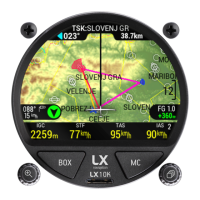
The Final glide indicator is an indicator located opposite of the wind indicator, on the far right
of the map, above the NavBox line. It displays the Final Glide for the set MC value. The MC
value is displayed above the Final Glide value, in white lettering. If you are within final glide,
and your arrival altitude is positive, the final glide will be written in green. If you are not within
final glide, your final glide will be written in red.
Once final glide is established, the LX 10k will notify you with a Voice notification over the
speaker, stating: ’Final glide established’.
4.1.3.2 The NavBox line
In the lower part of the screen a NavBox line containing 4 NavBoxes is shown. The pilot can
set-up up to three separate NavBox lines with his/her own NavBox preferences. Usually pilots
set one NavBox line for aerodrome gliding, one for racing tasks and one for AAT tasks.
Pressing the (BOX) push button will swipe through these NavBox lines. If the (BOX) push
button is pressed after the third line of navboxes, the navbox line will disappear, giving the pilot
a larger and clearer representation of the map. Press the (BOX) push button again, for the
NavBox line to reappear.
Holding the (BOX) push button, or holding the (PAGES) push-rotary knob for three seconds will
start the ’Select NavBox’ procedure. The navbox’s black background will turn red, and the pilot
can now choose which navbox he would like to change. Once the desired navbox position has
been chosen, he can press enter (PAGES) and a list of available NavBoxes will appear. From
the list, he can select a navbox he wishes and confirm it by pressing enter.
The following NavBoxes are available:
• UTC time
• Local time
• Flight time
• Altitude
• IGC altitude
• Flight level
• Density altitude
• GPS altitude
• Height AGL
• Elevation
• Alt. QNH [ft]
• Vario
• Vario AVG
• Vario netto
• Vario relative
• TAS
• IAS
• Ground speed
• True track
• Distance
• Final glide
• Speed to fly
• Bearing
• Task time elapsed
• Task time left
• Current efficiency
• Require efficiency
• Thermal max
• Thermal average
• Eff. thermal avg.
• Thermal gain
• Circling radius
• OAT
• ENL
• G-force
• Flap position
• Rec. flap position
• Phase of flight
• No of landings
• Last landing time
Since most of the indicators are self-explanatory, we will cover the ones that are not.
Device manual Public 22


 To Next Page