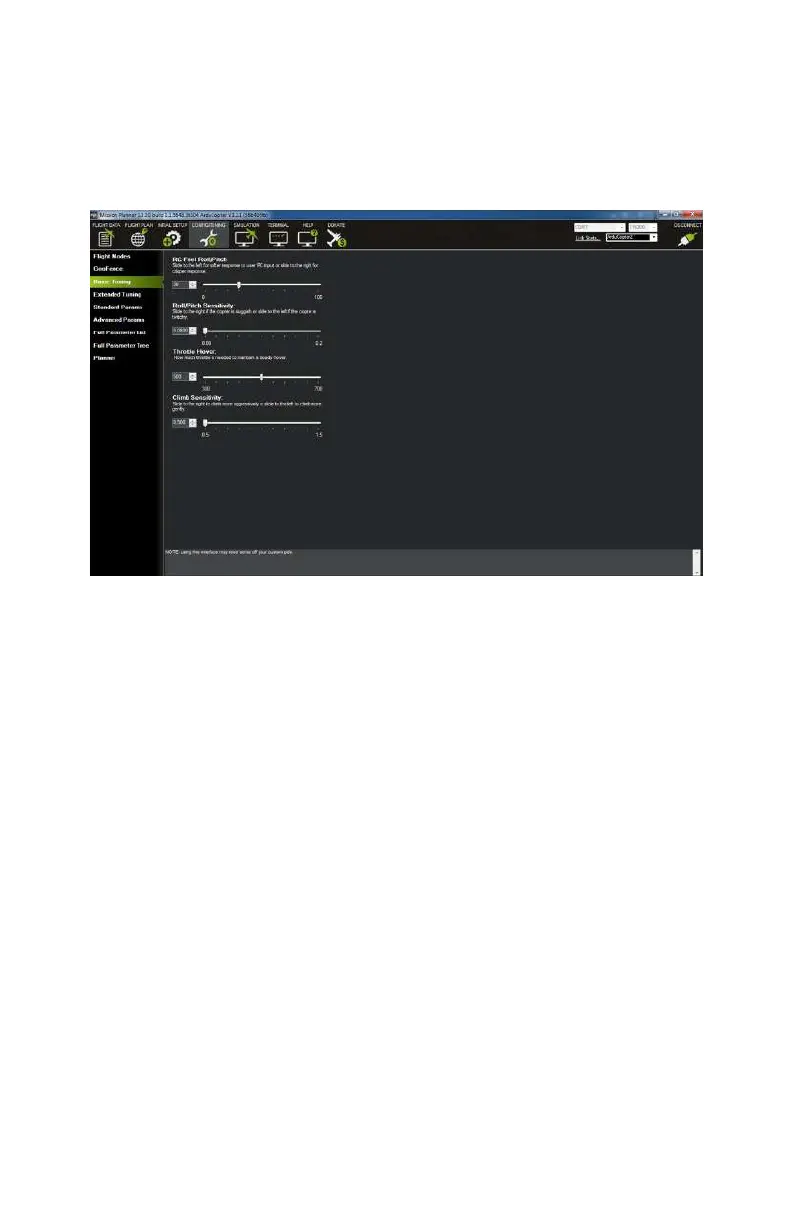
aggressively it will climb when given input from the throttle.
Each input provides a quick description of what the slider does
to the aircraft. If you have a telemetry radio, it’s easy to open
Mission Planner while the aircraft is in flight and slightly adjust
these to see their eect in real time.
Figure 9-24. Basic Tuning parameters.
Extended Tuning
This Extended Tuning screen allows you to do a much higher
level of
flight characteristic tuning (see Figure 9-25). Sometimes
called PID (Proportional, Integral, Derivative) tuning, the Exten-
ded Tuning screen lets you adjust each of the three aircraft
movements (roll, pitch, and yaw) with variables that feed into a
PID controller algorithm. This type of controller is very popular
in large-scale industrial control systems. The process works by
creating a control loop feedback that calculates an error value
and attempts to correct said error to a desired result.
Luckily, APM comes with standard settings here that seem to
work well for most installs right out of the box. If your aircraft is
not
flying as you would like, and you feel that you need to adjust
the PIDs to obtain peak performance, we do recommend that
you do some independent research on the topic. PID tuning can
become pretty complex pretty quickly, and as such, falls outside
154 Make: Getting Started with Drones



 To Next Page