although weight is distributed throughout the aircraft, one point
in the aircraft—called the center of gravity—has the most eect
on its ability to fly.
Lift
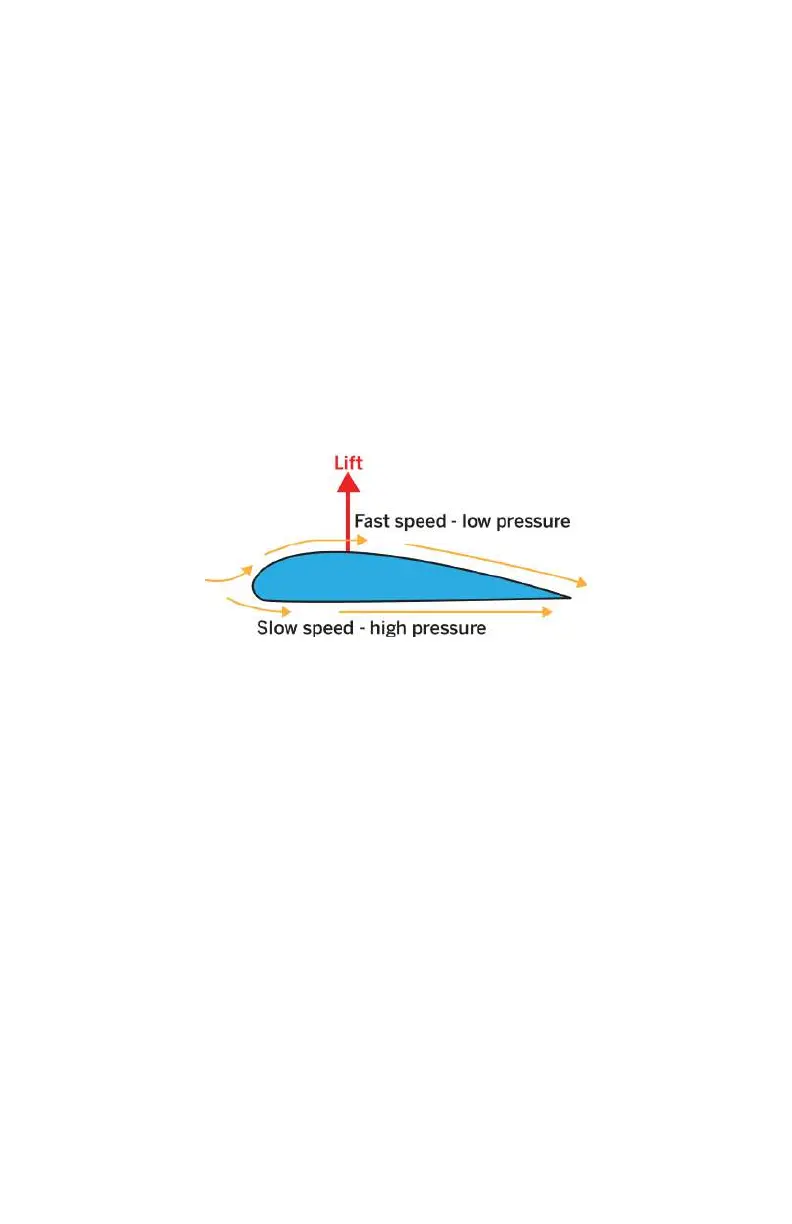
Lift, the opposite of weight, is an aerodynamic force that keeps
an aircraft in the air (see Figure 1-2). In the case of winged air-
craft, lift comes from air moving across an airfoil shape of a wing
or propeller. The air moving above the airfoil is moving faster;
therefore, it has lower pressure. Slower-moving air below the
wing has higher pressure. Thanks to the lower pressure above
the wing, an airplane or helicopter is literally sucked into the sky.
To hover or
fly level, lift must equal weight; to climb, lift must be
greater than weight.
Figure 1-2. As the airfoil form moves forward through the air, it
produces lift.
Drag
Have you ever stuck your hand out the window of a moving car
on a nice day? The force you felt pushing back is a perfect
example of drag. Any object that moves through the atmos-
phere at any speed will experience some level of drag, and it
increases with the speed of the object. Drag is the reason air-
planes, locomotives, and sports cars have smooth, sleek lines—
that type of streamlining allows air to
flow more cleanly around
the vehicle, cutting down on drag and making the vehicle more
ecient. Drag is also the reason jets retract their landing gear
right after takeo, and it can be a potent force for quadcopters/
drones.
8 Make: Getting Started with Drones



 To Next Page