10
FRAX User's Manual
© 2011 Megger Sweden AB
FRAX turned off, or FRAX is switched on, battery empty.
IFRAX connected to AC/DC adapter, Battery is fully charged (or charging
disabled of other reason see above)
FRAX runs on batteries (AC/DC adapter not connected)
1.6 Sweep Frequency Response
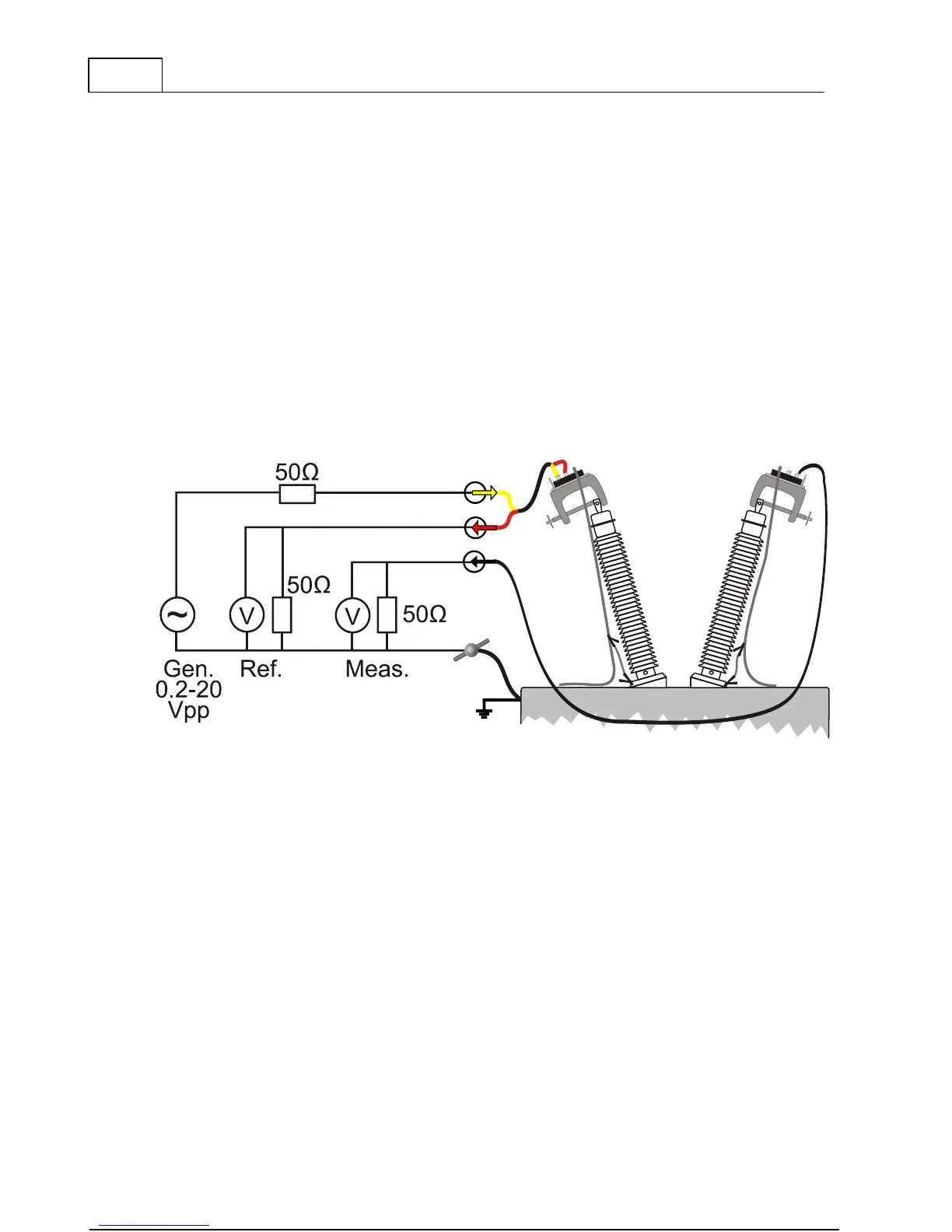
The FRAX "Generator" (Gen.) generates a sinusoidal voltage at a selected frequency and
measures the input voltages, amplitude and phase, on two input channels "Reference" (Ref.)
and "Measure" (Meas.). The instrument stores "Amplitude" and "Phase" data for both
"Reference" channel and "Measure" channel as well as the ratio "Measure" divided by
"Reference". The values can be plotted and exported as Magnitude, Phase, Impedance,
Impedance-Phase, Admittance and more. The Custom models function make it possible to
calculate almost any parameter based on the measured/stored data.
FRAX uses the sine correlation technique. This means that the input voltages are multiplied by
a sine and a cosine, and then averaged over an integer multiple of the interval of time. The
sine, cosine and the voltage applied have exactly the same frequency. The sine correlation
technique is well known and is suitable for Sweep Frequency Response Analysis (SFRA)
measurements. Since the signals on the two input channels are treated the same way, the
phase resolution between these two channels is very high. The rejection of DC offset and
harmonics - referred to as the applied voltage - are in theory infinite. By increasing the
integration cycles, the rejection gradually improves.
The IF Bandwidth is commonly used as a parameter defining the bandwidth around the
applied signal analyzed. An IF bandwidth of 10% of active frequency is equivalent to 12
cycles of integration.



 To Next Page