52
FRAX User's Manual
© 2011 Megger Sweden AB
Important note: Calculations of LRxy and LRxy is based on discrete mathematics described
under the DL/T 911-2004 Analyzer section. Therefore, same traces measured with logarithmic
or linearly spaced measurement points will give slightly different result. Mathematics
describing a continuous trace is best approximated using linear spaced measurement points.
Furthermore, the DL/T 911-2004 standard also assumes linearly spaced measurement points.
4.3.7.1
DL/T 911-2004 Analyzer
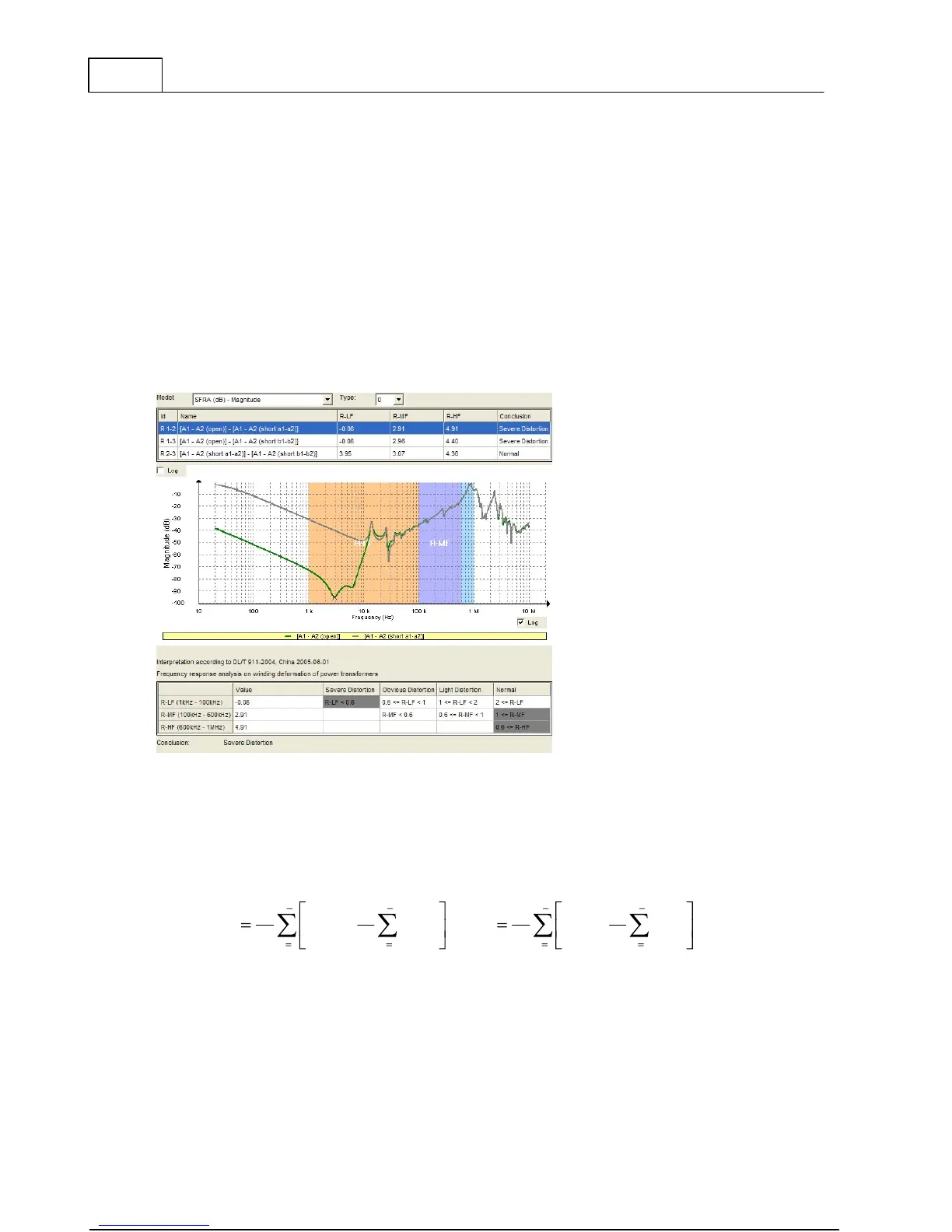
Use the test browser to select the two sweeps you want to compare. The results for the
combinations of the first three selected sweeps is displayed in a table at the top. If more than
three sweeps are selected, the analyzer will only display the first three. The calculations are
performed automatically and the "Conclusion" is presented in the table.
To see the curves and details of a certain combination, select it in the table.
The DL/T 911-2004 Analyzer computes the relative factor Rxy function for the three different
frequency ranges (1kHz-100kHz, 100kHz-600kHz and 600kHz-1MHz) according to equations in
A1, A2, A3 and A4. The value for each frequency range is assigned a "Winding Deformation
degree" and finally the Conclusion is set as the worst "Winding Deformation degree". Note
that RHF<0.6 is not assigned to any "Winding deformation degree".
A.1 Calculate the standard variance of these two sequences
A.2 Calculate the covariance of these two sequences



 To Next Page