4 Commissioning
19
Checking the metering concentration
The metering concentration is pre-set for the first commissioning and may be adapted to local conditions
by the service technician.
1. In the Settings > Diagnosis and service > Service > VRP Process-relevant
parameters, select the program to be checked.
2. Check the metering concentration in the respective partial cycle and set the concentration anew, if
necessary.
PLEASE NOTE
Observe the metering specifications of the process agent manufacturer. This information
is indicated on the container in ml/l or on separate data sheets provided by the
manufacturer.
Bleeding the metering system
} Start the program “Air removal” before commissioning.
Checking the metering accuracy
Ascertaining the density of the process agents
Depending on the manufacturer, the density or filling level with the associated weight is directly indicated
on the label of the process agents.
If the label or data sheet of the process agents does not provide information regarding the density, then
the density of the cleaning agent, neutralizer and rinse aid (not for ophthalmology) must be ascertained.
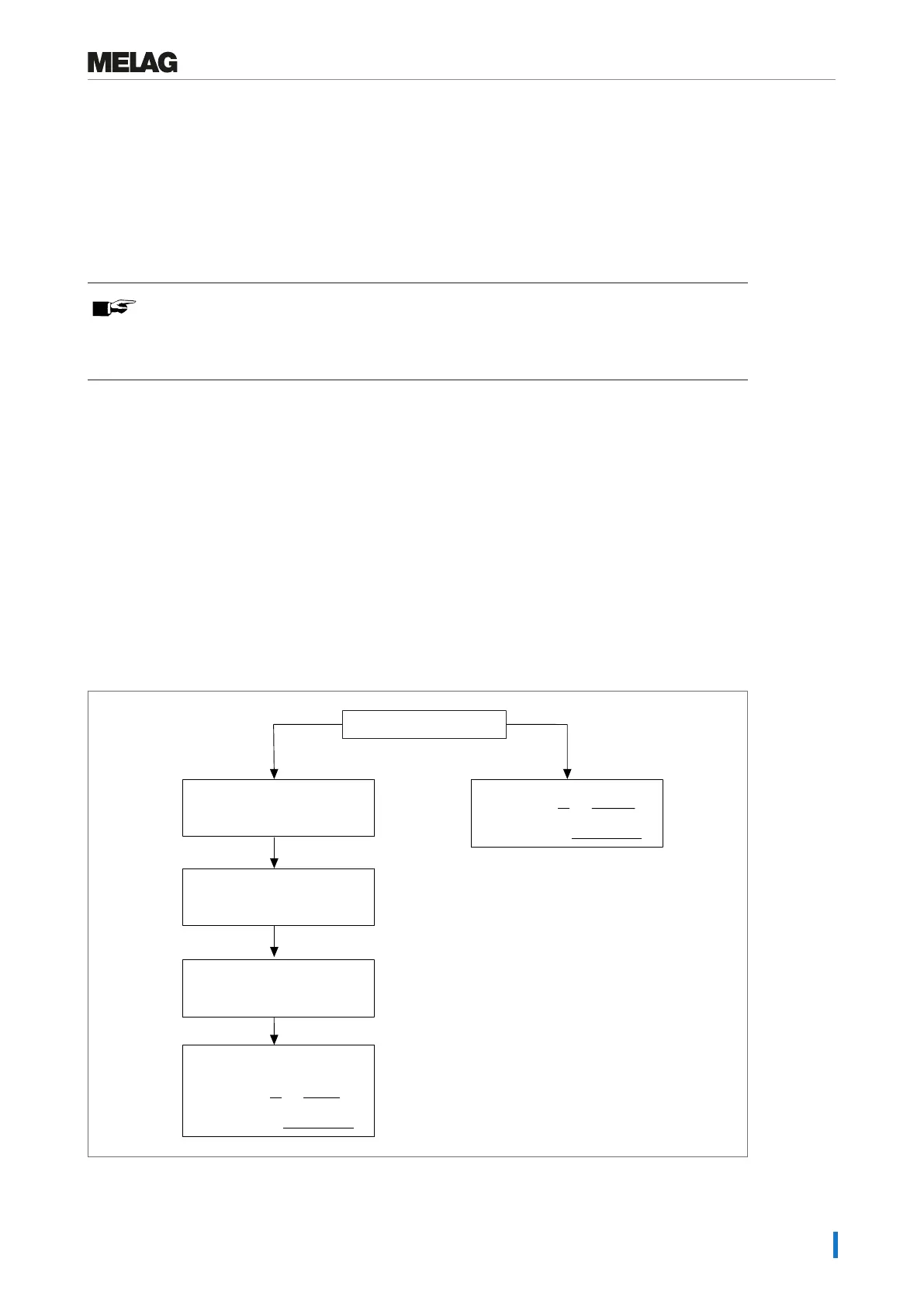
The following scheme shows the ascertainment of the density of the cleaning agent. The ascertainment of
the density of the other process agents can be done the same fashion.
Filling quantity / weight
indicated on the label
Place an empty measuring
cylinder on the scales and set
the scales to zero.
1.
Fill the measuring cylinder with
min. 200 ml cleaning agent and
read off the actual quantity.
2.
Read off the weight from the
scales.
3.
Calculate the density:
Density (p) =
m
V
p =
242 g
220 ml
p = 1.10 g/ml
4.
Calculate the density:
Density (p) =
m
V
p =
5500 g
5000 ml
p = 1.10 g/ml
1.
no
yes
Example: V = 200 ml 242 g
≙


 To Next Page