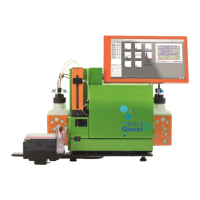
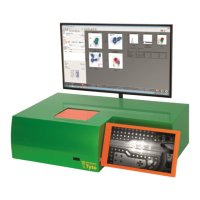
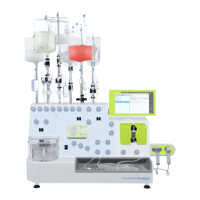
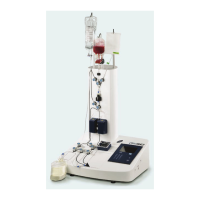
The instrument is equipped with a 2D Code Reader and with powerful light emitting diodes (LEDs) for
illuminating the reading area. Powerful LEDs are also used to illuminate the fluid bottles as well as the waste
bottle. According to the international standard IEC 62471, this lamp system has an exposure hazard value (EHV)
of 0.91 and is in excess of the Exempt Risk Group.
Do not look directly at laser or LED radiation or reflected laser or LED radiation from a mirrored
surface. Otherwise, eye injury may result. Do not direct the laser beam at others.
Be careful of the path of the light beam or reflection from a mirrored surface. Take care during installation of
the instrument that the path of the light beam is not at the same height as the human eye during operation. Do
not allow water, oil, dust or other foreign substances to stick to the 2D Code Reader aperture window. This may
cause reading errors. Be sure to stop the laser emission before cleaning the scanner. Otherwise, exposure to the
light may cause eye injury. Use a soft, dry cloth to wipe any substances from the scanner. Do not use alcohol or
other cleaning substances.
Do not disassemble, modify, or remove the installed laser or LED radiation sources. The laser or
LED radiation sources do not automatically stop emitting when disassembled. Radiation of
disassembled units may lead to eye injuries.
Output power Pulse time Wavelength
MACSQuant X
Rack Detection 3.3 mW 215 μs 850 nm
Internal Laser 1 30 mW Continuous 488 nm
Internal Laser 2 40 mW Continuous 404 nm
Internal Laser 3 20 mW Continuous 640 nm
Table 1: Laseroutput power, pulse time, and wavelength.
Chemical and biological hazards
Depending on the biological material used, contamination infection may lead to severe personal injury or
death. All clinical samples must be considered potentially infectious.
If biohazardous material is or has been used, the operator must choose and wear personal
safety equipment as indicated in the warnings and precautions for the particular substance.
The above safety precaution also accounts for any hazardous chemical, including toxic or
corrosive chemicals, acidic or radioactive substances that may be present in the sample.
Wear protective gloves and clothing, as well as safety glasses to prevent contact of the substance with skin and
eyes. Also protect moth and nose as aerosols might leak from the system. Defective or inadequate safety
equipment is hazardous. The instrument must be operated in a safety hood if hazardous or unknown material is
being processed. If hazardous material has been used or spilled, care must be taken to thoroughly
decontaminate the instrument. It is strictly prohibited to continue to handle contaminated accessories or parts
of the instrument.
All liquid and solid waste must be considered hazardous and, must be therefore handled taking universal
laboratory precautions. Waste disposal must be in accordance with any local regulations.
11
IMPORTANT SAFETY INFORMATION
EN
DEESFRIT


 To Next Page
 Loading...