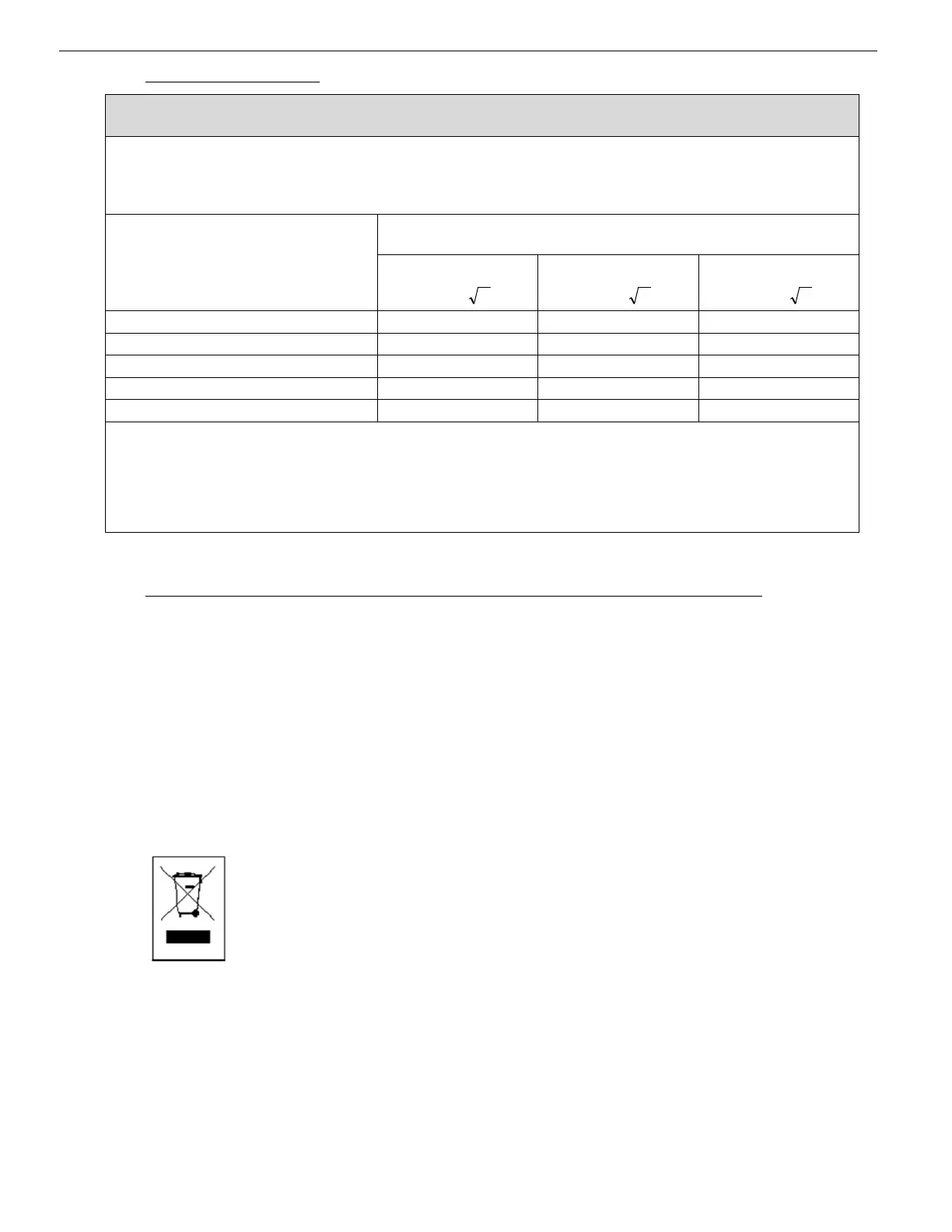
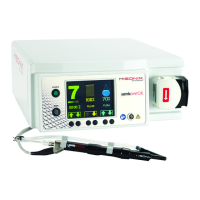
Instructions for Use SonaStar Ultrasonic Surgical Aspiration System
IFU-601 Rev T March 2023 Page 10 of 73
Environmental Protection
All equipment shall be disposed at the end of life in accordance to local requirements.
Important Environmental Information for Users within the European Economic Area
The European parliament will enforce new regulations developed in 2005 concerning the disposal of medical and
electrical and electronic equipment. The regulations, called Directives, place responsibilities on the supplier and
you, the purchaser/user. One of the actions required is to inform users of their obligations.
The device has been assessed in accordance with the European Parliament Directive 2002/96/EC on Waste
Electrical and Electronic Equipment, usually referred to as WEEE Directive.
The WEEE Directive requires that the device be disposed of at the end of its useful life in an environmentally
responsible manner. Similar requirements have been applied to refrigerators for some time.
The WEEE Directive requires that if replacing the device with a new equivalent product, that supplier shall
collect the old item without cost to the user.
If you wish to dispose of the device without replacing it then the device must not be mixed with
unsorted municipal waste. The crossed-out wheeled bin symbol on the unit label or packaging,
and repeated below, indicates this requirement.
You must ensure that the device is disposed of at an authorized treatment facility; details can be
obtained from your local council.
Your role is critical and will help to ensure the Earth’s resources are maintained and that as much re-usable and
recyclable material as possible is processed. It will also ensure that the landfill volume requirements are kept at a
minimum and that hazardous materials are not buried thereby providing future problems for the environment and
human health.
Recommended Separation Distances Between Portable and Mobile RF Communications Equipment and the
SonaStar Ultrasonic Surgical Aspirator
(Table 206)
The SonaStar Ultrasonic Surgical Aspirator is intended for use in an electromagnetic environment in which radiated RF disturbances are
controlled. The customer or the user of the SonaStar Ultrasonic Surgical Aspirator can help prevent electromagnetic interference by
maintaining a minimum distance between portable and mobile RF communications equipment (transmitters) and the SonaStar Ultrasonic
Surgical Aspirator as recommended below, according to the maximum output power of the communications equipment.
Rated Maximum Output Power
of Transmitter
W
Separation Distance According to Frequency of Transmitter
m
150 kHz to 80 MHz
Pd 2.1
80 MHz to 800 MHz
Pd 2.1
800 MHz to 2,5 GHz
Pd 3.2
0.01
0.12 0.12 0.23
0.1 0.37 0.37 0.37
1 1.2 1.2 2.3
10 3.7 3.7 7.4
100
12 12 23
For transmitters rated at a maximum output power not listed above, the recommended separation distance d in meters (m) can be
estimated using the equation applicable to the frequency of the transmitter, where P is the maximum output power rating of the
transmitter in watts (W) according to the transmitter manufacturer.
NOTE 1 At 80 MHz and 800 MHz, the separation distance for the higher frequency range applies.
NOTE 2 These guidelines may not apply in all situations. Electromagnetic propagation is affected by absorption and reflection from
structures, objects and people.


 To Next Page