12
wrapping too tightly, applying supplemental tape, failing to inspect periodically, or failing to position
appropriately. Read the Instructions for Use provided with the SpO2 sensor carefully prior to use.
Do not sterilize or immerse pulse oximetry sensors in liquid. Clean and/or disinfect re-usable sensors between
patients.
Pulse oximetry sensors are susceptible to high ambient light interference including surgical lights, especially
xenon light sources, ambient photodynamic therapy (e.g., Bilirubin lamps), fluorescent lights, infrared heating
lamps, direct sunlight. Shield the sensor area as necessary.
SpO2 measurement may be adversely affected by dyes (e.g., methylene blue, indocyanine green, indigo,
carmine, fluorescein) introduced into the bloodstream
That factors that may cause inaccurate readings and alarms, decreased perfusion, and or low signal strength
include:
Interfering substances:
o
Carboxyhemoglobin may erroneously increase SpO2 reading.
o
Methemoglobin (MetHb) usually represents less than 1% of the total Hgb, but in the case of
methemoglobinemia that can be congenital or induced by some IV dyes, antibiotics (such as sulphas,)
inhaled gases etc. this level increases sharply and thus can confound the SpO2 reading.
o
Intravascular dyes (such as indocyanine green, methylene blue, etc.).
Physiological conditions:
o
Cardiac arrest
o Hypotension
o Shock
o
Severe vasoconstriction
o
Severe anemia
o
Hypothermia
o
Venous pulsations
o
Ventricular septal defects (VSDs)
Sensor placement:
o
Incorrect sensor placement
o
Poor sensor fit
Any condition that restricts blood flow such as the use of a blood pressure cuff or supplemental tape, or
extremes in systemic vascular resistance may cause inability to determine accurate SpO2 readings.
Certain conditions such as physical movement (patient and imposed motion); diagnostic testing; low perfusion;
electromagnetic interference; electrosurgical patient monitors; dysfunctional hemoglobin; and inappropriate
positioning of the pulse oximeter sensor may result in pulse oximetry readings that are unreliable.
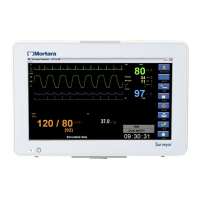
SpO2 signal inadequacy is indicated by error messages or alarms generated at the Surveyor patient monitors.
If the accuracy of any measurement does not seem reasonable, first check the patient’s vital signs, and then
check for conditions that may cause inaccurate SpO2 readings. If the problem is still not resolved, check the
monitor and the SpO2 module, cable, or sensor for proper functioning.
A pulse oximeter is not an apnea monitor. A pulse oximeter should be considered an early warning device. As a
trend toward patient deoxygenation is indicated, blood samples should be analyzed by a laboratory CO-oximeter
to completely understand the patient’s condition. Check that the pulse oximetry waveform is physiological in
shape.
To prevent erroneous readings, do not use physically damaged sensors, cables or modules. Discard a damaged
sensor or cable immediately.
The performance of the pulse oximetry may be compromised by excessive motion including tremors or


 To Next Page