GB
MSA OPERATION
ALTAIR 5 - Operating Manual 41
3.9. Calibration
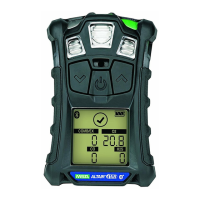
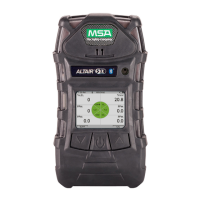
The ALTAIR 5 can be calibrated either manually using this procedure or
automatically using the GALAXY test stand. Refer to 7.7 of the appendix.
Calibration must be performed using a flow regulator with a flow rate set to
0.25 litres per minute for diffusion instrument. For instruments with an integral
pump, the demand regulator is recommended.
Warning!
Attention! Special conditions with toxic gases!
If the instrument is to be checked or calibrated for toxic gases,
prerequisites are required; otherwise, incorrect calibration would result
in incorrect instrument operation.
Reactive toxic gases (e.g., chlorine, ammonia, chlorine dioxide) have
the property of diffusing into the rubber and plastic tubes so that the
volume of test gas available in the instrument would no longer be
sufficient to correctly perform instrument calibration.
For this reason, when calibrating the instrument with toxic gases,
certain prerequisites are required:
• A special pressure regulator
• Short connection tubes between the pressure regulator and
the instrument (approximately one inch)
• Connection tubes made from a material that does not
absorb the test gases (e.g., PTFE).
NOTE: If using normal tubes and pressure regulators, expose them to
the required test gas for an extended time period. Keep these
materials dedicated for use with that test gas only; do not use them for
other gases.
For example, for chlorine, allow the entire contents of a test gas
cylinder to flow through the pressure regulator and tubes before using
to calibrate the instrument. Mark these materials for use with chlorine
only.
The phosphine (PH
3
) sensor used in the ALTAIR 5/ALTAIR 5 IR is
highly cross-sensitive to hydrogen sulphide (H
2
S) gas. Do not use
calibration gas that contains H
2
S on an instrument that is configured
with a PH
3
sensor.


 To Next Page