R3.1_v1.2
70/76
Expert Mode
User Manual MDM3X00
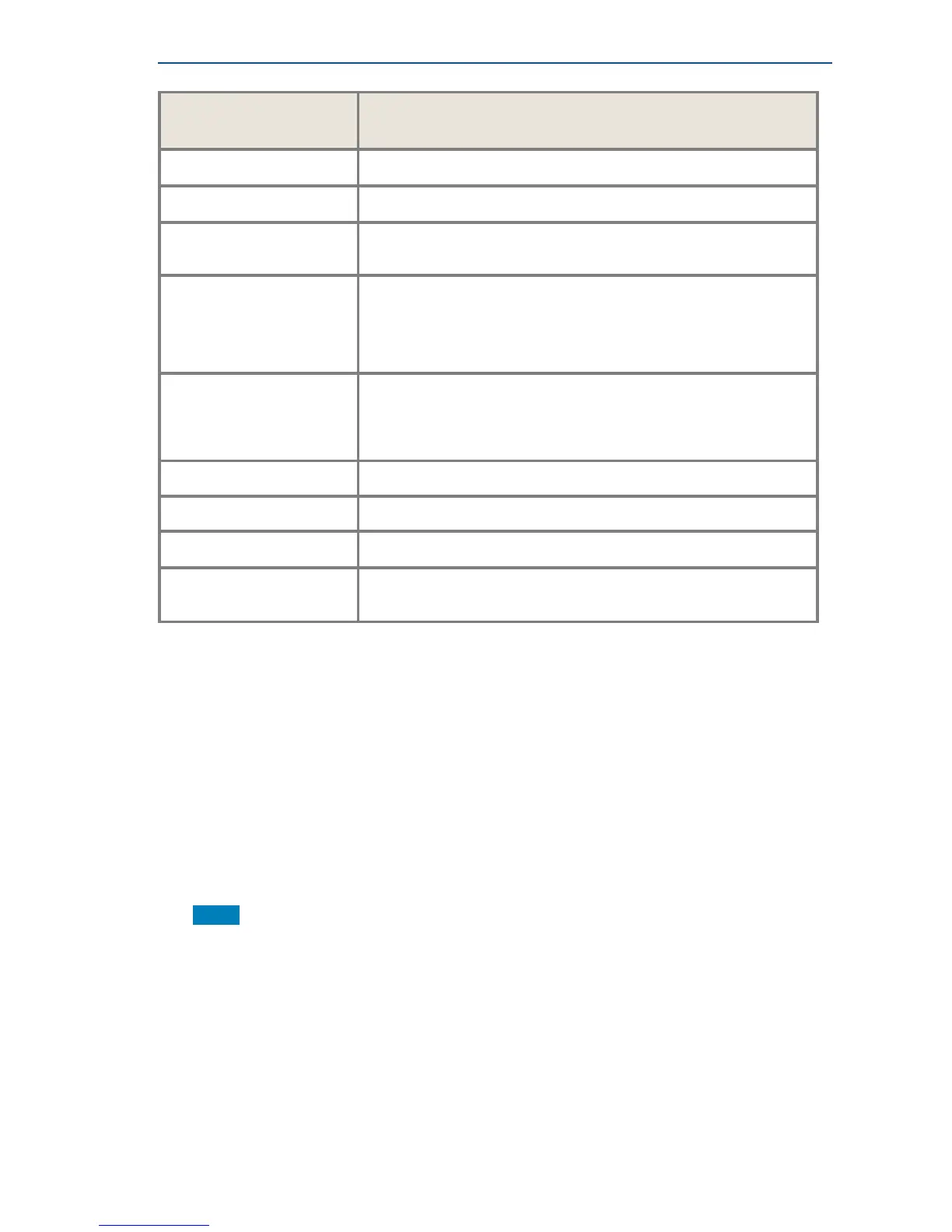
Demodulator MODCODs
Parameter
Description
ID
Identification assigned to the specific MODCOD.
Name
Name of the Modulation and Coding Scheme
DM + ML (dB) Total non-linear distortion. This distortion is substracted from the
measured Es/No.
ACM.In (dB) There is a threshold defined per MODCOD. This ACM in margin is
added to the threshold.
If Es/No > Threshold + ACM + DM + ML, you can use this specific
MODCOD.
ACM.Down (dB) There is a threshold defined per MODCOD. This ACM down
margin is added to the threshold. If Es/No < Threshold + ACM
down + DM + ML, the system switches to a lower MODCOD. This
is defined for each MODCOD.
Es/No.In (dB) This is Threshold (dB) + (DM + ML) (dB) + ACM.in (dB).
Es/No.Down (dB) This is Threshold (dB) + (DM + ML) (dB) + ACM.Down (dB).
BBFrames
Number of received BaseBand Frames
Dropped BaseBand
Frames
Number of dropped BaseBand Frames
Some rows in the table are shown in black: these are the MODCODs the terminal is able to receive.
In the previous example screenshot these are the lines with MODCOD Id: 4-7, 9, 13-14, 18-21
and 24-26.
Some rows in the table are shown in light-grey: these are the MODCODs which are not configured
on the terminal. In the previous example screenshot these are the lines with MODCOD Id:
1-3, 8, 10-12, 15-17 and 22-23.
The name and ID of one MODCOD is shown in green: this is the actual MODCOD that the terminal
uses to retrieve data. In the previous example screenshot this is MODCOD 32APSK 5/6 with Id 26.
The actual MODCOD is defined by the Es/No.In and Es/No.Down (for example rain will result in a
lower Es/No level and consequently a lower MODCOD).
Multicast and signaling are always received via the lowest configured MODCOD (QPSK ½ in this
example).
Click Reset to set the measurement counters to zero.



 To Next Page