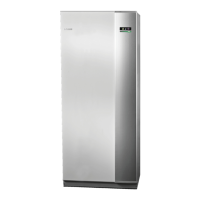
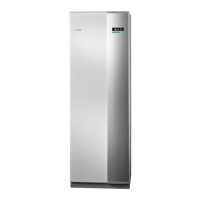
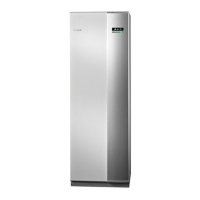
Connections
NOTE
To prevent interference, unscreened commu-
nication and/or sensor to external connections
cables must not be laid closer than 20 cm to
high voltage cable when cable routing.
Power connection
VVM 310 must be installed via an isolator switch with
a minimum breaking gap of 3 mm. Minimum cable
area must be dimensioned according to the fuse rating
used. Supplied cable (length approx. 2 m) for incoming
electricity is connected to terminal block X1 on the
immersion heater card (AA1). The connection cable
can be found on the reverse of VVM 310.
Connection
$$;
PE1
L11L2L3PE0N
VVM 310
AA1-X1
Tariff control
If the voltage to the immersion heater disappears dur-
ing a certain period, there must also be blocking via
the AU-input, see "Connection options- Possible selec-
tion for AU inputs".
Outside sensor
Install the outside temperature sensor (BT1) in the
shade on a wall facing north or north-west, so it is un-
affected by the morning sun.
Connect the sensor to terminal block X6:1 and X6:2 on
the input card (AA3). Use a twin core cable of at least
0.5 mm² cable area.
If a conduit is used it must be sealed to prevent con-
densation in the sensor capsule.
1
2
3
4
5
6
$$;%7
([WHUQDO
990
VVM 310
AA3-X6
Room sensor
VVM 310 is delivered with a room sensor supplied
(BT50). The room temperature sensor has up to three
functions:
1.
Show current room temperature in VVM 310's
display.
2.
Option of changing the room temperature in °C.
3.
Makes it possible to change/stabilise the room
temperature.
Install the sensor in a neutral position where the set
temperature is required. A suitable location is on a free
inner wall in a hall approx. 1.5 m above the floor. It is
important that the sensor is not obstructed from
measuring the correct room temperature by being
located, for example, in a recess, between shelves, be-
hind a curtain, above or close to a heat source, in a
draft from an external door or in direct sunlight. Closed
radiator thermostats can also cause problems.
The indoor module operates without the sensor, but
if one wishes to read off the accommodation's indoor
temperature in VVM 310's display the sensor must be
installed. Connect the room sensor to X6:3 and X6:4
on the input circuit board (AA3).
If the sensor is to be used to change the room temper-
ature in °C and/or to stabilise the room temperature,
the sensor must be activated in menu 1.9.4.
If the room sensor is used in a room with under floor
heating it should only have an indicatory function, not
control of the room temperature.
1
2
3
4
5
6
7
8
9
F1245RG 05
$$;
990 ([WHUQDO
%7
VVM 310
AA3-X6
Caution
Changes of temperature in accommodation
take time. For example, short time periods in
combination with underfloor heating will not
give a noticeable difference in room temperat-
ure.
NIBE™ VVM 310Chapter 5 | Electrical connections22


 To Next Page