16
minute or slower ascent to a depth slightly deeper than or equal to 10 feet (3
meters). The amount of decompression credit time you receive is dependent
on depth, with slightly less credit given the deeper you are.
Still, you must never ascend shallower than your decompression
ceiling! Doing so will place the PRODIGY into a Conditional Violation Mode
(see page 30) and greatly increase your risk of decompression sickness. Often
while coping with surge and swell, it is difficult to stay at a chosen depth. To
ensure that you do not enter a violation mode you should stay close to, but no
shallower than, the decompression ceiling depth. If the PRODIGY requires a
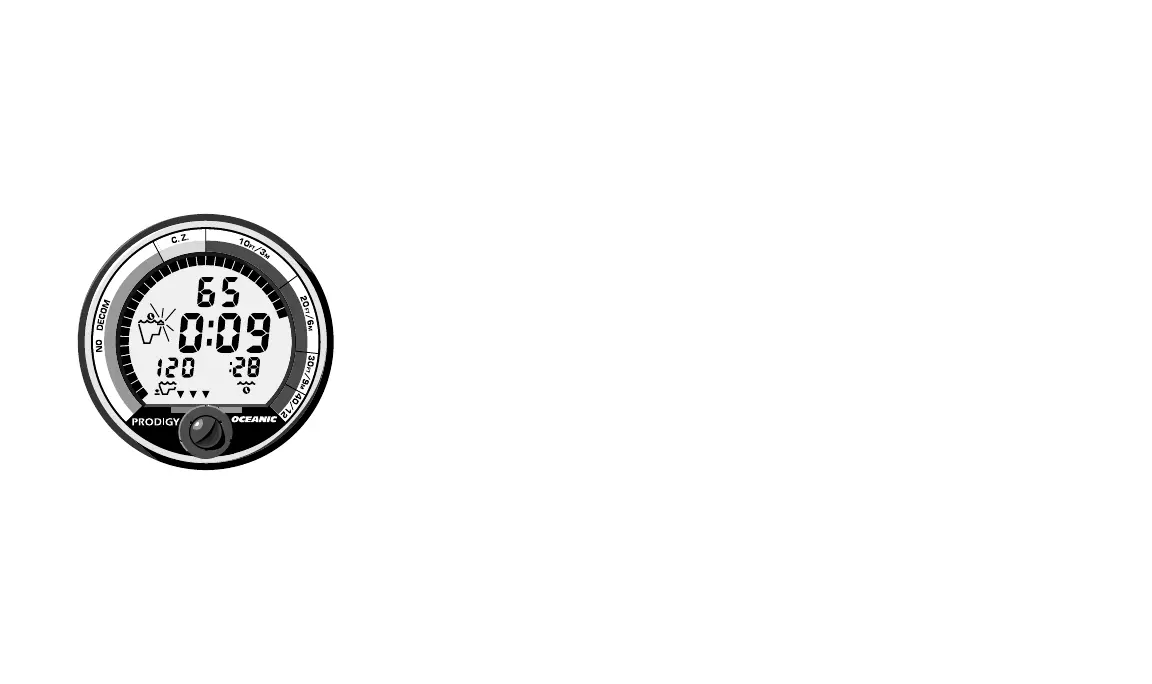
10, 20, 30, or 40 foot (3, 6, 9, or 12 meter) decompression ceiling, you should
stay slightly deeper than the depth indicated until the TLBG recedes into the
next shallower zone. When that occurs, you can ascend to, but not shallower
than, the new indicated ceiling.
Once you have performed the required decompression, the PRODIGY will
switch to No-decompression Dive Mode allowing additional time underwater.
After Total Decompression Stop Time reaches zero and the TLBG recedes
into the yellow Caution Zone (C.Z.), the diver can surface. However, to add a
greater margin of protection, Oceanic strongly recommends that you wait
until the TLBG segments are well within the green No Decom zone, unless a
low air condition requires you to surface. At the end of all decompression
dives, you must focus on reducing your tissue loading as much as possible
- by spending as much time as you can at your final safety stop and on the
surface - before your next dive.
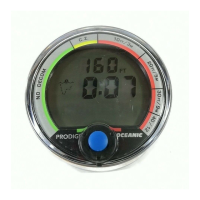
Fig. 13 – Decompression
Dive Mode-Alternate
®
FT



 To Next Page