23
The no-decompression algorithm is based upon Haldane’s theory using maxi-
mum allowable nitrogen levels developed by Merrill Spencer. Repetitive diving
control is based upon experiments designed and conducted by Dr. Ray Rogers and
Dr. Michael Powell in 1987. Diving Science and Technology
®
(DSAT), a corporate
affiliate of PADI
®
, commissioned these experiments and now uses the findings in the
Recreational Dive Planner
™
distributed by PADI.
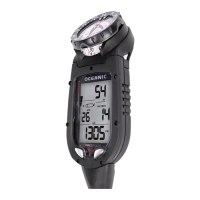
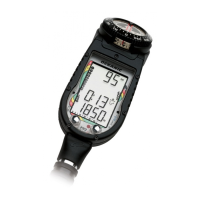
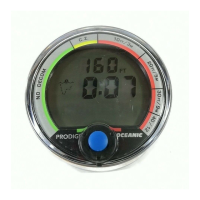
One advantage of using the PRODIGY is its ability to model many tissue com-
partments simultaneously. It constantly updates no-decompression time as the
controlling tissue changes with different depths. You always have a current predic-
tion of remaining no-decompression time regardless of which compartment is in
control.
ALTITUDE DIVING
The mathematical model in the PRODIGY accounts for the reduced no-decom-
pression time available at higher elevations based on National Oceanic and Atmo-
spheric Administration (NOAA) guidelines. When diving in high altitude lakes or
rivers from 3,000 to 14,000 feet (915 to 4,268 meters), the PRODIGY will automati-
cally adjust to these conditions providing corrected depth and reduced no-decompres-
sion times. Over 3,000 feet (915 meters) depth calibration automatically changes to
read in feet of freshwater rather than feet of seawater.
WARNING - Until it has shut itself off, you must not use the PRODIGY at a
different altitude than the altitude where it was originally activated. Doing
so will result in an error equal to the difference in barometric pressure, and
possibly a false dive mode.



 To Next Page