EasyManua.ls Logo

Philips pm3232 - Horizontal Amplifier

Philips pm3232
84 pages
Print Icon
To Next Page IconTo Next Page
To Previous Page IconTo Previous Page
Loading...
70
3. 1.4.1.
Sweep-gating
multivibrator
and
sawtooth
generator
The
sweep-gating
multivibrator
comprises
transistors
TS503
and TS504
in
Schmitt-trigger
configuration.
In
the
state
transistor TS503
cut
off and
transistor
TS504
conducting,
transistor
TS509
is
cut
off.
Then
the
time-base
capacitor
selected
with
TIM E/cm
switch SK2
is
charged
with
a
constant
current
supplied
by
transistor TS51
1 . The
rate
of
voltage
increase
which
determines
the
sweep
time
or
time
coefficient,
is
inversely
proportional to
the
capacitance
of the
selected
capacitor
and
direct
proportional
to
the
current
through
transistor TS511.
This
current is
determined
by
the base
voltage
of
transistor
TS51
1,
the
voltage
of
which
can
be
set
by the
TIM
E/cm
vernier
control R2
and
preset by
potentiometers
R534
and
R539.
The
charging
current
is,
moreover,
determined
by
the
value
of the
emitter
resistors
of
transistor
TS51
1,
which
are also
switched
over
by
TIME/cm
switch
SK2.
The
sawtooth
voltage
is
taken
off by a
cascade
circuit
consisting
of
emitter
followers
TS512
and TS513
and
applied to
both the
hold-off
circuit
and
the
horizontal
amplifier.
Via
the
hold-off
circuit, the
sawtooth
voltage
is fed
back to
the
input
of the
sweep-gating
multivibrator
whose
input
level
is
preset with
stability
potentiometer
R553.
At
a
certain
value
of
the
sawtooth
voltage,
in the
automatic
mode,
the
sweep-gating
multivibrator
is
set to
the state
transistor TS503
conducting
and
transistor
TS504
cut
off.
In
the other
trigger
modes the
switching
over
occurs
when
the sum
of
sawtooth
voltage
and
trigger
pulses
reaches
a
certain
value.
Then
transistor
TS509
starts
conducting
and the
time-base
capacitor
is
discharged
via this
transistor.
This
cycle
is
repeated
upon
arrival
of
the next
trigger
pulse.
3.1.
4.2. Hold-off
circuit
Due to
the effect
of diode GR504,
the
charge of
the
hold-off
capacitor
selected
with
TIME/cm
switch SK2,
cannot
follow
the decay
of
the
sawtooth
voltage.
The
capacitor
voltage
will
then
decrease
with
an
RC
time
which is
sufficiently
large to
allow the
sawtooth
to
reach
its
zero
level and to
ensure
the decay
of
the
switching
phenomena.
During
this
RC
time,
the
input
level
of
the
sweep-gating
multivibrator is
so high
that
incoming
trigger
pulses have
no
effect.
3.
1.4.3.
Auto
circuit
The AUTO
circuit
makes the
time-base
generator
free-running
when
there
are
no
trigger
pulses.
The
AUTO
circuit
works in
every
trigger
mode,
except
when
either
AC
push-button
SK1
1
or
DC
push-button
SKI
2 is
depressed.
If there
are
trigger
pulses, they
are
fed to
the
base
of
transistor TS506
of
the AUTO
circuit.
As
a
result
of
this,
the
two
transistors TS506
and TS508
of
the AUTO
circuit
are
conductive
until
capacitor C506
is
discharged.
The
voltage
at
the
cathode
of
diode GR502
is then
so
positive
that
the
latter
remains
blocked
and
the
working
of
the
sawtooth
generator,
as
described
above,
is
not
affected.
As
soon
as
there
are no
trigger
pulses,
capacitor
C506
will
be
charged
and
diode
GR502
becomes
conductive.
The
voltage
level at
the
input
of
the
sweep-gating
multivibrator
TS503-TS504
then
drops
to
such
a
value
that
the
multivibrator
switches
over
and a
sawtooth
is
formed.
This
occurs
immediately
after the
drop
of
the
holi-
off
pulse, i.e.,
the
time-base
generator
is
free-running.
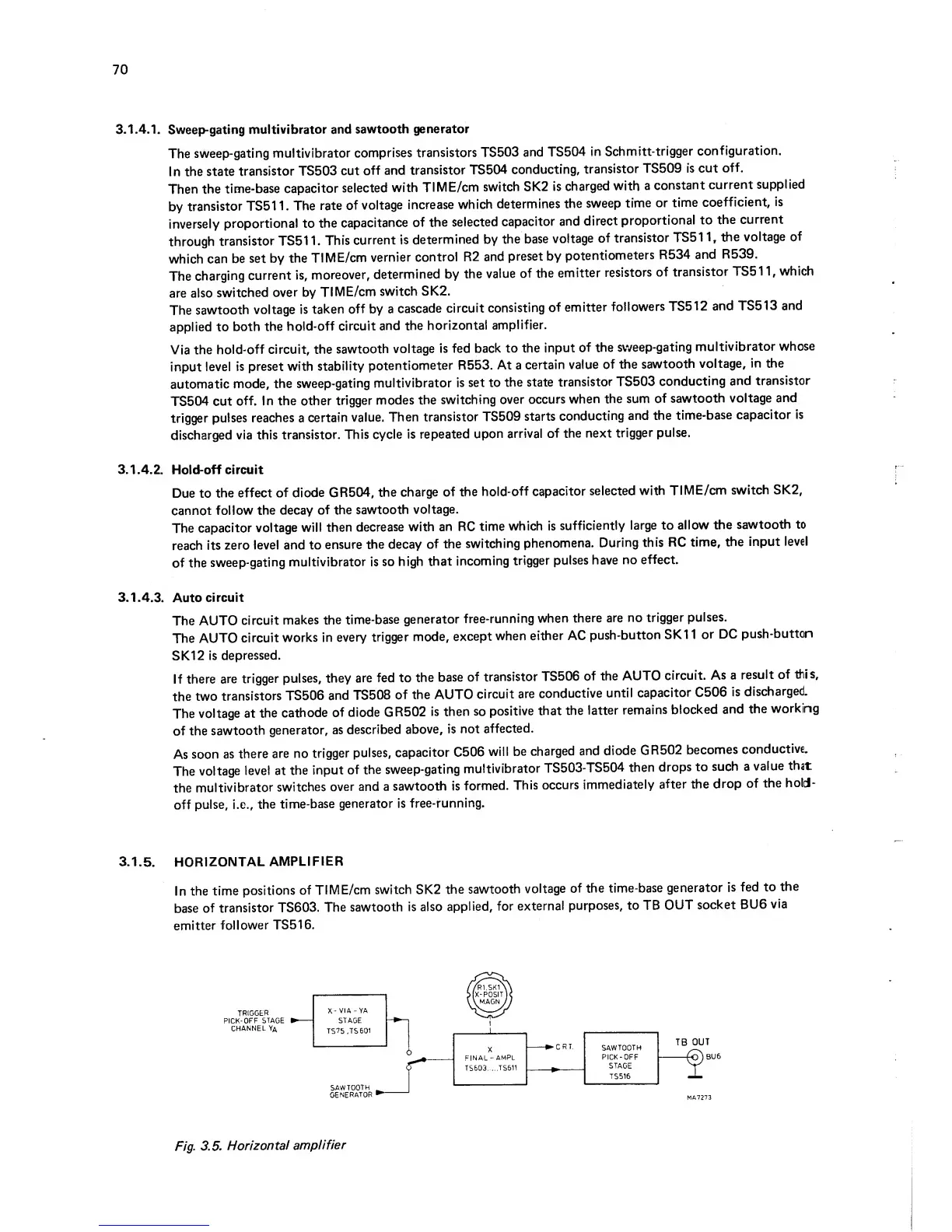
3.1.5. HORIZONTAL
AMPLIFIER
In
the
time
positions
of
TIME/cm
switch SK2
the
sawtooth
voltage
of
the
time-base
generator
is
fed
to
the
base
of
transistor TS603.
The
sawtooth
is also
applied,
for
external
purposes, to TB
OUT
socket
BU6
via
emitter
follower TS516.
TRIGGER
PICK-
OFF
stage
CHANNEL
Ya
X-
VIA
-
YA
STAGE
TS75 ,TS601
SAWTOOTH
GENERATOR
r
Fig,
3.5.
Horizontal
amplifier

Table of Contents

Related product manuals