EasyManua.ls Logo

Philips pm3232 - Basic Diagram of the Converter

Philips pm3232
84 pages
Print Icon
To Next Page IconTo Next Page
To Previous Page IconTo Previous Page
Loading...
74
3.1.
8.2. Converter
and stabilized
power
supply
The
converter
is
a
regenerative
square-wave
generator operating
at
^
frequency
of
approx.
18 kHz.
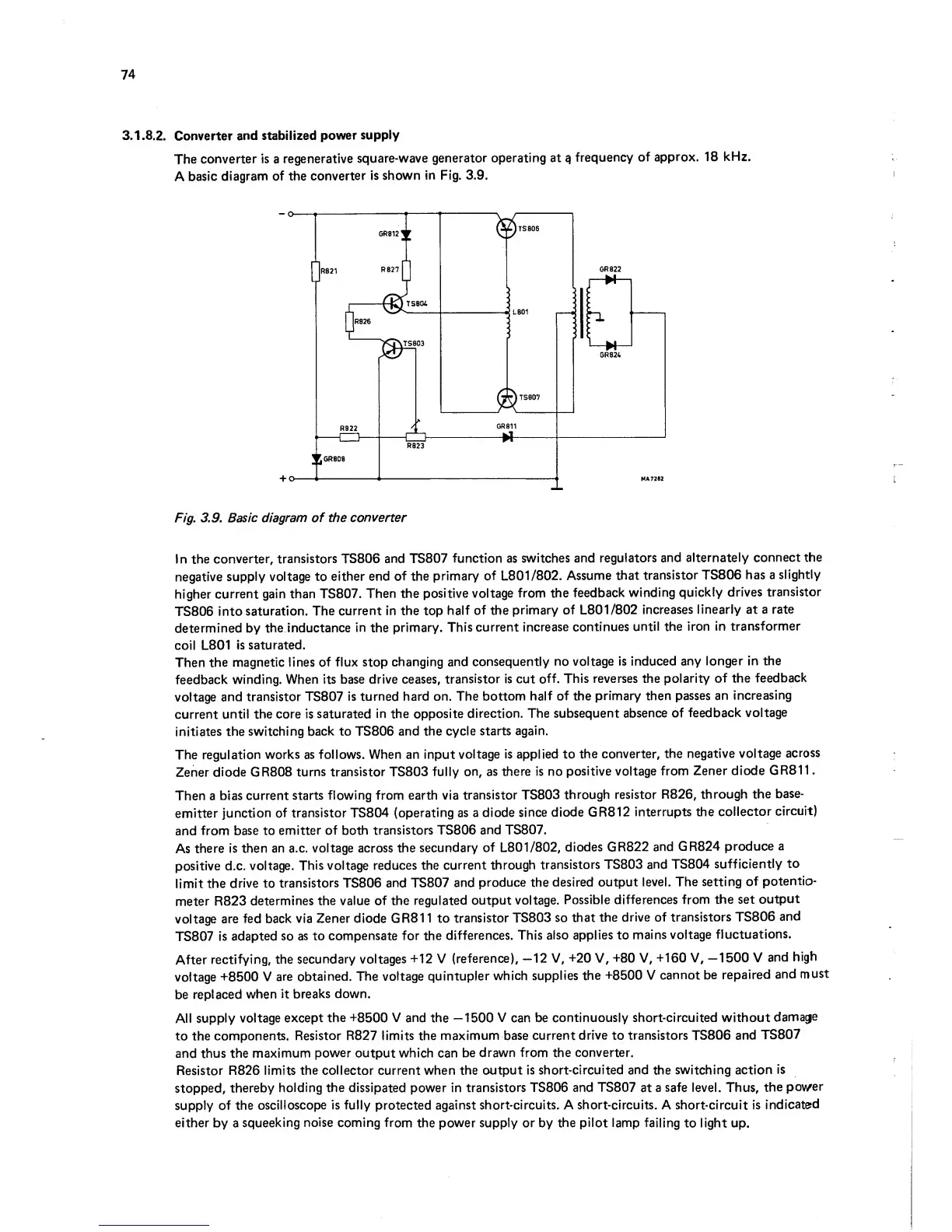
A
basic
diagram of
the
converter
is
shown
in Fig. 3.9.
Fig, 3.9.
Basic diagram of
the
converter
In the
converter,
transistors
TS806
and
TS807
function
as
switches
and
regulators
and
alternately
connect the
negative
supply voltage to
either end
of
the
primary
of
L801/802.
Assume
that
transistor
TS806
has a
slightly
higher
current gain than TS807.
Then the
positive voltage
from the
feedback
winding
quickly
drives
transistor
TS806
into
saturation.
The
current in the top
half
of
the
primary of L801/802
increases
linearly at a
rate
determined by
the Inductance
in
the
primary.
This
current
increase
continues
until the iron in
transformer
coil L801
is saturated.
Then
the magnetic lines
of
flux
stop
changing
and
consequently
no voltage
is induced
any
longer in the
feedback
winding.
When
its
base
drive ceases,
transistor
is cut
off.
This reverses the
polarity of
the
feedback
voltage
and transistor TS807
Is
turned
hard on. The
bottom
half
of
the
primary
then
passes an
increasing
current
until the core is
saturated
in the opposite
direction.
The
subsequent
absence of
feedback
voltage
initiates the
switching
back to
TS806
and the
cycle
starts
again.
The
regulation
works
as
follows. When an input
voltage is applied to
the converter,
the
negative
voltage
across
Zener
diode GR808
turns transistor
TS803
fully
on, as
there is no
positive voltage
from
Zener diode
GR811
.
Then
a
bias current
starts
flowing from earth via
transistor TS803
through resistor R826,
through
the
base-
emitter
junction of
transistor
TS804
(operating as
a diode
since
diode GR81 2
interrupts the
collector
circuit)
and
from base to
emitter of both
transistors TS806
and
TS807.
As
there is
then an a.c.
voltage across the
secondary
of
L801/802,
diodes
GR822
and GR824
produce
a
positive d.c.
voltage.
This voltage
reduces the
current
through
transistors TS803
and TS804
sufficiently
to
limit
the
drive
to
transistors
TS806
and TS807
and
produce the
desired output
level. The setting
of
potentio-
meter
R823
determines the
value
of the
regulated
output
voltage.
Possible
differences from
the set
output
voltage
are
fed back
via Zener diode GR81 1 to
transistor TS803
so that
the
drive of
transistors TS806
and
TS807
Is
adapted so as
to
compensate
for the
differences. This
also
applies to
mains
voltage
fluctuations.
After
rectifying,
the
secondary voltages
+12
V
(reference),
—12
V,
+20
V,
+80
V,
+160 V,
—1500
V
and
high
voltage
+8500 V
are
obtained. The
voltage
quintupler
which
supplies
the
+8500
V
cannot
be
repaired
and
must
be
replaced
when
it breaks
down.
All
supply
voltage except
the
+8500
V
and the
—1500
V
can be
continuously short-circuited without
damage
to
the
components. Resistor
R827 limits
the
maximum base
current
drive
to
transistors
TS806
and
TS807
and
thus
the
maximum
power
output
which can
be drawn
from the
converter.
Resistor
R826 limits the collector current when
the
output
is
short-circuited
and
the switching
action
is
stopped,
thereby
holding the
dissipated power in
transistors TS806
and
TS807 at a
safe level. Thus,
the
pov/er
supply
of
the
oscilloscope
is fully
protected
against short-circuits.
A
short-circuits.
A
short-circuit is
indicated
either by a
squeeking
noise
coming from
the power
supply or by the
pilot
lamp failing
to light up.

Table of Contents

Related product manuals