EasyManua.ls Logo

Physio Control LIFEPAK 9 - Page 148

Physio Control LIFEPAK 9
214 pages
Print Icon
To Next Page IconTo Next Page
To Previous Page IconTo Previous Page
Loading...
©
November
1994
Physio-Control
Corporation
Description
1
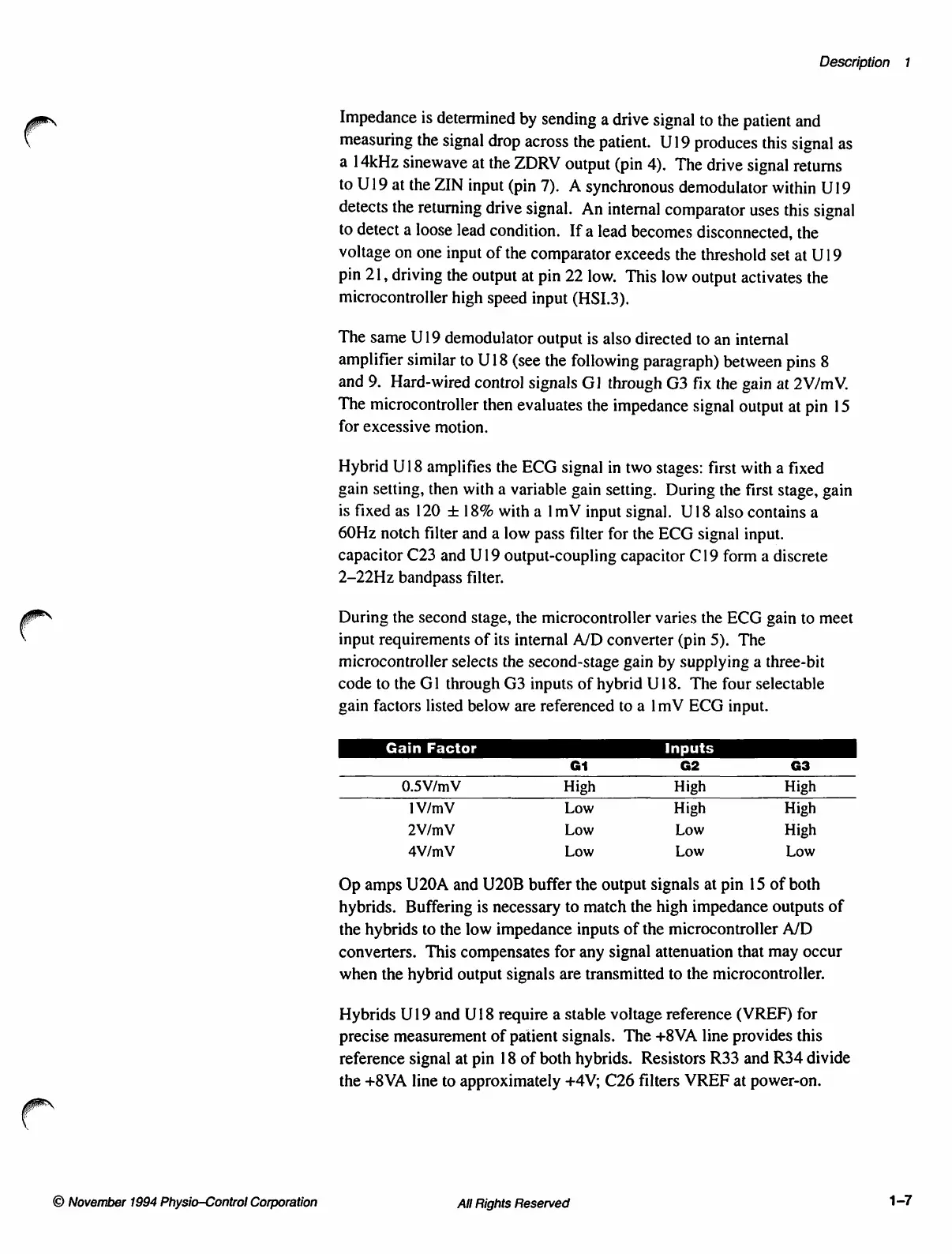
Impedance
is
determined
by
sending
a
drive
signal
to
the
patient
and
measuring
the
signal
drop
across
the
patient.
U19
produces
this
signal
as
a
14kHz
sinewave
at
the
ZDRV
output
(pin
4).
The
drive
signal
returns
to
U19
at
the
ZIN
input
(pin
7).
A
synchronous
demodulator
within
U19
detects
the
returning
drive
signal.
An
internal
comparator
uses
this
signal
to
detect
a
loose
lead
condition.
If
a
lead
becomes
disconnected,
the
voltage
on
one
input
of
the
comparator
exceeds
the
threshold
set
at
U19
pin
21,
driving
the
output
at
pin
22
low.
This
low
output
activates
the
microcontroller
high
speed
input
(HSI.3).
The
same
U19
demodulator
output
is
also
directed
to
an
internal
amplifier
similar
to
U18
(see
the
following
paragraph)
between
pins
8
and
9.
Hard-wired
control
signals
G1
through
G3
fix
the
gain
at
2V/mV.
The
microcontroller
then
evaluates
the
impedance
signal
output
at
pin
15
for
excessive
motion.
Hybrid
U18
amplifies
the
ECG
signal
in
two
stages:
first
with
a
fixed
gain
setting,
then
with
a
variable
gain
setting.
During
the
first
stage,
gain
is
fixed
as
120
+
18%
with
a
ImV
input
signal.
U18
also
contains
a
60Hz
notch
filter
and
a
low
pass
filter
for
the
ECG
signal
input.
capacitor
C23
and
U19
output-coupling
capacitor
C19
form
a
discrete
2—22Hz
bandpass
filter.
During
the
second
stage,
the
microcontroller
varies
the
ECG
gain
to
meet
input
reguirements
of
its
internal
A/D
converter
(pin
5).
The
microcontroller
selects
the
second-stage
gain
by
supplying
a
three-bit
code
to
the
GI
through
G3
inputs
of
hybrid
U18.
The
four
selectable
gain
factors
listed
below
are
referenced
to
a
ImV
ECG
input.
Gain
Factor
Inputs
G1
G2 G3
0.5V/mV
High High
High
1V/mV
Low
High
High
2V/mV
Low
Low
High
4V/mV
Low Low
Low
Op
amps
U20A
and
U20B
buffer
the
output
signals
at
pin
15
of
both
hybrids.
Buffering
is
necessary
to
match
the
high
impedance
outputs
of
the
hybrids
to
the
low
impedance
inputs
of
the
microcontroller
A/D
converters.
This
compensates
for
any
signal
attenuation
that
may
occur
when
the
hybrid
output
signals
are
transmitted
to
the
microcontroller.
Hybrids
U19
and
U18
require
a
stable
voltage
reference
(VREF)
for
precise
measurement
of
patient
signals.
The
+8VA
line
provides
this
reference
signal
at
pin
18
of
both
hybrids.
Resistors
R33
and
R34
divide
the
+8VA
line
to
approximately
+4V;
C26
filters
VREF
at
power-on.
All
Rights
Reserved
1-7

Table of Contents

Other manuals for Physio Control LIFEPAK 9

Related product manuals