EasyManua.ls Logo

Physio Control LIFEPAK 9 - Page 34

Physio Control LIFEPAK 9
214 pages
Print Icon
To Next Page IconTo Next Page
To Previous Page IconTo Previous Page
Loading...
LIFEPAK
9
defibrillator/monitor
e
———
1852u»
——>»İ
+»!
VARIABLE
Le
(540Hz)
+»!
VARIABLE
lat
TP6
i
DR
| |
LOGIC
TP17
|
|
LEVELS
ua
1200
to
18001
ef
İİ
|,|,
|
PRECISIO
TP19
SLOPE
oV
|
DA
AP
ΩΩ
ΧΧΧ
ασ.
|
|
Å
|
|
ke
—ECHO
PERIOD"
==
PROPORTIONAL
TO
NEGATIVE
VOLTAGE
AT
TP20
TP4
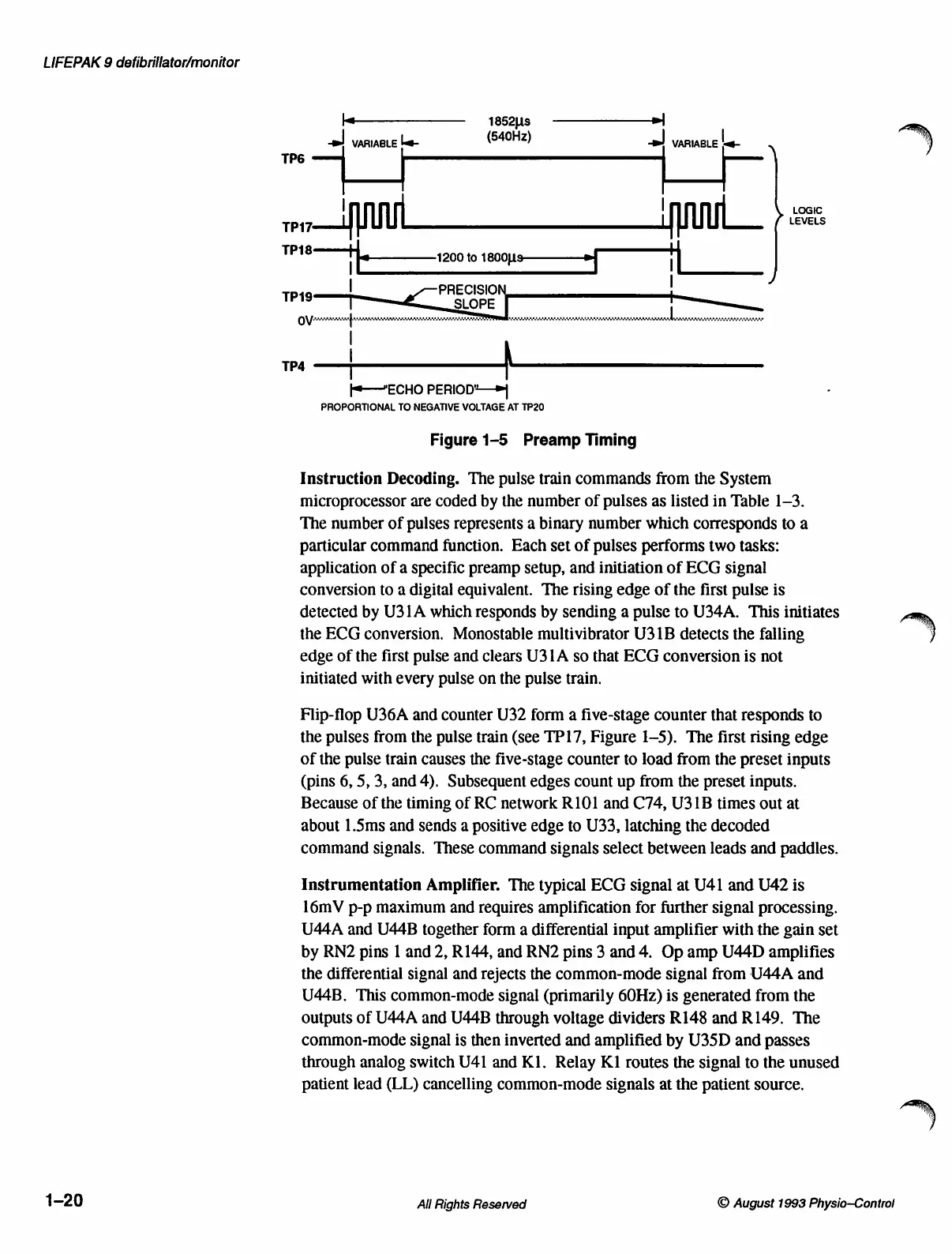
Figure
1-5
Preamp
Timing
Instruction
Decoding.
The
pulse
train
commands
from
the
System
microprocessor
are
coded
by
the
number
of
pulses
as
listed
in
Table
1-3.
The
number
of
pulses
represents
a
binary
number
which
corresponds
to
a
particular
command
function.
Each
set
of
pulses
performs
two
tasks:
application
of
a
specific
preamp
setup,
and
initiation
of
ECG
signal
conversion
to
a
digital
equivalent.
The
rising
edge
of
the
first
pulse
is
detected
by
U31A
which
responds
by
sending
a
pulse
to
U34A.
This
initiates
the
ECG
conversion.
Monostable
multivibrator
U31B
detects
the
falling
edge
of
the
first
pulse
and
clears
U31A
so
that
ECG
conversion
is
not
initiated
with
every
pulse
on
the
pulse
train.
Flip-flop
U36A
and
counter
U32
form
a
five-stage
counter
that
responds
to
the
pulses
from
the
pulse
train
(see
TP17,
Figure
1-5).
The
first
rising
edge
of
the
pulse
train
causes
the
five-stage
counter
to
load
from
the
preset
inputs
(pins
6,
5,
3,
and
4).
Subsequent
edges
count
up
from
the
preset
inputs.
Because
of
the
timing
of
RC
network
R101
and
C74,
U31B
times
out
at
about
1.5ms
and
sends
a
positive
edge
to
U33,
latching
the
decoded
command
signals.
These
command
signals
select
between
leads
and
paddles.
Instrumentation
Amplifier.
The
typical
ECG
signal
at
U41
and
U42
is
16mV
p-p
maximum
and
requires
amplification
for
further
signal
processing.
U44A
and
U44B
together
form
a
differential
input
amplifier
with
the
gain
set
by
RN2
pins
1
and
2,
R144,
and
RN2
pins
3
and
4.
Op
amp
U44D
amplifies
the
differential
signal
and
rejects
the
common-mode
signal
from
U44A
and
U44B.
This
common-mode
signal
(primarily
60Hz)
is
generated
from
the
outputs
of
U44A
and
U44B
through
voltage
dividers
R148
and
R149.
The
common-mode
signal
is
then
inverted
and
amplified
by
U35D
and
passes
through
analog
switch
U41
and
K1.
Relay
K1
routes
the
signal
to
the
unused
patient
lead
(LL)
cancelling
common-mode
signals
at
the
patient
source.
1-20
All
Rights
Reserved
©
August
1993
Physio-Control

Table of Contents

Other manuals for Physio Control LIFEPAK 9

Related product manuals