4-10 888-2408-002
WARNING: Disconnect primary power prior to servicing.
Overall System Theory
4.3.4.3 PA Modules
Each of the 8 PA Modules contain two PA Amplifier boards mounted on opposite
sides of the PA Module heat sink. The modules are numbered 1 through 8 with the
top module in the front being #1 and counting to #4 at the bottom. The top rear
module is #5 counting down to #8 at the bottom rear, see Figure 4-5 for the front
view and Figure 4-6 for the rear view. The PAs are numbered as 1A, 1B, 8A, 8B
etc... with the “A” side PAs being plugged into the “A” Z Plane, and the “B” PAs
plugged into the “B” Z Plane. From the front of the transmitter, the “A” Z Plane is
on the right and the “B” Z Plane is on the left. Keep in mind this is reversed when
viewing from the rear of the transmitter. All DC, signal and RF connections to a PA
board are through one edge connector.
4.3.4.4 Power Amplifier (PA)
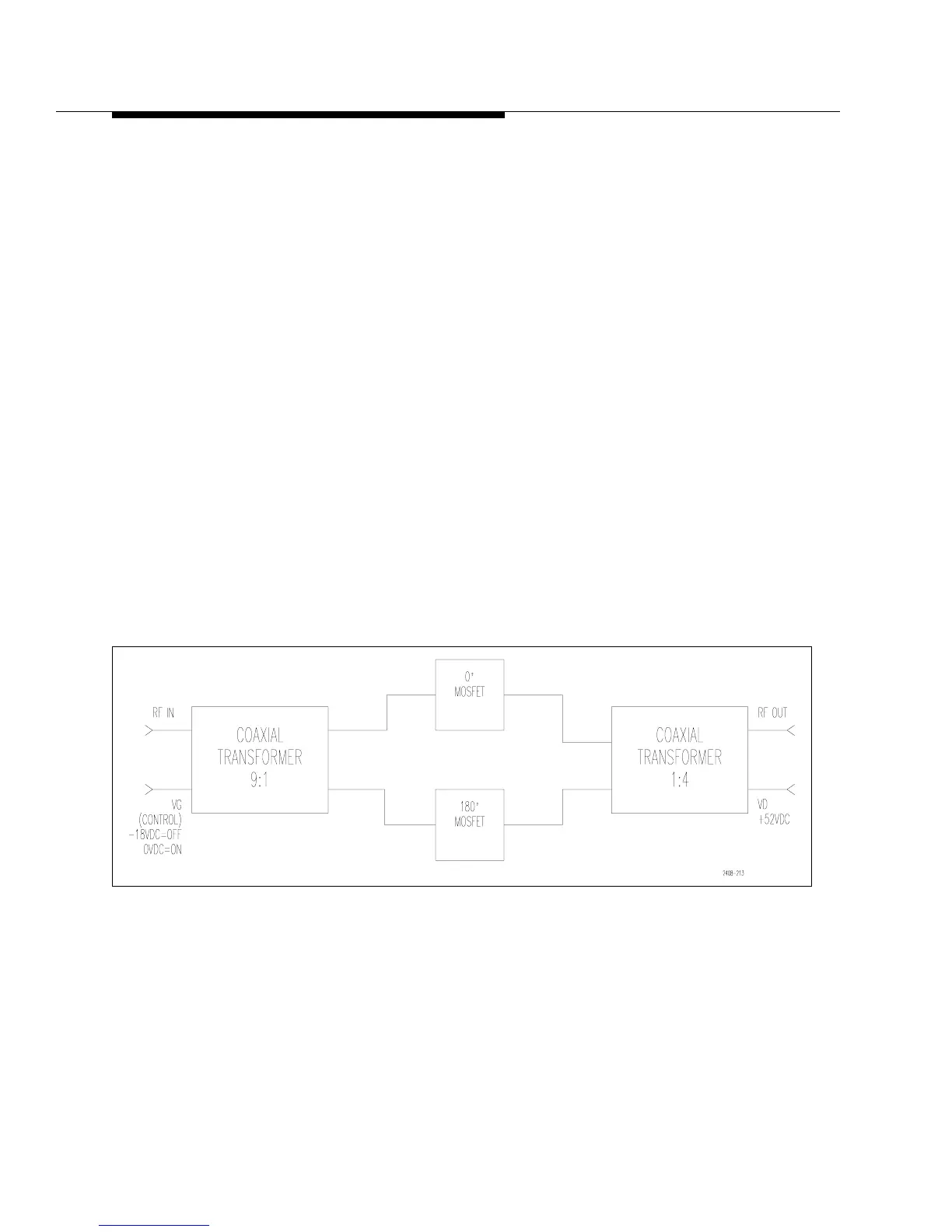
See Figure 4-4. The RF drive from the IPA enters the PA Amplifier Boards at Pin C.
The RF input level for each amplifier is typically 15-20 watts. TL1, C1 and C2
allow the input impedance to be matched to 50 ohms and permit the phase shift
through the module to be trimmed to a nominal value which allows all modules to
combine in-phase. The RF signal is then sent to T1, a coaxial 9:1 transformer which
also splits the phase providing 0 degree and 180 degree outputs to drive a pair of
push-pull RF power MOSFETs (Q1 and Q2). Bias to Q1 and Q2 (labeled VG for
Gate Voltage) is connected through the center of the secondary winding of T1.
Figure 4-4 Power Amplifier Block Diagram
The control voltage input called VG can be thought of as a bias voltage which can
be used to vary the amplifier output. Normally for the PAs it is simply used to turn
the amplifiers on and off. If VG is -18V the amplifier is off or muted. If VG is 0V
the amplifier is fully turned on and drive level from the IPA determines the
amplifier power output.


 To Next Page