Page 39 of 43
4. Hyperopia
A hyperopia can be either totally or partially compensated for by means of
accommodation. As a result, a measurement in miosis does not provide exact values,
respectively an existing hyperopia can be considerably underestimated. Regardless of
this, a higher hyperopia can however possibly be detected in children older than 2
years by means of a measurement using +3.00 dpt lenses.
Examples:
Measurement using +3.00 dpt lenses is not possible in children under two years of
age These children can also be measured in cycloplegia with the plusoptiX A09, as
the pupils are generally not larger than 8 mm. Note that 1.00 dpt must be subtracted
from the spherical measurement values, as a value of 1.00 dpt is included in the
measurement values for accommodation in miosis, at a distance of 1 metre.
5. Media blurring
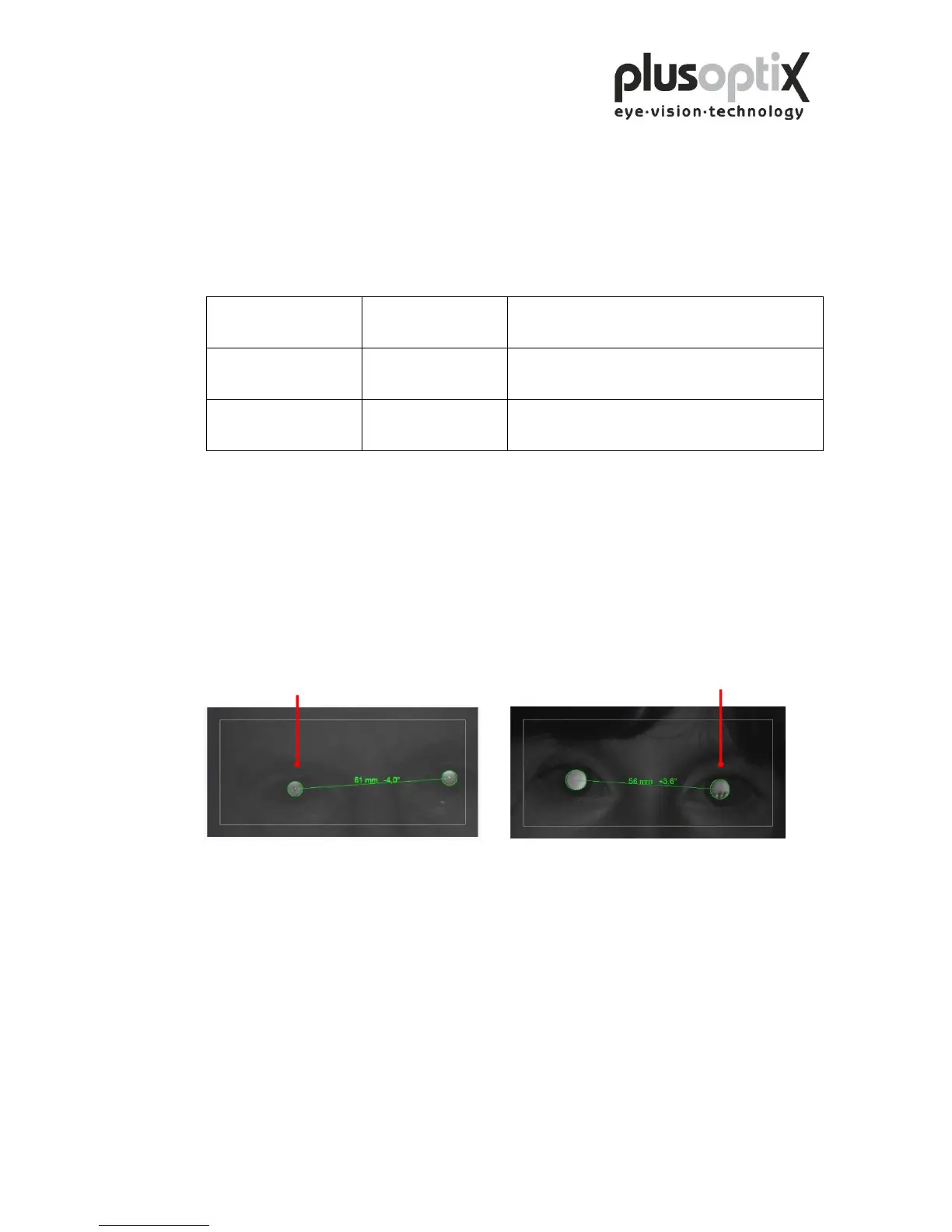
Where different brightness structures or black dots are detected in the pupils, media
blurring, a foreign particle or corneal damage is indicated. The following images
show clear cataract-like structures.
6. Nystagmus
The plusoptiX A09 can be used to measure nystagmus in children in most cases, as
the determination of refraction is performed at 50 Hz, i.e. every measurement is
performed at 20 ms.
7. Anisocoria
An anisocoria can be detected, as the plusoptiX A09 also indicates the pupil diameter
of both eyes.


 To Next Page