Page 38 of 43
12. Practical tips
12.1 Measurement results
The major benefit of the plusoptiX A09 is that binocular measurements in miosis in
children can be performed from a distance of one meter. Device accommodation is
therefore unnecessary, and the measurement is non-stressful for the child, the parent and
the examiner. A value of 1.00 dpt is taken into consideration for accommodation in the
measurement, at a distance of 1 meter.
1. Myopia and astigmatism
Neither myopia nor astigmatism is influenced by accommodation. Consequently,
these measurement values have a tolerance of ± 0.50 dpt in 80% of cases and a
tolerance of max. ± 1.00 dpt in the remaining 20% of cases, in comparison to
retinoscopy in mydriasis.
2. Anisometropia
Regardless of the accommodation status, an anisometropia can be detected with
certainty, as both eyes are measured simultaneously (binocular).
3. Small-angle squint
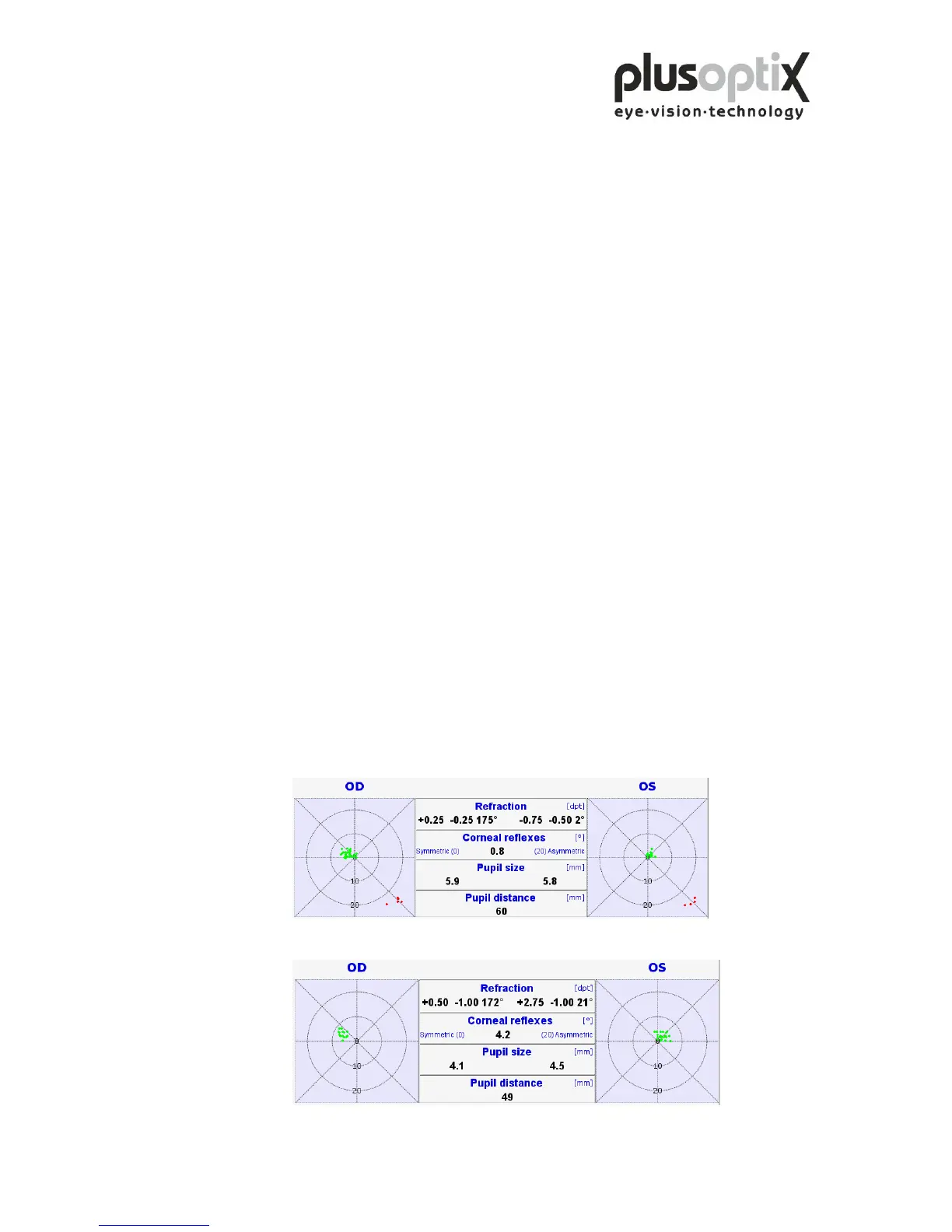
During every measurement, the corneal reflex for both eyes is displayed
simultaneously. Where the corneal reflexes are asymmetric, the possibility exists that
the child has a squint (Fig. 2). In the case of infants however, asymmetric corneal
reflexes can also be measured by a fixation that is not yet fully developed. Due to the
camera resolution and the measurement distance, asymmetries of less than 2 degrees
cannot be reliably detected.


 To Next Page