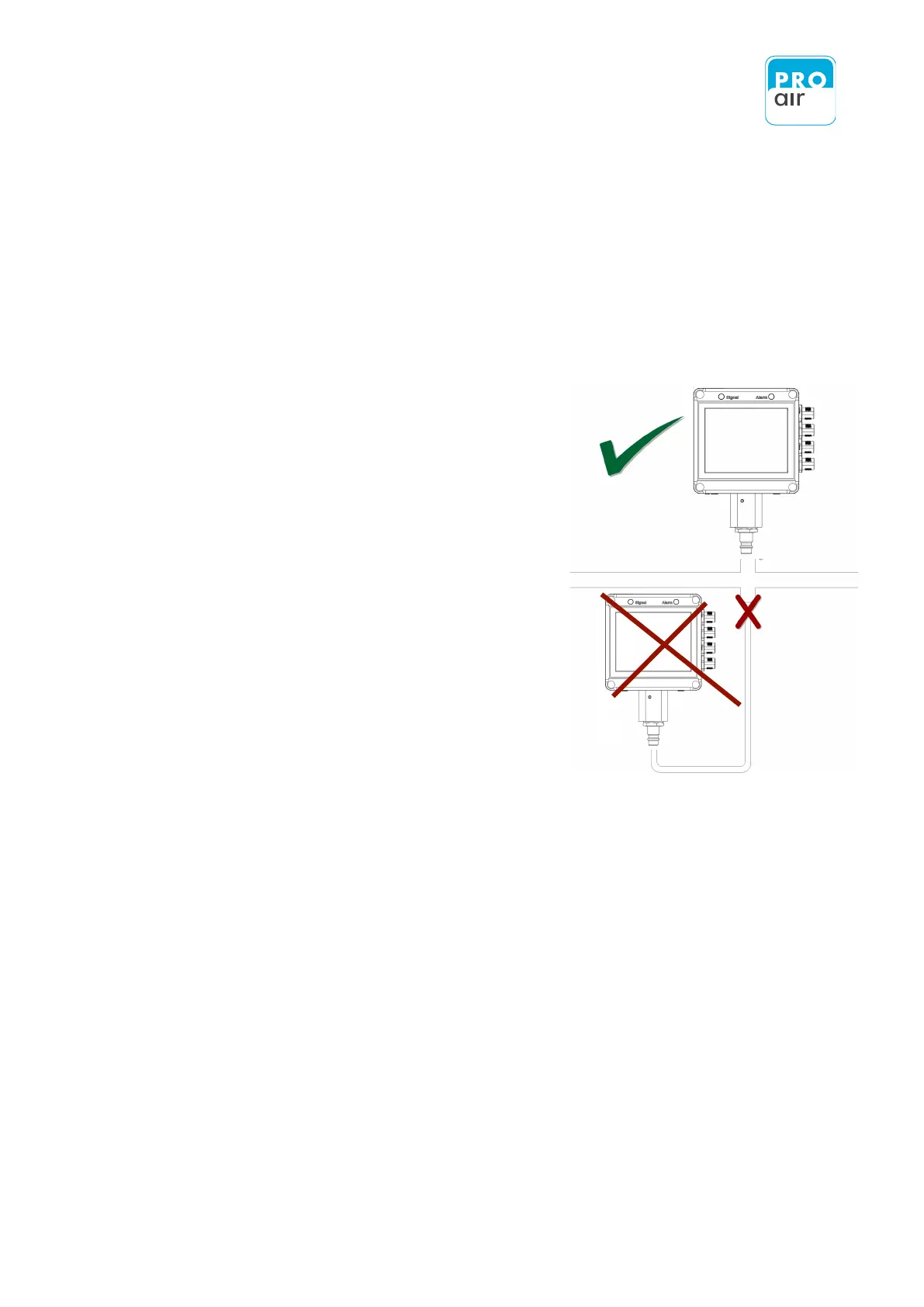
In the case of stationary use, the device is usually installed downstream of the dryer/filter,
enabling the entire system to be monitored. It may also be installed at any point further
downstream in the distribution system in order to
monitor subsegments or the air supply entering a
particular machine.
In order to avoid unnecessary compressed-air
consumption through loss of scavenging air, the
measuring chamber with the sensor should preferably
be directly installed into the compressed-air line.
To prevent the accumulation of condensation in the
event of a fault, the measuring chamber must be
screwed vertically into the line from the top.
Extremely high flowrates or sudden pressure changes
should be avoided, as these may damage the sensor
element.
If a spur line is required for connection, this should
only be a few centimetres long, otherwise the
response will be impaired, especially at low dew-point
values. If longer spur lines are used, the choke must be opened onto the measuring chamber
and set to approximately 60 l/h.
Long, vertical spur lines impair the response or result in incorrect measured values.
The device may be alternatively connected to the compressed-air supply via a Teflon connection
line through the built-in measuring chamber with choke. To ensure correct functioning and
guarantee measuring accuracy there must be a throughflow of air. The basic flow rate can be set
at the choke. In order to avoid unnecessarily high loss of scavenging air, the flow at the rated
pressure can be set to 60 l/h by means of a flow meter. Check from time to time that there is air
flowing at the adjusting screw. If the choke is closed, the measuring device displays values that
are too high or triggers an alarm


 To Next Page