REYMSA COOLING TOWERS, INC.
www.reymsa.com
The
All-Fiberglass
Cooling Towers
9
A.2.3. QUADRUPLE FAN TOWERS
Follow this procedure to assemble and install quadruple fan Closed Circuit Fluid Coolers.
A. Upon the equipment arrives with the end user, check any abnormality or apparent damage in the
packaging before any landing maneuver of the Closed Circuit Fluid Cooler and its components. The
packing list must match the goods received. Any absence or abnormality of the equipment should be
reported immediately and directly to your local REYMSA representative.
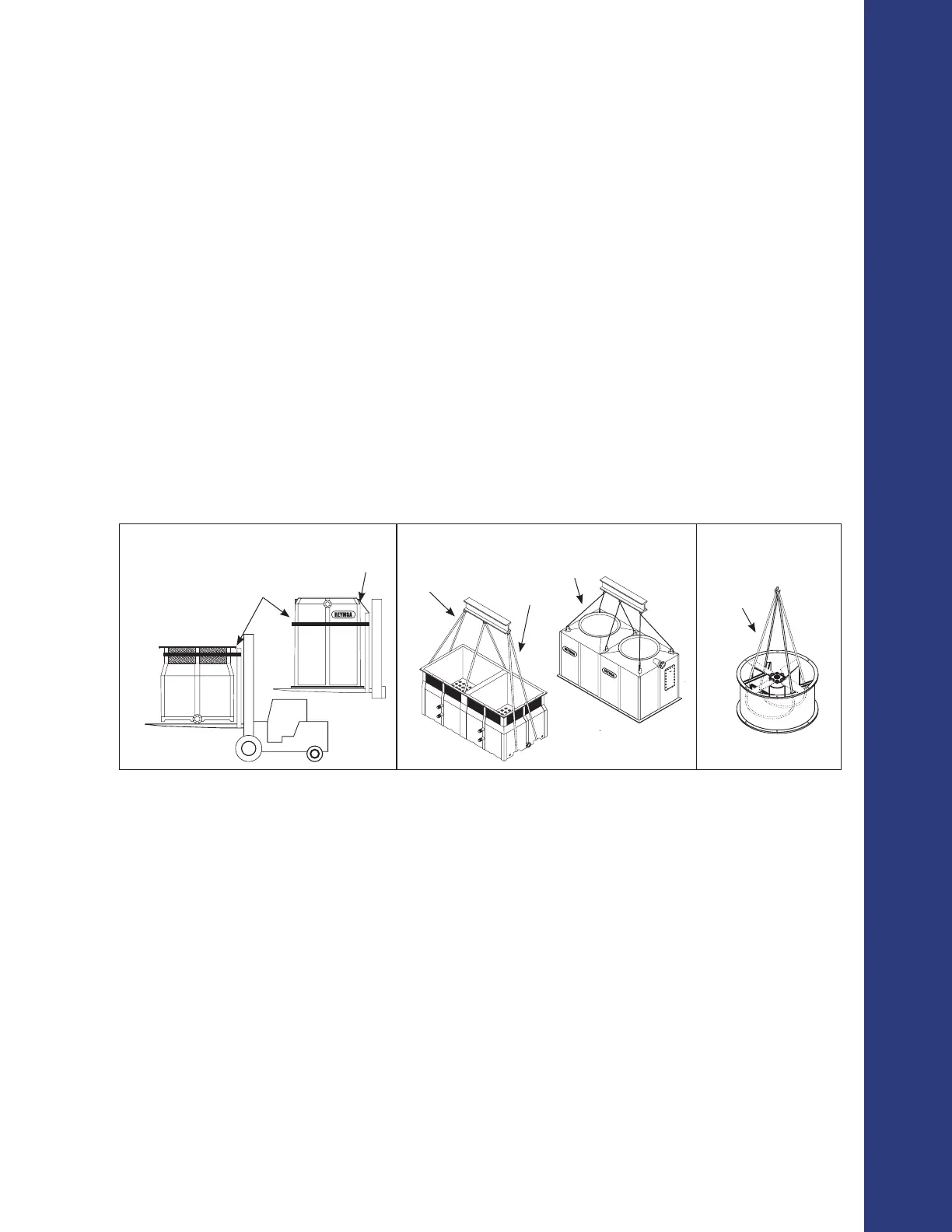
B. After verifying the equipment is received in proper conditions, proceed to unload it piece by piece,
with a crane or forklift of the appropriate capacity (see Figure A-18, Figure A-19 and Figure A-20 for
reference).
C. For crane lifting, it is recommended to use a minimum elevation angle of 60 ° between the belt and
the horizontal, also pay special attention when lifting the bottom of the tower (basin with copper coil),
because it does not count with lifting brackets due to their weight. Explicit instructions are described below.
D. Surround the lower section of the tower with the straps, placing them through the basin openings (as shown
in Figure A-19), use a spreader frame to avoid damage on the upper edge of the tower, when lifting don’t
balance until tensing the straps (see Figure A-19), pad the strap areas on the tower to avoid scratching.
E. Remove the plastic wrap that surrounds the tower and its components, loosen the nuts and bolts that keep
the basin section attached to the wooden pallet (the body comes unattached), the nuts and bolts are
located at the bottom of the basin (some models comes totally unattached).
F. Before tower’s assembly, REYMSA recommends to install a steel base structure that supports the tower’s
operational weight; also place an isolation pad (supplied by others) between the tower and the base
structure for support purposes. Verify that the base structure has the proper dimensions (for construction,
refer to factory certied drawings). For more information, see section “A.3.1. LEVELING AND TOWER
SUPPORTS”.
G. Place the lower section of the tower (basin whit copper coil) on top of the isolation pad and the steel
base structure; for crane lifting, notice that some towers doesn’t have basin openings for the straps, care
must be taken to avoid them get stocked between the tower and the base (See gures A-19 and A-21).
making sure that the anchorage holes on the bottom of the tower are aligned with the perforations of the
base. Then proceed to bolt it down and secure it with stainless steel nut and bolt sets (supplied by others).
H. Place the lower section #2 of the tower following the same instructions G. Is strongly recommended the use
of the spreader frame as illustrated on Figure A-23. Once the both section are in the structural base, then
proceeds to bolt together the vertical anges of Sections 1 & 2; use rsts the galvanized bolts and nuts
to join sections (supplied by REYMSA); then replace the galvanized bolts with the stainless steel nut and
bolt set supplied by REYMSA. Then bolt down and secure both sections to the structural base with stainless
steel nut and bolts set (supplied by others, see gure A-22).
Installation
Figure A-18: Double fan tower fork lifting
Figure A-19: Double fan tower crane lifting
Figure A-20: Fan duct
lifting
STRAPS
STRAPS
SPREADER
BAR
BASIN
BASIN
BODY
BODY DUCT
CABLE
CABLE
ROPE
FORK EXTENSIONS
9 FT MINIMUM PALLET
LENGTH


 To Next Page