13
GA--A 181
5Use
5.1 Operating principle of Ultrasound Generator
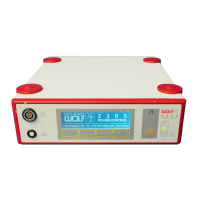
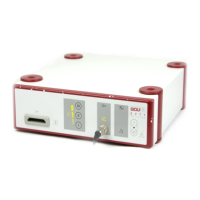
The Ultrasound Generator generates an output voltage at a frequency
which corresponds to the resonance frequency of the oscillating system
consisting of the transducer and a suitable sonotrode. The Ultrasound
Generator 2271 automatically adapts to the resonance frequency of this
oscillating system.
Actuating the footswitch supplies an output voltage to the transducer out-
put of the device.
The ultrasound energy is generated outside the body and outside the de-
vice, in the transducer. The output voltage of the Ultrasound Generator
excites two piezoceramic discs that transfer the ultrasound oscillations to
the sonotrode.
The excitation of the sonotrode causes a stationary wave at the reso-
nance frequency which has its maximum amplitude at the distal end of
the sonotrode. Load--dependent changes in the oscillation behaviour are
compensated by a control circuit in the generator. Selecting the required
stage on the generator adapts the oscillation intensity to the require-
ments.
During operation, a safety circuit monitors the selected output power. If
the output power exceeds the selected value, the “Generator malfunction”
alarm lamp in the device lights up, at the same time an accustic alarm is
sounded and the transducer output is switched off.
5.2 Operating principle of ultrasound lithotripsy
Ultrasound lithotripsy systems are used for minimally invasive desintegra-
tion of urinary bladder stones, kidney stones and ureter stones. Access to
the stone is gained endoscopically via the urethra or percutaneously di-
rectly into the kidney. The stone is desintegrated under endoscopic view
by contact with the sonotrode.
The stone fragments are pumped off through the sonotrode together with
the irrigation fluid. Suction is achieved by a vacuum generated by a
preadjustable suction pump via a fluid trap. The stone fragments and de-
bris are collected in the fluid trap while the irrigation fluid is pumped via
an overflow device into the drain.


 To Next Page