
 Need help?
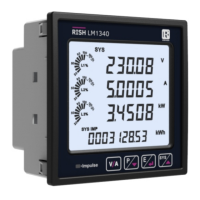
Do you have a question about the Rishabh RISH LM 1340 and is the answer not in the manual?
Details on available measurement screens and how to navigate them.
Explains the energy and counter screens and their navigation.
Covers Current Reversal, Phase Rotation Error, and Phase Absent screens.
Information on Individual Harmonics and Load Health Monitor screens.
Procedure for enabling and changing the meter's password for security.
Overview of menu structure for configuring system, communication, IP, output, health, digital input, tariff, display, and factory reset parameters.
Setting system type, PT/CT ratios, frequency, integration time, and other system-related settings.
Setting up RS485 communication and IP network parameters for the meter.
Setting up relay outputs for pulse, limit, timer, load health, and pre-paid energy modes.
Setting health monitor limits and configuring digital input modes, pulse multiplier, and de-bounce time.
Configuring tariff modes, energies, display backlight, contrast, and user screens.
Procedures for resetting parameters and restoring factory default settings.
How to exit the setup menu and return to the measurement screen.
Explains the auto-ranging calculation for displaying energy values.
Setting the initial count value for energy measurement.
Setting up pulse output parameters like duration, rate, and divisor.
Configuring limit switch parameters, trip points, hysteresis, and logic operations.
Configuring timer outputs and load health monitoring relay assignments.
Managing pre-paid energy, balance, unit cost, and recharge settings.
Visual guide to understanding power flow direction and quadrants.
Guidelines for meter installation, EMC compliance, and environmental considerations.
Physical dimensions of the meter and required panel cut-out size.
Instructions for wiring, auxiliary supply, fusing, and grounding connections.
Schematics illustrating connection methods for different system types.
Information on installing optional communication or I/O modules.
Details on system types, nominal input voltage, current, and PT/CT values.
Specifies operating ranges, accuracy metrics, and reference conditions.
Information on operating environment, safety standards, EMC, and enclosure ratings.
Details on available interfaces, dimensions, mechanical housing, and connection terminals.
Specifications for relay outputs, pulse rate divisors, and pulse duration settings.
Instructions for connecting optional pulse output, digital input, and communication modules.
 General
| Brand | Rishabh |
|---|---|
| Model | RISH LM 1340 |
| Category | Music Equipment |
| Language | English |

 To Next Page