3-8 3rd Ed. Sep 30, 06
S–TEC
3.1.4 Altitude Hold (ALT HOLD) Mode
The altitude hold mode can only be engaged if a roll mode (HDG, NAV, NAV APR,
REV, REV APR, NAV GPSS) is already engaged. With a roll mode engaged and
the aircraft at the desired altitude, press the ALT mode selector switch to engage
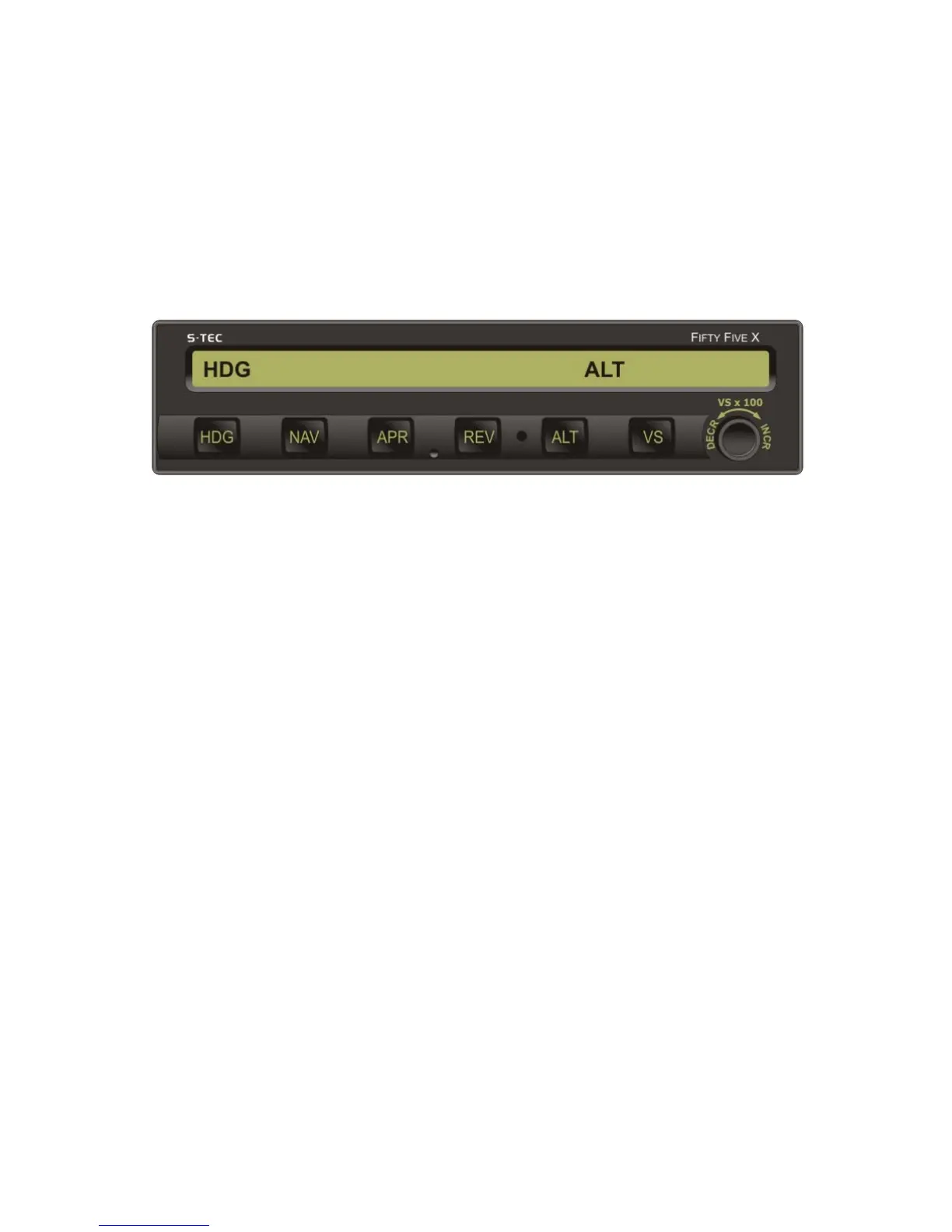
the altitude hold mode. The ALT annunciation will appear as shown in Fig. 3-11,
to acknowledge that this mode is engaged. The autopilot will hold the aircraft at
its current (captured) absolute pressure altitude. This altitude may be modified
for barometric pressure changes, by rotating the Modifier Knob either clockwise
(CW) for an increase in altitude, or counter-clockwise (CCW) for a decrease in
altitude. Each detent equals 20 feet, and the range is ±360 feet from the original
captured altitude.
Fig. 3-11. AP Display, HDG and ALT HOLD Modes Engaged
3.1.5 Vertical Speed (VS) Mode
Caution:
The vertical speed mode is used to establish and hold a PILOT selected
vertical speed. Since the autopilot receives no airspeed information, it is the
responsibility of the pilot to ensure that the vertical speed selection is within
the operating limits of the aircraft's capabilities. Selection of a vertical
speed beyond the capability of the aircraft can create a condition of reduced
airspeed, and possibly lead to a stall condition.
The vertical speed mode can only be engaged if a roll mode (HDG, NAV, NAV
APR, REV, REV APR, NAV GPSS) is already engaged. With a roll mode engaged
and the aircraft at the desired vertical speed, press the VS mode selector switch
to engage the vertical speed mode. The VS annunciation will appear as shown
in Fig. 3-12, to acknowledge that this mode is engaged, along with the current
vertical speed. The latter appears as a number in units of FPM x 100, prefixed by
either a "+" to indicate a climb, or a "-" to indicate a descent (i.e., for example, +5
indicates 500 FPM climbing, if within the aircraft's capabilities). The autopilot
will hold the aircraft at its current (captured) vertical speed. This vertical speed
may be modified by rotating the Modifier Knob. In a climb, rotating the Modifier
Knob clockwise (CW) increases the climb rate, whereas rotating it counter-
clockwise (CCW) decreases the climb rate. In a descent, rotating the Modifier
Knob CCW increases the descent rate, whereas rotating it CW decreases the
descent rate. Each detent equals 100 FPM, and the range is ±1600 FPM from
the original captured vertical speed.
During a climb, should the aircraft become unable to hold the captured vertical
speed for a period of fifteen seconds, the VS annunciation will flash as an alert
to the potential for an impending stall condition. In that event, immediately
increase the aircraft's thrust if possible, reduce the commanded vertical speed
using the Modifier Knob, or both, until the VS annunciation stops flashing.


 To Next Page