1. Do not connect supply voltages exceeding the equipment rated voltage to avoid
damaging the internal circuits.
2. If the drive
is installed in environments exposed to flammable and/or explosive
substances (AD zones according to IEC 64-2 standards), please refer to IEC 64-2,
EN 60079-10 and related standards.
3. Do not connect the equipment power supply to the output terminals (U,V,W), to the
resistive braking module terminals (+, -, B) or
to the control terminals. The
equipment power supply must be connected only to terminals R,S,T.
4. Do not short-circuit terminals (+) and (-) and terminals
(+) and (B); do not connect
any braking resistors with lower ratings than the required ratings given in the
Installation Instructions
Do not start or stop the connected motor using a contactor over the inverter power
supply.
6. Do not install any cont
actor between the inverter and the motor. Do not connect any
power factor correction capacitor to the motor.
7. Operate the inverter only if a proper grounding is provided.
8. If an alarm trips, a comprehensive review of the ALARMS AND WARNINGS section
is recommended; restart the equipment only after removing the cause responsible
Do not perform any insulation test between the power terminals or the control
terminals.
10. Make sure that the fastening screw
s of the control terminal board and the power
terminal board are properly tightened.
11. Do not connect single-phase motors.
12. Always use a motor thermal protection (use the inverter motor thermal model or a
thermoswitch installed in the motor).
13. Respect the environmental requirements for the equipment installation.
14. The bearing surface of the drive
must be capable of withstanding high temperatures
(up to 90°C).
15. The drive
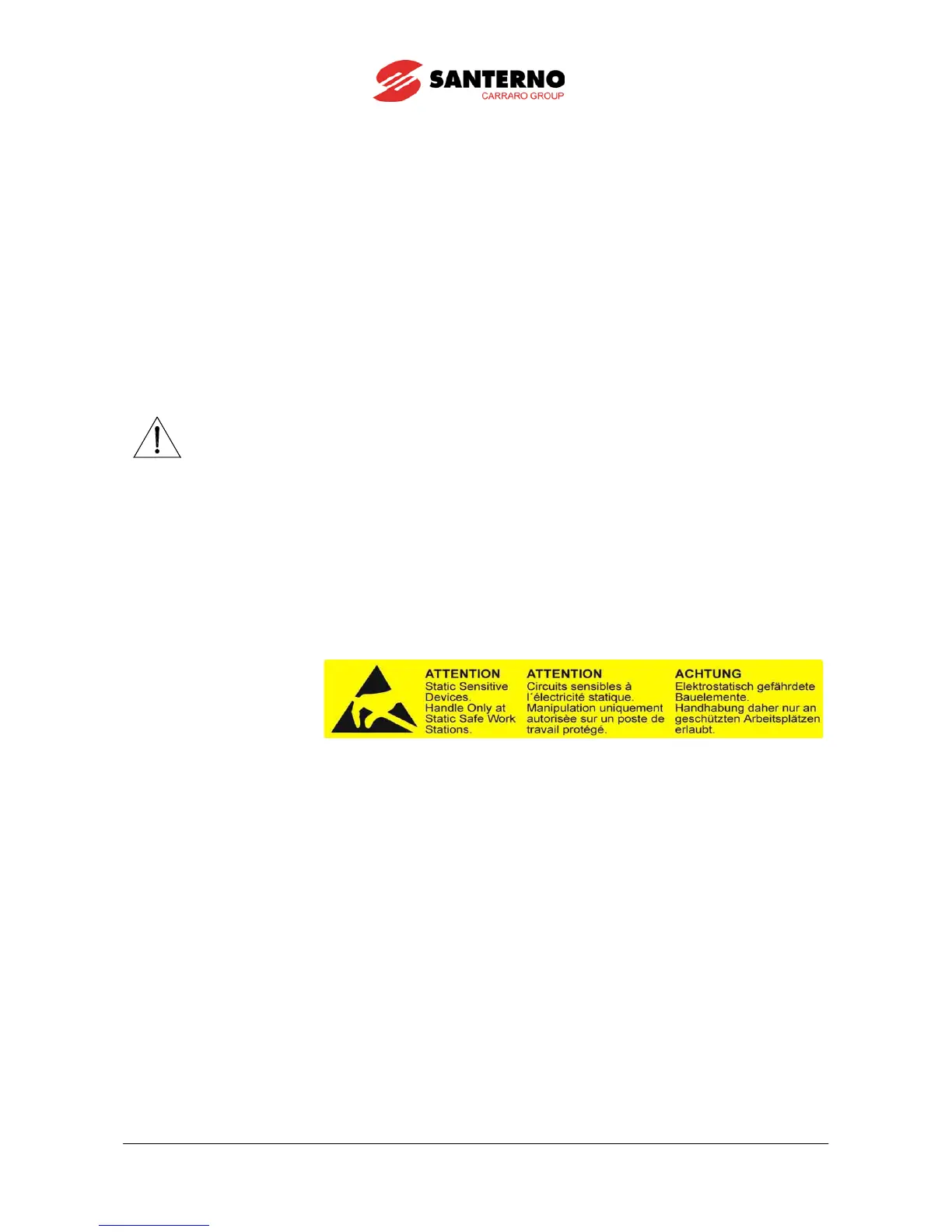
electronic boards contain components which may be affected by
electrostatic discharges. Do not touch them unless it is strictly necessary.
very careful so as to prevent any damage caused by electrostatic discharges.


 To Next Page