3.1.8 Master / Slave
To start up a DSL span, one system unit must be configured as master modem
(STU-C) and the other one as slave (STU-R). The master controls the span star-
tup procedure. If both system units are configured as master or as slave, no star-
tup will occur.
Usually, the plug-in is configured as master and the tabletop modem as slave
(default setting). However, it is possible to set up a DSL span between two plug-
ins or two tabletops, as long as one is configured as master and the other one as
slave.
3.1.9 DSL Clocking
Watson Ethernet modems have a crystal controlled DSL clock that does not de-
pend on the clocking of the Ethernet user interfaces (clockmode 1 of TS 101
524).
3.2 Ethernet (plug-in modem)
3.2.1 Ethernet over DSL
Ethernet packets are mapped on the DSL frame using the packet mode TPS-TC
layer of ETSI TS 101 524. The modems use bit stuffing to improve efficiency.
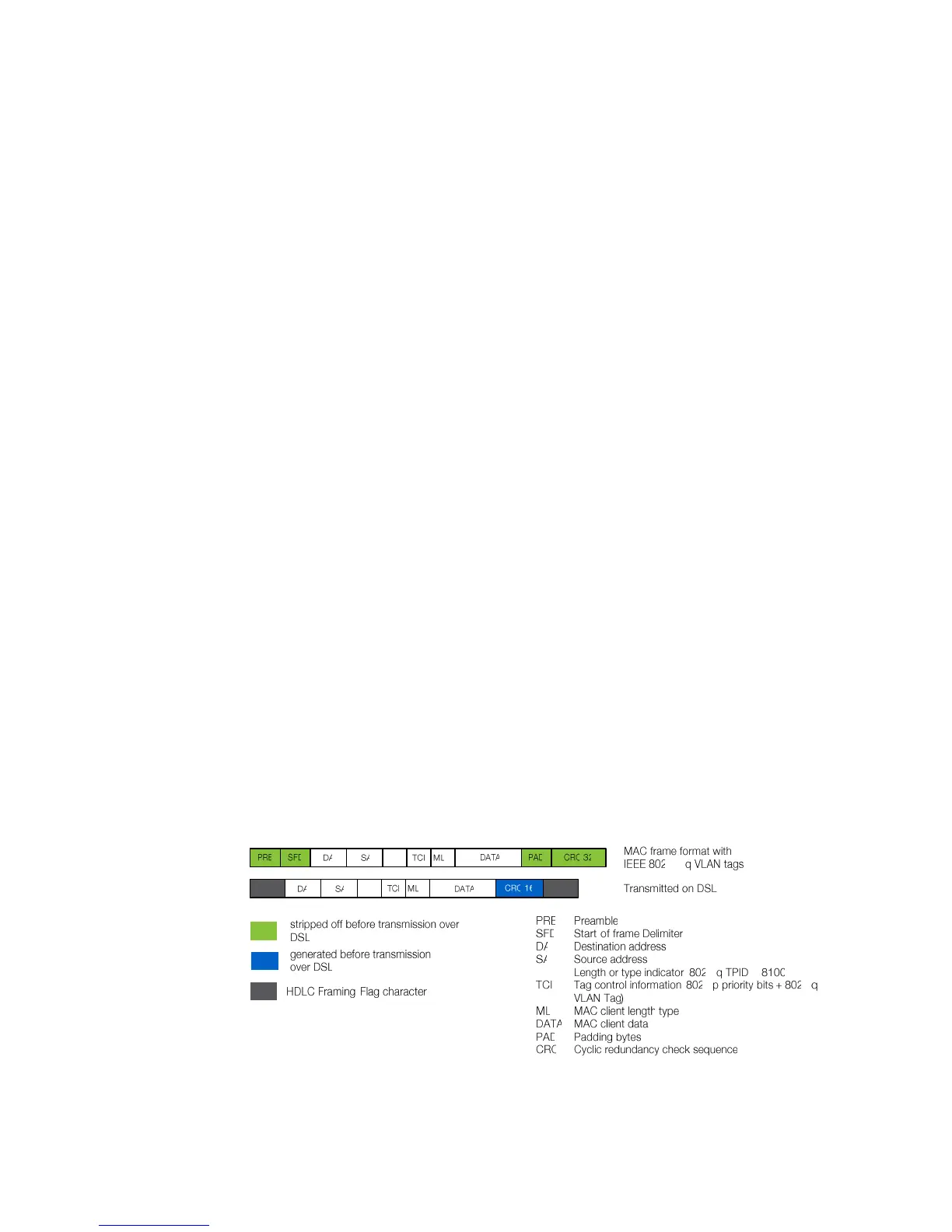
The Ethernet MAC-frames are reformatted before being transmitted over the
DSL span:
Preamble (PRE), Start-of-Frame delimiter (SFD) and PAD fields are stripped
off
The Ethernet CRC-32 is replaced by a CRC-16 calculated over all fields of
the MAC frame
PRE, SFD, an eventual PAD and the CRC-32 are reconstructed by the receiving
modem before transmitting the MAC frame over its Ethernet interface.
Figure 3-3: Ethernet over DSL


 To Next Page