Operations Manual Perdix
Manual DocRev B
61
0
34.7
15
24 1
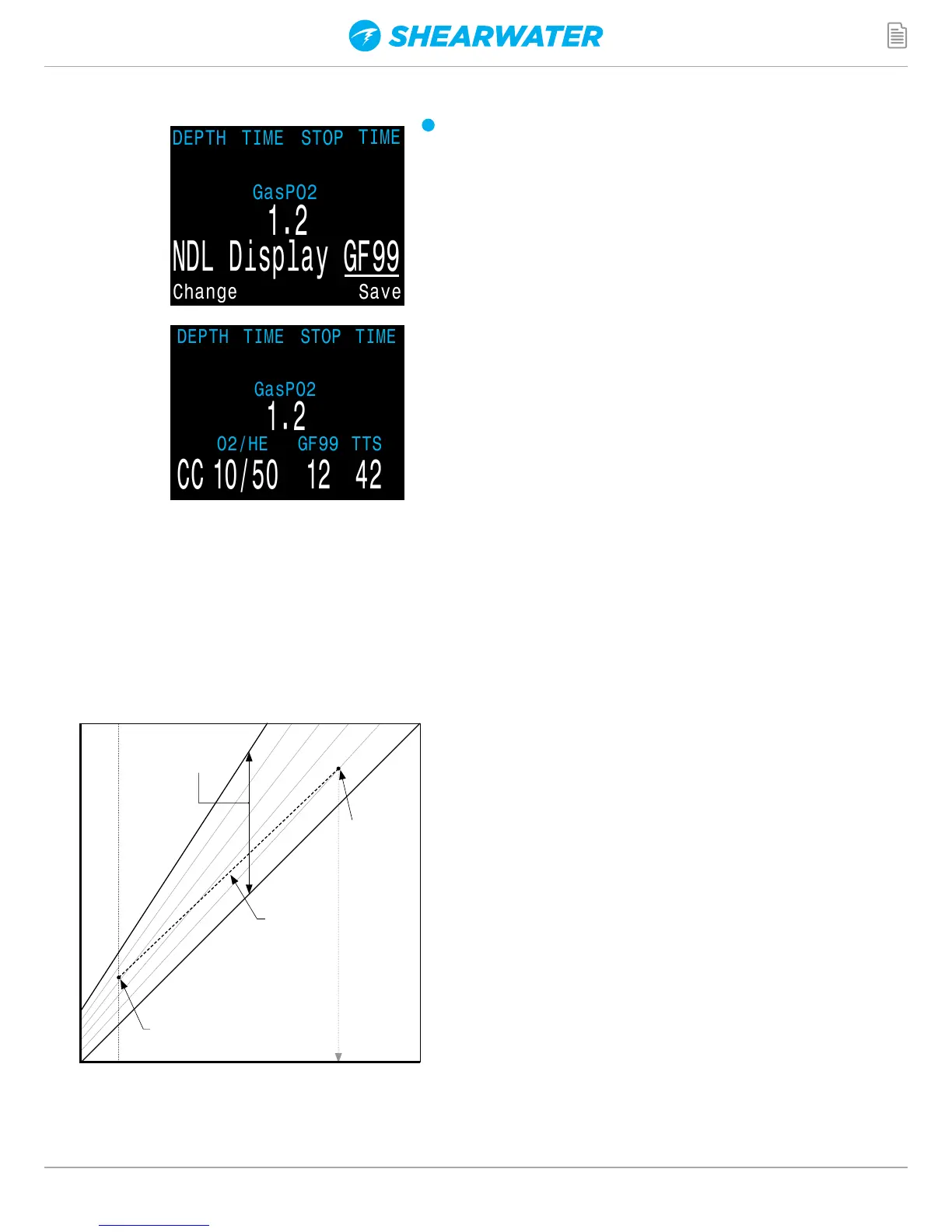
The next option is to display the actual
supersaturation gradient for a pure Bühlmann
(99/99) profile.
The selection is GF99. With this setting, as long
as the NDL time is 0 (you have a decompression
ceiling), the gradient will be displayed instead of
the NDL.
The number shown is the percentage of
supersaturation. The number is calculated by
reference to the Ambient Pressure Line and the
M-Value line. It can be thought of as the current
GF, but it is different in a couple of ways. First, the
current GF generates stops rounded to the nearest
10 feet or 3 meters. So a gradient of 40 may reflect
a ceiling of 15 feet, but the computer will show a
rounded-up 20 foot stop.
3
This number can be used in several ways. First,
it can be used to calculate an aggressive ascent
that still has some justification in decompression
science. For example, if a diver were to lose a
significant portion of their gas and needed to get
shallow fast, they could ascend until they reached
a gradient of 90, then stop until it dropped to 80,
then ascend to 90 again, etc. That would produce a
Bühlmann-like profile with very little conservatism.
In an emergency, that may be an acceptable risk.
Another use might be to do a slower ascent on a
dive to sightsee, but to stay in the decompression
zone by keeping the gradient above 0.
Another use would be to observe the rapidly
increasing gradient in the last 10 feet to the surface
and slow that ascent.
All of this is based on gradient theory that may be
completely false. There is significant disagreement
in the decompression research community about
the nature and practice of decompression. Any
techniques described here should be considered
experimental, but the concepts may be useful to
the advanced diver.
Pressure Graph: Gradient Factors
1 .8 .6 .4 .2 0
Ambient Pressue, absolute
Surface Pressure
Linear
function
for gradual
change in
Gradient
Factors
M-value
Gradient
Compartment inert gas pressure, absolute
y
0
0 x
Ambient Pressue Line
M-value Line
GF Lo
generates
first stop
GF Hi (surfacing value)
maintains safety margin
First
Stop


 To Next Page
 Loading...