Instruction Manual
20220653 / Rev. C 17
Then slowly proceed to move the compass in a straight line fore
and aft (without turning it!) approximately 30 cm out of the
mounting location. Repeat the movement, but this time athwart
ship.
If at all possible, also move the compass in the vertical plane (up
and down).
As a thumb rule, the compass reading should not vary more than
5 degrees from the initial reading during this test. You can then
be reasonably sure that the compass location is OK.
If more than 5 degrees deflection is observed, it might still be
OK, but if exceeding 10 degrees, chances are that the calibration/
compensation will not be optimal.
If a large deflection is observed, try to find what is causing it or
find a new compass location.
Even though the RFC35 Fluxgate compasses can compensate for
up to 30 degrees of deviation, these general rules should be
followed to ensure the best performance from the compass.
FWD
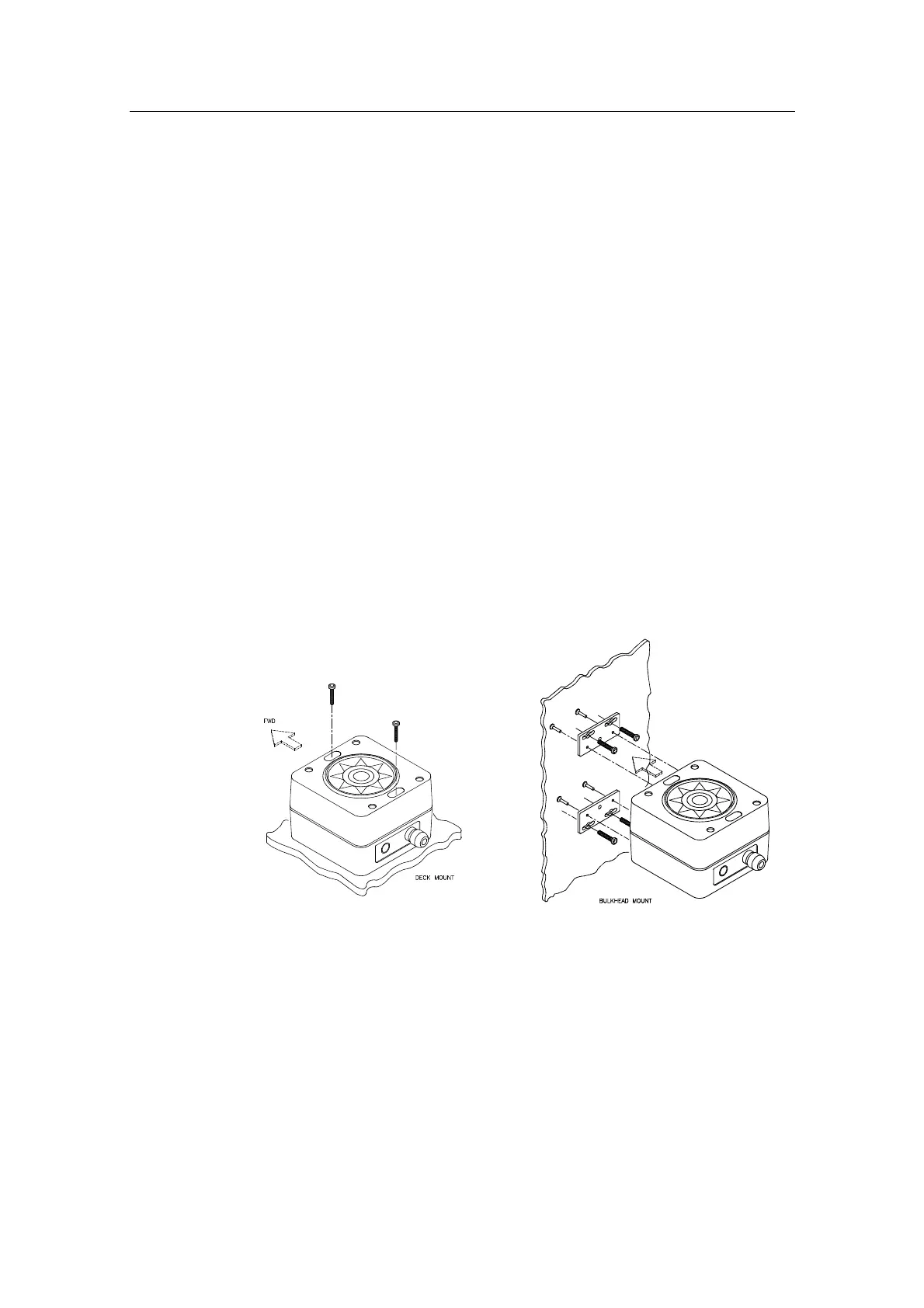
Figure 4-1 RFC35 mounting
4.3 Northerly / Southerly turning error
Autopilot installers operating in higher northerly or southerly
latitudes have most probably experienced steering problems
when sailing in northerly or southerly direction.
To illustrate this common problem we quote the following from
a NMEA publication dated February 1978, written by Mr. M.W.
Freeman:


 To Next Page