Page 36 of 77
SKIPPER Electronics AS
Edition: 2017-06-12
GDS102 Operation and Installation Manual
First Page Last PagePrev Page Next Page
Chapter: 3. Installation
3. Installation
Standard System Supply
A basic GDS102 system consists of the following units. (See “Fig. 3.1. Basic System Conguration.” on
page 37):
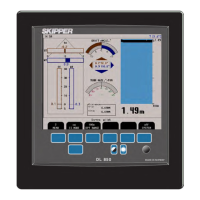
1. Operator unit with installation material.
2. Transducer junction box(es). See “Transducer Junction Box” on page 38.
3. Approved transducer steel tank(s) and sea valves.
4. Transducer(s) with attached cable(s) and installation material.
Transducer Installation
Single transducer location
A transducer should be installed in an area securing
optimal measurement free from noise and aeration.
Transducers are normally installed in the noise free
area in the foreship (see A on g.)
Optimal system operation is achieved by tting
the transducer as deep as possible on the hull. The
transmitting surface of the transducer must be
installed horizontally.
Do not mount transducers close to the propeller or
aft of other hull installations (outlets, vents or other
protruding details). It is necessary to select a part of the hull that is submerged under all load and speed
conditions, and to avoid positions where air is trapped in heavy weather.
If a at, horizontal section is not available for transducer tting, the shipyard must construct a suitable bed.
Dual tranducer location (fore/aft)
Larger vessels are often tted with two transducers, one
fore and one aft (see g.)
The fore transducer is the primary transducer, (normally
50 kHz).
The aft transducer is a secondary transducer, (normally
200 kHz).
The aft transducer will be troubled with aeration and
noise and will not operate in speed >4-5 knots. It is
used to measure aft depth in shallow water.
A
Bubbles
Single transducer
installation
A
Bubbles
Side view
Bottom view
A
Bubbles
Dual transducer
installation
A
Bubbles
Side view
Bottom view
Fore/primary transducer
(normally 50 kHz)
Aft/secondary transducer
(normally 200 kHz)
Often troubled with aeration
in speeds > 4-5 knots



 To Next Page