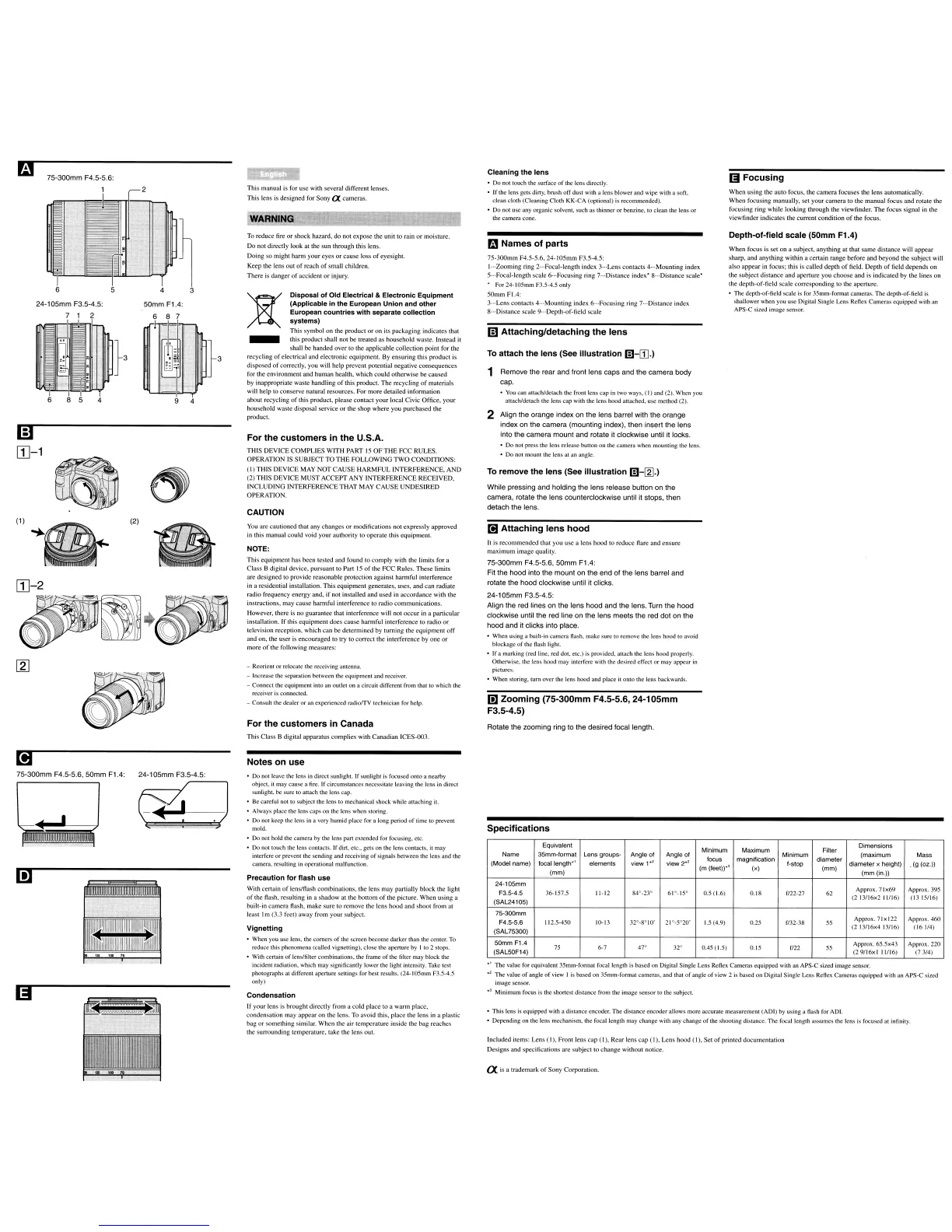
When
using the
auto
focus, the
camera
focuses the lens automatically.
When
focusing manually, set
your
camera
to the
manual
focus
and
rotate the
focusing ring
while
looking
through the viewfinder.
The
focus signal in the
viewfinder indicates
the
current
condition
of
the focus.
Depth-of-field scale (50mm F1.4)
When
focus is
set
on
a subject,
anything
at that
same
distance
will
appear
sharp,
and
anything
within a certain
range
before
and
beyond
the
subject
will
also
appear
in focus; this is
called
depth
of
field.
Depth
of
field
depends
on
the
subject
distance
and
aperture
you
choose
and
is indicated
by
the lines
on
the depth-of-field
scale
corresponding
to the aperture.
• The depth-of-field scale
is
for 35mm-format cameras. The depth-of-field
is
shallower when you use Digital Single Lens Reflex Cameras equipped with an
APS-C sized image sensor.
Ii
Focusing
To remove
the
lens (See
illustration
m-[2].)
While pressing and holding the lens release button on the
camera, rotate the lens counterclockwise until it stops, then
detach the lens.
• Do not press the lens release button on the camera when mounting the lens.
• Do not mount the lens at
an
angle.
IE)
Attaching/detaching
the
lens
2 Align the orange index on the lens barrel with the orange
index on the camera (mounting index), then insert the lens
into the camera mount and rotate it clockwise until it locks.
Cleaning
the
lens
•
Do
not touch the surface
of
the lens directly.
•
If
the lens gets dirty, brush off dust with a lens blower and wipe with a soft,
clean cloth (Cleaning Cloth KK-CA (optional)
is
recommended).
• Do not use any organic solvent, such as thinner or benzine, to clean the lens or
the camera cone.
To attach the lens (See
illustration
m-ITJ.)
1 Remove the rear and front lens caps and the camera body
cap.
•
You
can attach/detach the front lens cap
in
two ways,
(I)
and (2). When you
attach/detach the lens cap with the lens hood attached, use method (2).
mNames
of
parts
75-300mm
F4.5-5.6,
24-105mm
F3.54.5:
1..
·Zooming
ring 2..·Focal-Iength index 3.. -Lens contacts 4..
·Mounting
index
5
..
·Focal-Iength
scale
6·..
Focusing
ring 7
..
·Distance
index'
8.. ·Distance scale*
* For
24-1
05mm F3.5-4.5 only
50mm
FIA:
3..·Lens
contacts
4..
·Mounting
index 6..·Focusing ring 7..·Distance index
8.. ·Distance
scale
9..·Depth-of-field scale
To reduce fire
or
shock hazard,
do
not
expose
the unit to rain
or
moisture.
Do
not directly look at the sun through this lens.
Doing
so
might harm
your
eyes
or
cause
loss
of
eyesight.
Keep the lens
out
of
reach
of
small children.
There
is
danger
of
accident
or
injury.
For
the
customers
in
the
U.S.A.
THIS
DEV[CE
COMPLIES
W[TH
PART
15
OF
THE
FCC
RULES.
OPERAT[ON
[S
SUBJECT
TO
THE
FOLLOWING
TWO
CONDITIONS:
(I)
TH[S
DEV[CE
MAY
NOT
CAUSE
HARMFUL
[NTERFERENCE,
AND
(2)
TH[S
DEV[CE
MUST
ACCEPT
ANY
[NTERFERENCE
RECEIVED,
[NCLUDING
[NTERFERENCE
THAT
MAY
CAUSE
UNDES[RED
OPERAT[ON.
CAUTION
WARNING
This
manual is for use with several different lenses.
This lens is designed for
Sonya.
cameras.
)t
Disposal
of
Old Electrical & Electronic Equipment
(Applicable
in
the European Union and other
European
countries
with
separate collection
systems)
This
symbol
on the product
or
on
its
packaging
indicates that
this
product
shall not
be
treated as household waste.
Instead
it
shall
be
handed
over
to the applicable collection point for the
recycling
of
electrical
and
electronic
equipment.
By
ensuring
this
product
is
disposed
of
correctly, you will
help
prevent potential negative
consequences
for the environment
and
human
health,
which
could
otherwise
be
caused
by inappropriate waste handling
of
this product.
The
recycling
of
materials
will help to
conserve
natural resources.
For
more
detailed information
about recycling
of
this product, please
contact
your
local Civic Office,
your
household waste disposal
service
or
the shop
where
you
purchased
the
product.
3
I
4
50mm F1.4:
8 7
}3
~1
}3
9
5
75-300mm F4.5-5.6:
1
=r--~1
6
24-105mm F3.5-4.5:
712
III
[1]-1
[1]-2
• When using a built-in camera flash, make sure to remove the lens hood to avoid
blockage
of
the flash light.
• If a marking (red line, red dot, etc.)
is
provided, attach the lens hood properly.
Otherwise, the lens hood may interfere with the desired effect or may appear
in
pictures.
• When slOring, tum over the lens hood and place
it
onlO
the lens backwards.
Rotate the zooming ring to the desired focal length.
75-300mm F4.5-5.6, 50mm F1.4:
Fit the hood into the mount on the end of the lens barrel and
rotate the hood clockwise until it clicks.
24-105mm F3.5-4.5:
Align the red lines on the lens hood and the lens. Turn the hood
clockwise until the red line on the lens meets the red dot on the
hood and it clicks into place.
It is
recommended
that you use a lens
hood
to reduce flare
and
ensure
maximum
image
quality.
m
Zooming
(7S-300mm F4.S-S.6, 24-10Smm
F3.S-4.S)
[!J
Attaching
lens
hood
- Reorient
or
relocate the receiving antenna.
- Increase the separation between the equipment and receiver.
- Connect the equipment into
an
outlet on a circuit different from that to which the
receiver is connected.
- Consult the dealer
or
an
experienced radioffV technician for help.
This
equipment has
been
tested
and
found to
comply
with the limits for a
Class B digital device, pursuant to Part
15
of
the
FCC
Rules.
These
limits
are designed to provide reasonable protection
against
harmful interference
in a residential installation.
This
equipment
generates, uses,
and
can
radiate
radio frequency energy and,
if
not installed
and
used in
accordance
with the
instructions, may
cause
harmful interference to radio
communications.
However, there is no guarantee that interference will not
occur
in a
particular
installation.
If
this
equipment
does
cause
harmful interference to radio
or
television reception, which
can
be
determined
by turning the
equipment
off
and
on,
the user is
encouraged
to
try
to correct the interference by one
or
more
of
the following measures:
For
the
customers
in
Canada
You are
cautioned
that any
changes
or
modifications
not
expressly
approved
in this manual could void your authority to
operate
this
equipment.
NOTE:
(2)
(1
)
This
Class B digital apparatus
complies
with
Canadian
ICES-003.
Notes
on
use
75-300mm F4.5-5.6, 50mm F1.4:
Equivalent
Dimensions
Name
35mm-format
Lens
groups-
Angle of Angle of
Minimum Maximum
Minimum
Filter
(maximum
Mass
(Model
name)
focallength*'
view 1*2
view 2*2
focus
magnification
f-stop
diameter
diameter
x height) . (g (oz.))
elements
(m (feet))*3
(x) (mm)
(mm)
(mm(in.))
24-105mm
F3.5-4.5
36-157.5 11-12 84°-23°
61°_15°
0.5 (1.6)
0.18 f/22-27 62
Approx.7lx69
Approx.395
(SAL241
05)
(2
13/16x2 11/16)
(13 15/16)
75-300mm
F4.5-5.6
112.5-450 10-13
32°-8°10'
21°_5°20'
1.5
(4.9)
0.25 f/32-38 55
Approx.71xl22
Approx.460
(SAL75300)
(2 13/16x4 13/16)
(161/4)
50mm
F1.4
75 6-7 47° 32°
0.45 (1.5)
0.15 f/22 55
Approx. 65.5x43 Approx.220
(SAL50F14)
(2 9/16x I 11/16)
(73/4)
.,
The value for equivalent 35mm-forrnat focallenglh
is
based on Digital Single Lens Reflex Cameras equipped with
an
APS-C sized image sensor.
*2
The value
of
angle
of
view I
is
based on 35mm-format cameras, and that
of
angle
of
view 2
is
based on Digital Single Lens Reflex Cameras equipped with an APS-C sized
image
senSOT.
*3
Minimum focus
is
the shortest distance from the image sensor 10 the subject.
()(
is a
trademark
of
Sony
Corporation.
Included items: Lens
(I),
Front
lens
cap
(I),
Rear
lens
cap
(I),
Lens
hood
(I),
Set
of
printed
documentation
Designs
and specifications are
subject
to
change
without
notice.
• This lens
is
equipped with a distance encoder. The distance encoder allows more accurate measurement (ADI)
by
using a flash for AD!.
• Depending on the lens mechanism, the focal length may change with any change
of
the shooting distance. The focal length assumes the lens
is
focused at infinity.
Specifications
Condensation
[f
your
lens is brought directly from a
cold
place to a warm place,
condensation may
appear
on the lens. To avoid this, place the lens in a plastic
bag
or
something
similar.
When
the air temperature inside the
bag
reaches
the surrounding temperature, take the lens out.
•
Do
not
leave the lens
in
direct sunlight.
If
sunlight
is
focused onto a nearby
Object,
it
may cause a fire.
If
circumstances necessitate leaving the lens in direct
sunlight,
be
sure to attach the lens cap.
• Be careful not
to
subject the lens to mechanical shock while attaching
it.
• Always place the lens caps on the lens when storing.
• Do not keep the lens
in
a very humid place for a long period
of
time to prevent
mold.
•
Do
not hold the camera
by
the lens part extended for focusing, etc.
•
Do
not touch the lens contacts.
If
dirt, etc., gets on the lens contacts,
it
may
interfere or prevent the sending and receiving
of
signals between the lens and the
camera, resulting
in
operational malfunction.
Precaution
for
flash
use
With certain
of
lenslflash combinations, the lens may partially
block
the light
of
the flash, resulting in a
shadow
at the bottom
of
the
picture.
When
using a
built-in
camera
flash, make
sure
to remove the lens
hood
and
shoot from at
least
1m
(3.3 feet) away from
your
subject.
Vignetting
• When you use lens, the comers
of
the screen become darker than the center. To
reduce this phenomena (called vignetting), close the aperture
by
I to 2 stops.
• With certain
of
lens/filter combinations, the frame
of
the filter may block the
incident radiation, which may significantly lower the light intensity. Take lest
photographs
at
different aperture sellings for best results. (24-1 05mm F3.5-4.5
only)
24-105mm F3.5-4.5:
Ii]






 To Next Page