58
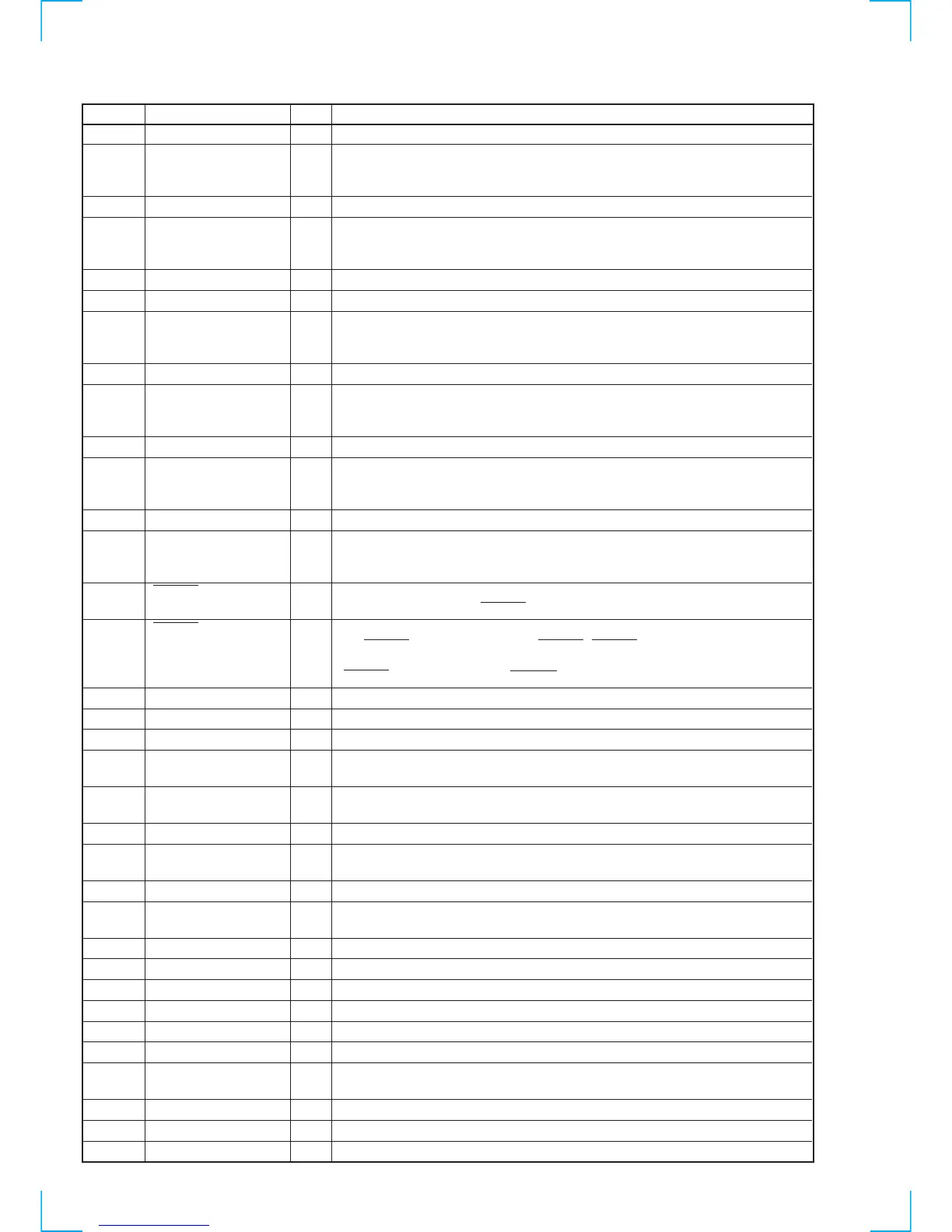
141 PIO [10:0] I/O Programmable I/O pins.
142, 143 VDATA [7:0] O Video data bus. Byte serial CdYCrY data synchronous with VCLK. At power-up, the
decoder does not drive VDATA. During boot-up, the decoder uses configuration
parameters to drive or 3-state VDATA.
144 VDD — 3.3-V supply voltage for core logic and I/O signals.
145 VDATA [7:0] O Video data bus. Byte serial CdYCrY data synchronous with VCLK. At power-up, the
decoder does not drive VDATA. During boot-up, the decoder uses configuration
parameters to drive or 3-state VDATA.
146 VSS — Ground for core logic and I/O signals.
147 PIO [10:0] I/O Programmable I/O pins.
148 VDATA [7:0] O Video data bus. Byte serial CdYCrY data synchronous with VCLK. At power-up, the
decoder does not drive VDATA. During boot-up, the decoder uses configuration
parameters to drive or 3-state VDATA.
149 VDD — 3.3-V supply voltage for core logic and I/O signals.
150 VDATA [7:0] O Video data bus. Byte serial CdYCrY data synchronous with VCLK. At power-up, the
decoder does not drive VDATA. During boot-up, the decoder uses configuration
parameters to drive or 3-state VDATA.
151 VSS — Ground for core logic and I/O signals.
152 VDATA [7:0] O Video data bus. Byte serial CdYCrY data synchronous with VCLK. At power-up, the
decoder does not drive VDATA. During boot-up, the decoder uses configuration
parameters to drive or 3-state VDATA.
153 PIO [10:0] I/O Programmable I/O pins.
154, 155 VDATA [7:0] O Video data bus. Byte serial CdYCrY data synchronous with VCLK. At power-up, the
decoder does not drive VDATA. During boot-up, the decoder uses configuration
parameters to drive or 3-state VDATA.
157 HSYNC I/O Horizontal sync. The decoder begins outputting pixel data for a new horizontal line after
the falling (active) edge of HSYNC.
158 VSYNC I/O Vertical sync. Bi-directional, the decoder outputs the top border of a new field on the
first HSYNC after the falling edge of VSYNC. VSYNC can accept vertical
synchronization or top/bottom field notification from an external source.
(VSYNC HIGH=Bottom field. VSYNC LOW=Top field)
160 VDD — 3.3-V supply voltage for core logic and I/O signals.
161 DA-DATA O Serial audio samples relative to DA-BCK clock.
162 VSS — Ground for core logic and I/O signals.
166 DA-LRCK O PCM left-right clock. Identifies the channel for each audio sample. The polarity is
programmable.
167 DA-BCK O PCM bit clock. Divided by 8 from DA-XCX, DA-BCK can be either 48 or 32 times the
sampling clock.
168 VDD — 3.3-V supply voltage for core logic and I/O signals.
169 DA-XCX I/O Audio external frequency clock. Used to generate DA-BCK and DA-LRCK. DA-XCK
can be either 384 or 256 times the sampling frequency.
170 VSS — Ground for core logic and I/O signals.
171 DAI-DATA I PCM input data, two channels. Serial audio samples relative to DA-BCK clock,
resulting in downmixed audio output.
172 DAI-LRCK I PCM input left-right clock.
173 DAI-BCK I PCM input bit clock.
174 PIO [10:0] I/O Programmable I/O pins.
175 VDD — 3.3-V supply voltage for core logic and I/O signals.
176 A-VDD — 3.3-V analog supply voltage.
177 VCLK I Video clock. Clocks out data on input. VDATA [7:0]. Clock is typically 27 MHz.
178 SYSCLK I System clock. Decoder requires an external 27 MHz TTL oscillator. Drive with the
same 27-MHz as VCK.
179 A-VSS — Analog ground for PLL.
180 CD-DATA I Serial CD data.
181 VDD — 3.3-V supply voltage for core logic and I/O signals.
Pin No.
Pin Name
I/O Function


 To Next Page
 Loading...