Clock management AN3029
12/42 DocID16139 Rev 5
Recommendations
In the PCB layout all connections should be as short as possible. Any additional signals,
especially those that could interfere with the oscillator, should be locally separated from the
PCB area around the oscillation circuit using suitable shielding.
4.3.2 LSE clock
The low-speed external clock signal (LSE) can be generated from two possible clock
sources:
• LSE external crystal/ceramic resonator (see Figure 6)
• LSE user external clock (see Figure 6)
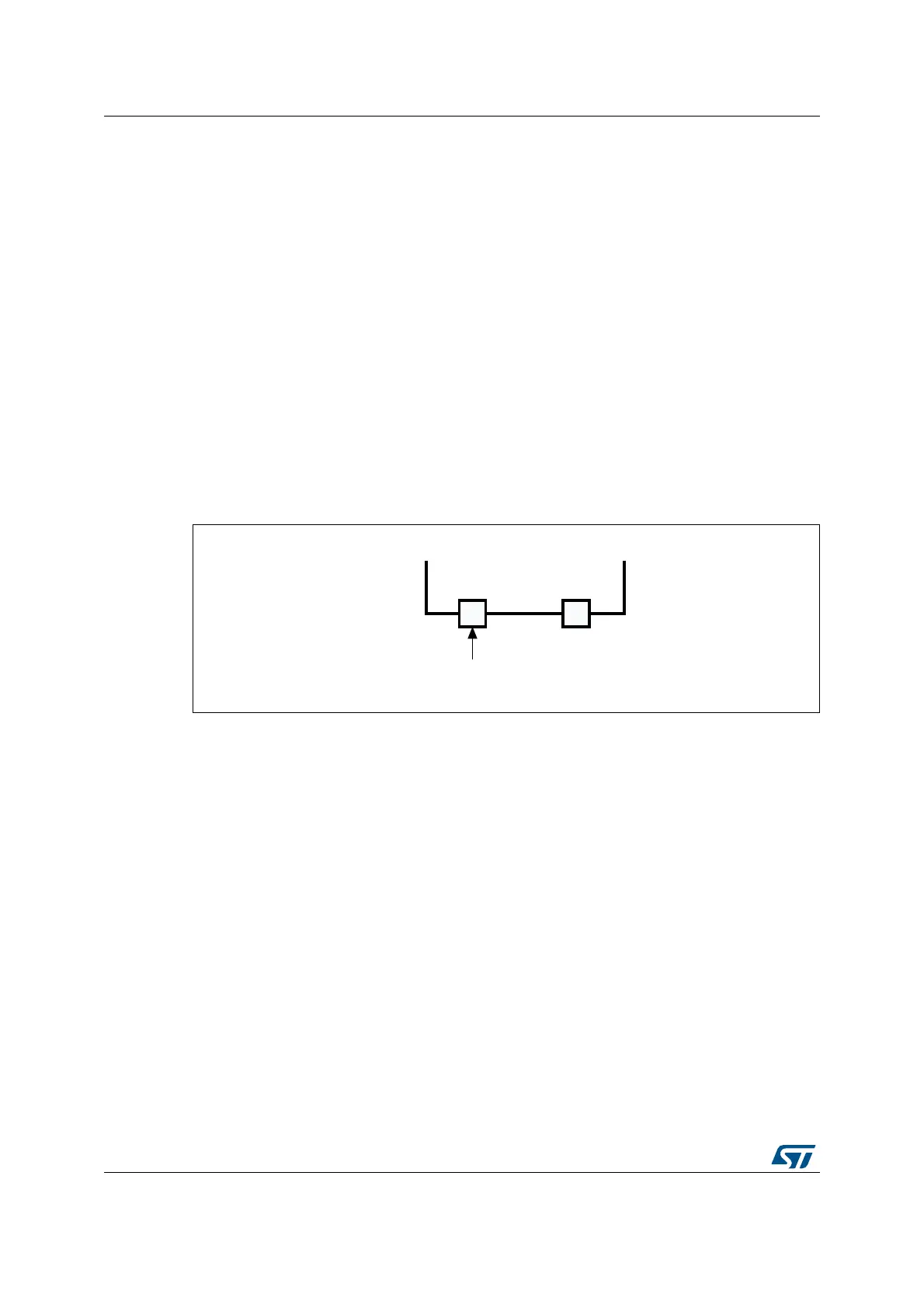
External source (LSE bypass)
In this mode, an external clock source must be provided. It must have a frequency of
32.768
kHz. The external clock signal (square, sine or triangle) with a duty cycle of about
50% has to drive the OSC32_IN pin while the OSC32_OUT pin must be left high impedance
(see
Figure 5 and Figure 6).
Figure 5. External clock
1. OSC32_IN and OSC32_OUT pins can be used also as GPIO but, it is recommended not to use them as
both RTC and GPIO pins in the same application.
External crystal/ceramic resonator (LSE crystal)
The LSE crystal is a 32.768 kHz low-speed external crystal or ceramic resonator. It has the
advantage of providing a low-power, but highly accurate clock source to the real-time clock
peripheral (RTC) for clock/calendar or other timing functions.
The resonator and the load capacitors have to be connected as close as possible to the
oscillator pins in order to minimize output distortion and start-up stabilization time. The load
capacitance values must be adjusted according to the selected oscillator.
OSC32_OUTOSC32_IN
External source
(Hi-Z)
ai15765
Microcontroller


 To Next Page