S - 22 | English English | S - 23
Before Every Ride
Your STEVENS bicycle has undergone numerous tests during production and
a final check has been carried out by your STEVENS dealer. Nevertheless, be sure
to check the following points before you set off for the first time to exclude any
malfunctioning that may be due to the transport of your STEVENS bicycle or to
changes a third person may have performed on your STEVENS bicycle during a
standstill:
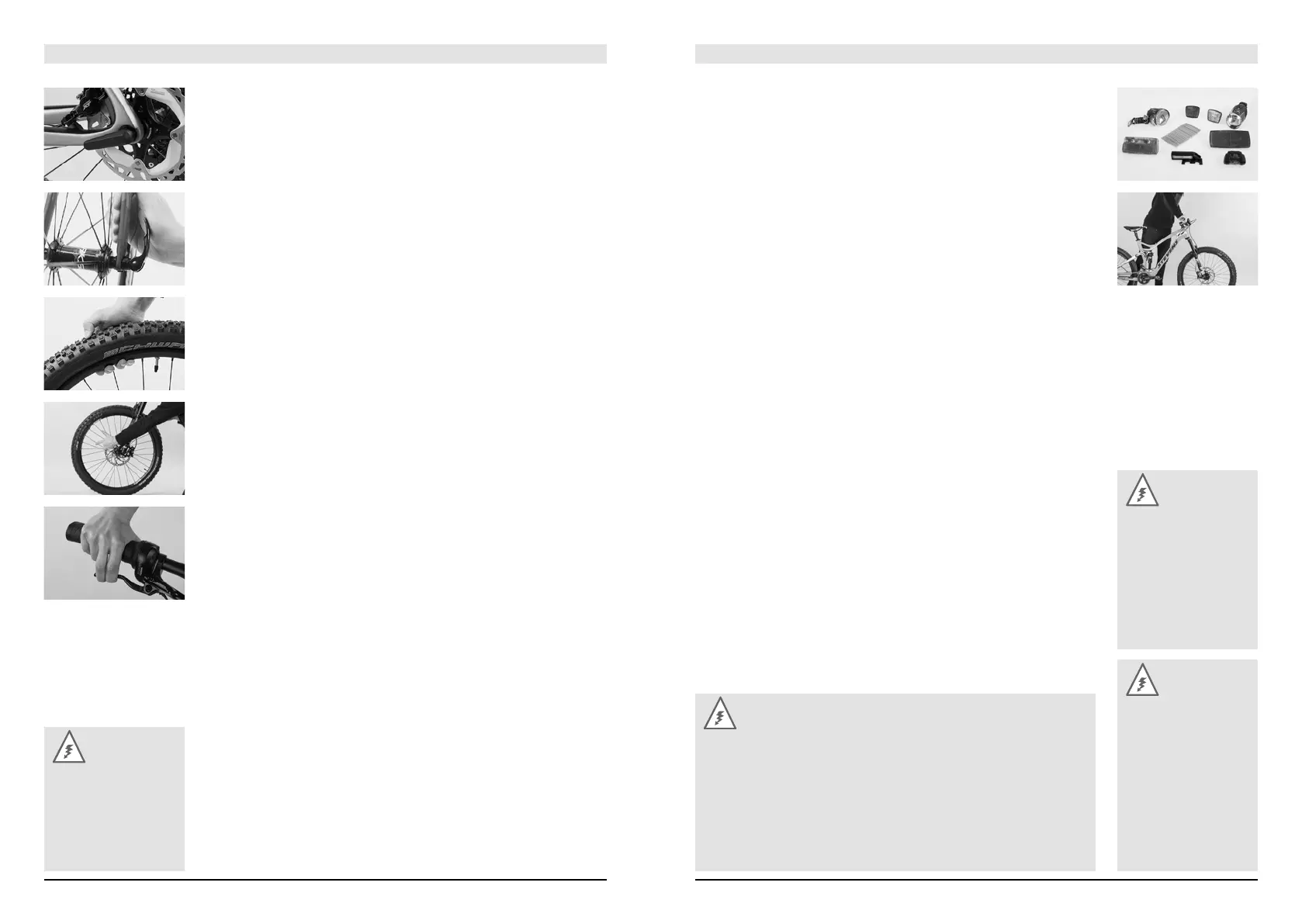
1. Are the quick-release levers or the bolted connections of the front and rear
wheel, the seat post and other components properly closed and tightened?
For more information see the chapter “How to Use Quick-Releases and
Thru Axles” further below as well as the instructions of the component man-
ufacturers.
2. Are the tyres in good condition and do they have sufficient pressure? The
minimum and maximum pressure (in bar or PSI) is indicated on the tyre side.
For more information see the chapter “The Wheels” further below as well as
the instructions of the component manufacturers.
3. Let both wheels rotate freely to check whether the rims run true. Watch the gap
between rim and brake pad or, in the case of disc brakes, between frame and
rim or tyre. Poor concentricity can also be an indication of laterally burst tyres,
broken axles or torn spokes.
For more information see the chapter “The Wheels” further below as well as
the instructions of the component manufacturers.
4. Test the brakes while stationary by firmly pulling the brake levers towards the
handlebar. The brake pads of rim brakes must hit the rim evenly with their
entire surface without touching the tyre during braking, in open condition or
in between. Make sure that you cannot pull the brake levers all the way to the
handlebar and check the hydraulic brake hoses for leaks! Check the thickness
of the brake pads as well.
With disc brakes you should directly get a positive braking response. If you
have to actuate the brake lever more than once to get a positive braking
response, have your STEVENS bicycle checked by your STEVENS dealer.
For more information see the chapter “The Brake System” further below as
well as the instructions of the component manufacturers.
5. Let your STEVENS bicycle bounce on the ground from a small height. If there
is any rattling, see where it comes from. Check the bearings and bolts, if nec-
essary.
6. If you want to ride on public roads, make sure your STEVENS bicycle is
equipped according to the regulations of the respective country. In any case,
riding without lights and reflectors in dark or dim conditions is very dangerous.
A lighting set that corresponds to the regulations is a must on public roads.
Turn on the lights as soon as dusk sets in.
For more information see the chapter “Legal Requirements for Riding on
Public Roads”.
7. In case you have a STEVENS bicycle with suspension, press down on STEVENS
bicycle and see whether the spring elements retract and extend as usual.
For more information see the chapters “Suspension Forks” and “Full Sus-
pension of the Mountain Bike Models” further below as well as the instruc-
tions of the component manufacturers.
8. Make sure that the kickstand, is fully raised before you set off. Risk of accident!
9. Do not forget to take a high quality folding, D- or chain lock with you on your
ride. The only way to effectively protect your STEVENS bicycle against theft is
to lock it to an immovable object.
Danger:
Be aware that the
distance you need to
stop increases, when
you are riding with your
hands on bar ends. The
brake levers are not in
all grip positions within
easy reach.
Danger:
Do not use your
STEVENS bicycle, if
it fails on one these
points! Riding a defec-
tive STEVENS bicycle
can result in serious
accidents! If you are in
doubt or if you have any
questions, contact your
STEVENS dealer.
Danger:
During use your STEVENS bicycle is undergoing stress resulting from the
surface of the road and from the rider’s action. Due to these dynamic
loads, the different parts of your bicycle react with wear and fatigue. Check
your STEVENS bicycle regularly for wear marks, scratches, deformations,
colour changes and any indication of cracking. Components which have
reached the end of their service life may break without previous warning.
Let your STEVENS dealer maintain and service your STEVENS bicycle regu-
larly and in cases of doubt it is always best to replace components.
Danger:
Improperly closed
fastenings can cause
components of your
STEVENS bicycle to
come loose and result in
serious accidents!



 To Next Page