S - 32 | English English | S - 33
Danger:
Make sure that you
cannot pull the brake
levers all the way to
the handlebar. Your
maximum brake force
should be reached short
of this point.
Note:
If you have hydraulic
brakes and disc brakes,
follow the instructions of
the brake manufacturer.
If you are in doubt or if
you have any questions,
contact your STEVENS
dealer.
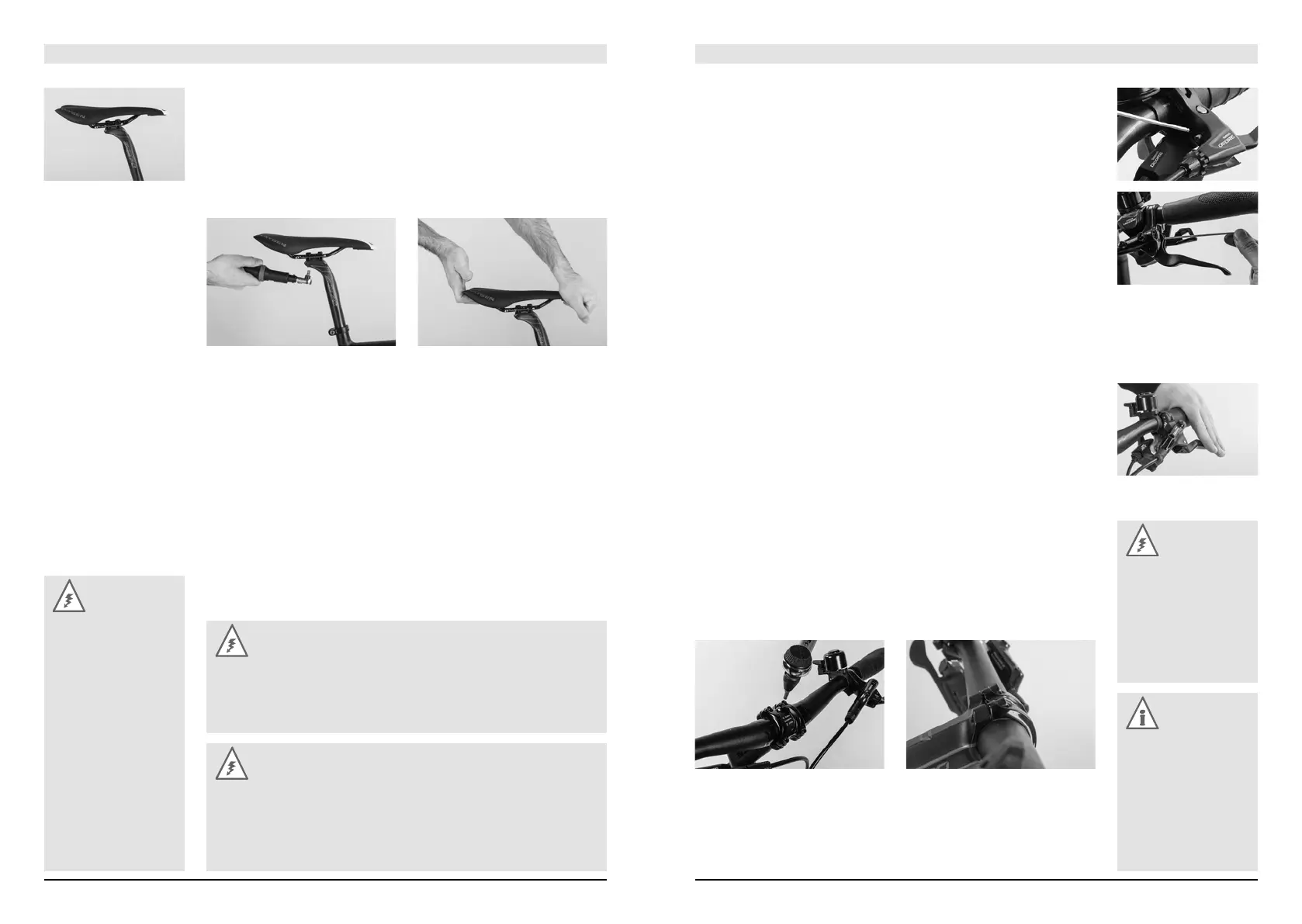
Having found your preferred position, make sure that both clamp halves fit
snugly around the saddle rails before tightening the bolt(s) to the correct torque
value as prescribed by the seat post manufacturer.
Retighten the bolt(s) with a torque wrench according to the instructions of the
manufacturer. After fastening the saddle, check whether it resists tilting by bringing
your weight to bear on it once with your hands at either end of the saddle.
Danger:
The bolted connections of the seat post have to be tightened to the
prescribed torque value. Use a torque wrench and do not exceed the max-
imum torque values! You find them on the components themselves and/or
in the chapter “Recommended Torque Settings”.
Danger:
Make sure that the saddle is clamped within the range of the marking on
the saddle rail. Otherwise the saddle rail can fail! Check the bolts by using
a torque wrench once a month according to the values indicated on the
components themselves and/or in the chapter “Recommended Torque
Settings”.
Danger:
The saddle clamping
bolts belong to the most
delicate bolts of the
entire STEVENS bicycle.
Therefore, strictly ob-
serve the recommended
minimum and maximum
torque values. Do not
under- or overtighten.
You find them on the
components themselves
and/or in the chapter
“Recommended Torque
Settings”. Always use a
torque wrench.
Adjusting the Brake Lever Reach
With most brake systems the distance between the brake levers and the han-
dlebar grips is adjustable. This gives in particular riders with small hands the
convenience of bringing the brake levers closer to the handlebars.
On most bicycles there is a small adjusting screw near the point where the
brake cable of a cable brake enters the brake lever unit or at the lever itself. Turn
the bolt clockwise and watch how the lever adjusts as you do so.
With hydraulic brakes you also have adjusting devices at the brake lever. There
are different systems, ask your STEVENS dealer for help or read the instructions
of the component manufacturers. When adjusting the lever reach, make sure the
first phalanx of the index finger reaches around the brake lever. Check the proper
adjustment and functioning of the brake system subsequently, as described in the
chapter “The Brake System” further below as well as in the instructions of the
brake manufacturer.
Adjusting the Tilt of Handlebars, Bar Ends and Brake Levers of
STEVENS Mountain Bikes, Kids’ and Junior Bikes
The handlebars are usually slightly bent at the ends. Set the handlebars to a
position in which your wrists are relaxed and not turned too much outwards.
To adjust the angle of the handlebars, release the Allen bolt(s) on the underside
or front side of the stem. Turn the handlebar to the desired position. Make sure
that the handlebar is accurately centred in the stem. Carefully retighten the bolt(s)
with the torque wrench.
Make sure that the upper and lower clamping slots of the stem are parallel
and identical in width. If you have a stem with several bolts, tighten them evenly in
a cross pattern by using a torque wrench and observe the recommended torque
values.



 To Next Page