S - 80 | English English | S - 81
Functioning
When a shock acts on the front wheel, the lower part of the fork (also referred
to as lower legs) is pressed upwards. The lower legs slide on thinner stanchion
tubes which are firmly connected to the fork crown by bolts, press fit or glueing.
The fork retracts as a spring inside is compressed. The spring allows for the fork
to extend again and assume its original position. An ideal spring would instantly
extend again, the bicycle would not be ridable. The fork is equipped with an oscil-
lation damper which prevents the fork from springing back uncontrolled and pro-
vides a smooth return travel.
The telescopic forks differ in their spring elements and in the type of damping.
For elasticity these forks are provided with steel or titanium springs, special types
of plastic (also referred to as elastomers) or sealed air compartments or combina-
tions of these options. The damping is usually done by oil or by the self-damping
properties of the elastomers. Some models are equipped instead with friction or
air damping elements.
Adjusting Suspension Forks
To work perfectly, the fork has to be adjusted to the weight of the rider and
the intended use.
Adjusting the fork to your needs is easy, if you use a simple trick.
• Start adjusting the fork with the spring preload being completely turned off and
with the lowest damping level.
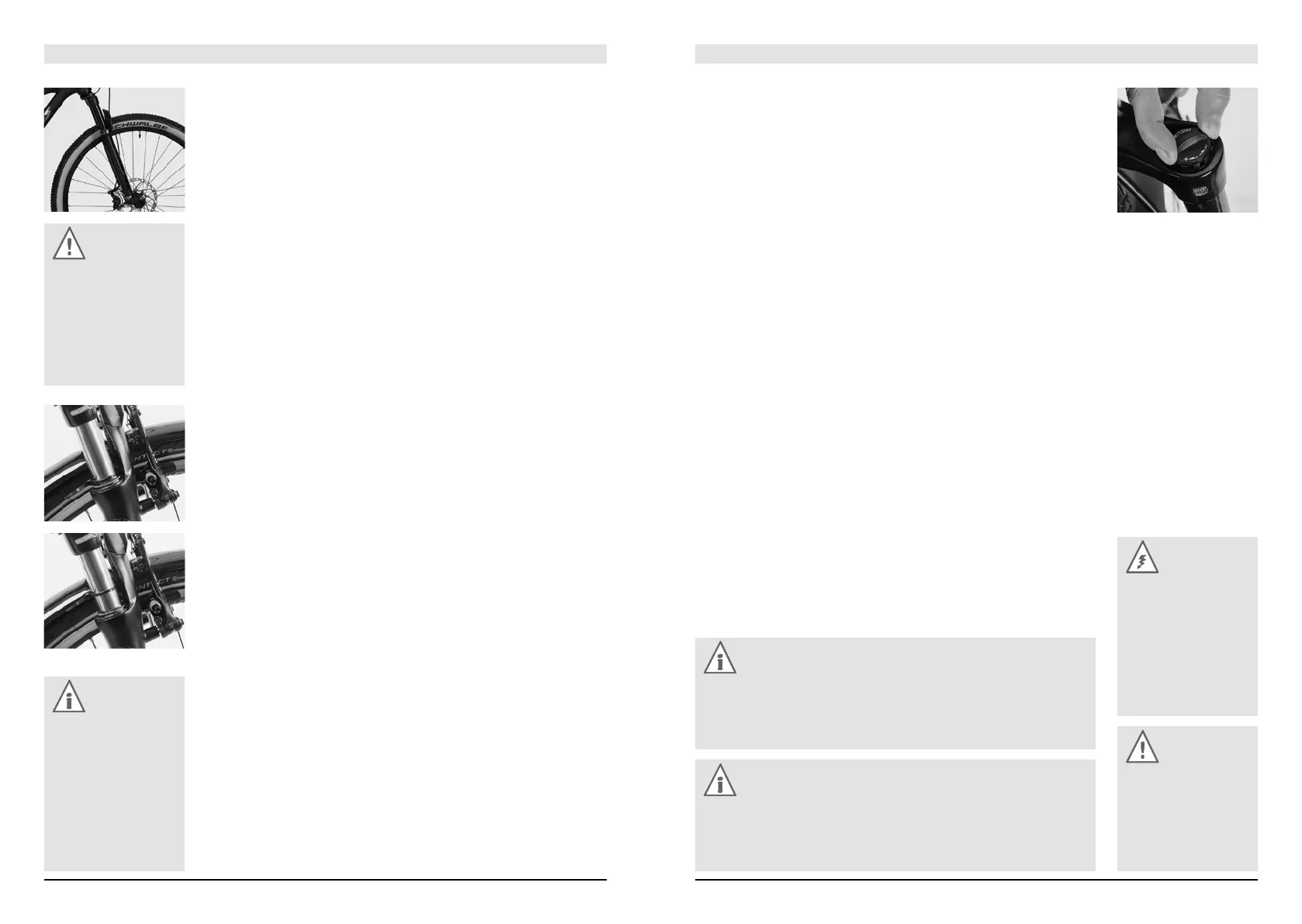
• Slip a cable tie onto the stanchion tube so that it can still shift easily along
the tube.
• When you sit on your bicycle, the fork should compress in general by approx.
10 to 25% of its maximum suspension travel depending on the suspension
travel. If this is not the case, you have to change the spring preload. If you
cannot mount a cable tie above the stanchion tube due to a bellow, ask a
helper to measure in unloaded condition from the top edge of the fork crown
to the ground. Sit on your STEVENS bicycle and measure once again.
• Ride your STEVENS bicycle in terrains with different surfaces and check after-
wards how much of the fork’s travel was used. If the cable tie has moved only
a few millimetres, your fork has a too rigid adjustment; check whether the
preload of the springs has been turned off completely and have the springs
replaced, if necessary.
• If the cable tie has moved along the entire travel range or if you can hear the
fork bottom out, the spring is too flexible. Increase the spring preload first and
increase the pressure subsequently. If the behaviour has not improved, have
the springs replaced by an expert.
Caution:
Many simple forks do
not have a sophisticated
damping system and
are not comparable to
high-quality suspension
forks in terms of the
riding behaviour.
Note:
If you cannot mount a
cable tie over your stan-
chion tube, you need
someone to ride with
you. He can observe
the behaviour of the
fork during the ride and
give useful tips for the
adjustment.
• If the spring adjustment meets your wishes, start optimizing the damping.
Approach in quarter or half turns and observe the speed, with which the fork
rebounds.
If the damping is too low you feel as if the STEVENS bicycle wants to throw
you off, as the return travel springs back uncontrolled. The more you close the
damping, the slower the spring rebounds, the smaller is the oscillation effect. A
too hard damping makes the fork compress with shocks in quick succession, as it
can no longer rebound quickly enough.
The different suspension forks of different manufacturers differ a lot in parts.
Make sure that you have received the fork description together with the STEVENS
bicycle from your STEVENS dealer. If necessary, you can also download the
instructions and further information on the following websites on the internet:
www.foxracingshox.de
www.sportimport.de/en/home/
www.sram.com/en/rockshox
www.srsuntour.com
Note:
Almost all fork manufacturers deliver their forks with well-written instruc-
tions. You find them on our website at www.stevensbikes.de/manual. Read
these carefully before changing any settings or doing any maintenance on
your fork.
Note:
Adjusting a suspension fork accurately takes quite long and is a very del-
icate job. Be sure to read in any case the instructions of the manufacturer
on our website at www.stevensbikes.de/manual. If you are in doubt,
contact your STEVENS dealer.
Danger:
A too strong damping of
the fork can result in a
sluggish rebound move-
ment with a suspension
fork that will not recover
when exposed to a
quick series of impacts.
Risk of accident!
Caution:
Do not ride your bicycle,
if the suspension fork
often bottoms out. This
could damage the fork
itself as well as the
frame.



 To Next Page