S - 66 | English English | S - 67
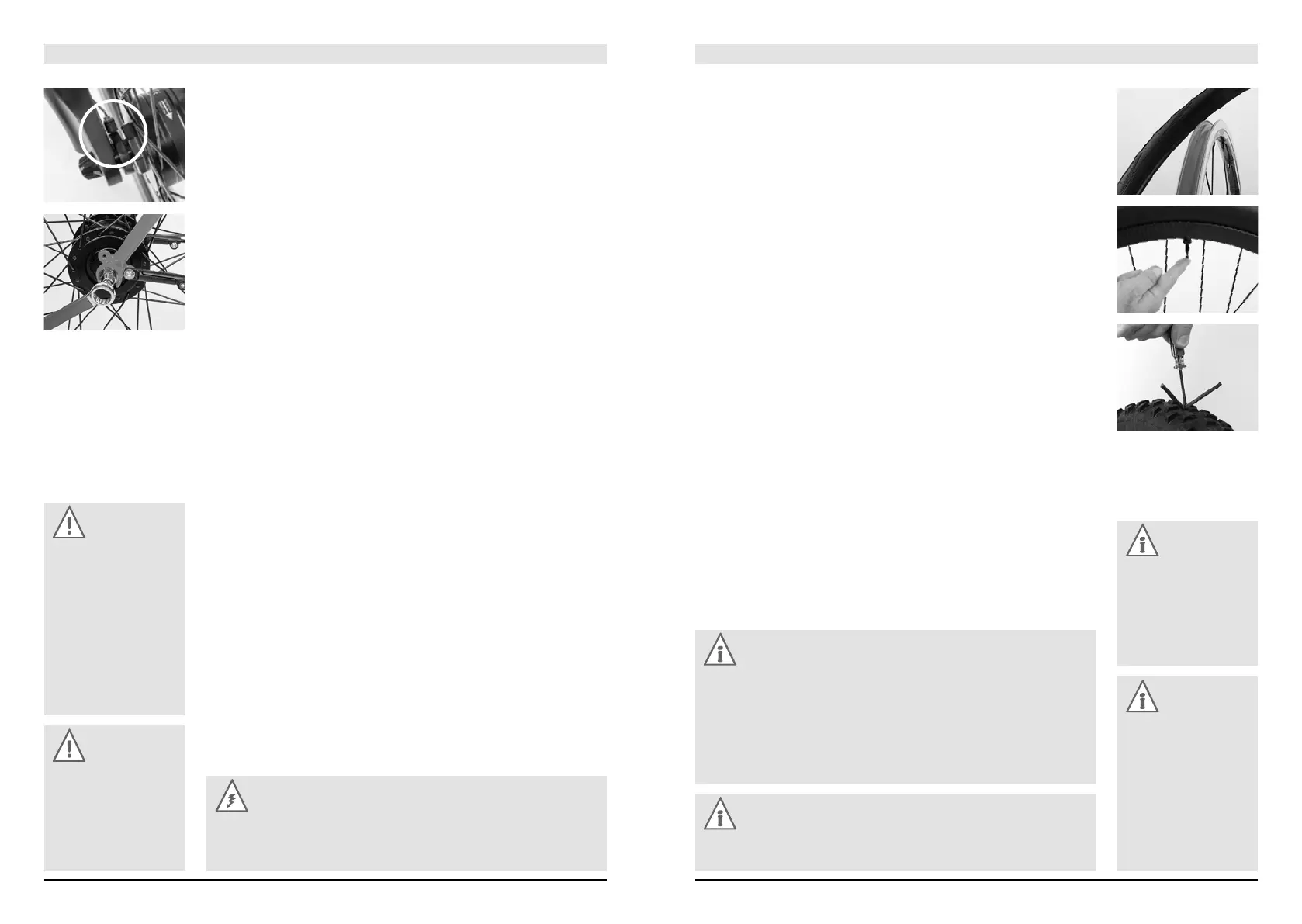
When mounting a front wheel with hub dynamo make sure the hub dynamo’s
connection terminal is on the right side in direction of motion. The connection
terminal has to be aligned with the front wheel fork in a way that it points slightly
backwards and upwards. Do not try to turn the connection terminal after having
fixed the front wheel in the fork.
If your front wheel has no quick-release, you need a 15 mm open-end wrench
or ring spanner or still better a torque wrench to tighten the axle nuts.
Axle nuts have to be tightened alternately on both sides. Otherwise the hub
axle can twist with the lock washers and be subject to stress. The torque value is
20–25Nm.
After you have securely fixed the wheel in the fork, re-connect the plug of the
lighting cable to the connection terminal.
Finish by checking the front and rear lights on the bicycle by turning the front
wheel.
Caution:
When working in the
area of the rear wheel
hub and its gear
mechanism, be aware
of the risk of crushing
the fingers. Therefore,
do not turn the cranks
during the work or do
not push the bicycle
backwards.
Caution:
Do not pull the (disc)
brake lever with a re-
moved wheel and make
sure to mount the safety
locks when removing
the wheel
Danger:
If your bicycle has hydraulic disc brakes, do not place it upside down for
repair purposes, i.e. handlebars and saddle on the ground. This would
render the brake ineffective.
Tubeless Tyres (UST tyres)
Tubeless tyres are also referred to as “tubeless ready”. The rims are provided
with specific valves, have an entirely enclosed rim base and partly also a specific
rim shape. There is no inner tube.
Tyre Removal
Deflate the tubeless/UST tyre completely. Press the tyre from one side towards
the centre of the rim, until the tyre bead is loose in the rim base.
Start removing the tyre close to the valve and lift one tyre side over the edge
of the rim with your fingers. After you have pulled the entire tyre side over the rim
edge press, if necessary, the other tyre side into the rim base and remove this side
also from the rim.
Puncture Assistance – Repair
In case of a puncture, tubeless tyres can also be used with inner tubes.
Remove any available perforating object from the tyre first and remove the valve
from the rim. Slightly inflate the new inner tube and place it in the tyre. Mount it
as described in the chapter “Removing Clincher and Folding Tyres”. You may
need tyre levers for this purpose.
You can repair larger tears or holes up to a maximum of 10mm in length
by using special tyre repair stuff such as “tyre repair strips”, “plugs” or “tubes”.
The area is prepared and the strip threaded on the tool. Press both strip and tool
into the defective area so that both ends of the strip are still just protruding on
the outside. Remove the tool. If necessary, fill in some new sealant or let existing
sealant run on the area. Inflate the tyre subsequently; during a ride this is best
done with a repair spray.
Note:
You can also inflate the tyre with the repair spray actually designed
for a repair during the ride. The spray provides an integrated puncture
protection. To do so slide the spray head on the valve. Align the bottle in a
way that the opening of the head is flush with the valve. Keep the top of
the head tight with one finger and press the bottle for about two minutes
against the head. Remove the bottle quickly from the valve. Then set off on
your bike for a few miles to make the latex milk spread inside the tyre.
Note:
Do not use tyre levers in order to avoid damage to the sensitive sealing lip
on the tyre bead!
Note:
It is recommended that
you use the tools of the
respective tyre manu-
facturer for removal as
they are designed to be
used together.
Note:
For tubeless tyres there
are specific patches that
are mounted on the in-
side. If need be, you can
also use a conventional
repair patch. Always
observe the operating
instructions of the repair
kit manufacturer.



 To Next Page