S - 52 | English English | S - 53
Hand pumps are often unsuitable for inflating tyres to the necessary pressure.
A better choice is a stand or foot operated pump equipped with a manometer
which enables you to check the pressure at home.
Your STEVENS dealer has adapters for all valve types. They allow you to inflate
any type of inner tube at the filling station.
Replace tyres with a worn tread or brittle or frayed sides. Dampness and dirt
penetrating the tyre can cause damage to its inner structure. Replace spoilt rim
tapes immediately. In the extreme case, the inner tube may suddenly burst!
Rim Trueness, Spoke Tension
The spokes connect the rim to the hub in the middle of the wheel. An even
spoke tension makes for the true running of the wheel. If the tension of individual
spokes changes, e.g. as a result of riding too fast over a kerb or due to spoke
breakage, the tensile forces acting on the rim become unbalanced and the wheel
will no longer run true.
The functioning of your STEVENS bicycle may even be impaired before you
notice the wobbling appearance of a wheel that has gone out of true.
With rim brakes the sides of the rims also serve as braking surfaces. An untrue
wheel can impair the braking effect.
It is therefore advisable to check the wheels for trueness from time to time. For
this purpose lift the wheel from the ground and spin it with your hand. Watch the
gap between rim and brake pad or, in the case of disc brakes, between frame and
rim or tyre. If the gap varies by more than a millimetre, you should ask a skilled
mechanic to true up the wheel. Poor concentricity can also be an indication of
laterally burst tyres, broken axles or torn spokes.
Ask your STEVENS dealer for advice. Inflation pressure is often given in the
old system of units, i.e. in psi (pounds per square inch). The table shows common
values converted. The tyre and rim alone are not able to hold the air. Therefore, an
inner tube has to be placed inside the tyre to retain the air pressure. The tube is
pumped up via a valve.
Exceptions to this are the tubeless wheel/tyre systems. With these systems rim
and tyres are tight without inner tube (tubeless/UST tyres) or sealed with specific
rim tapes and/or sealed with liquid sealants (Tubeless-Ready/NoTubes system).
Read the respective instructions before doing any work on such tyres or con-
tact your STEVENS dealer.
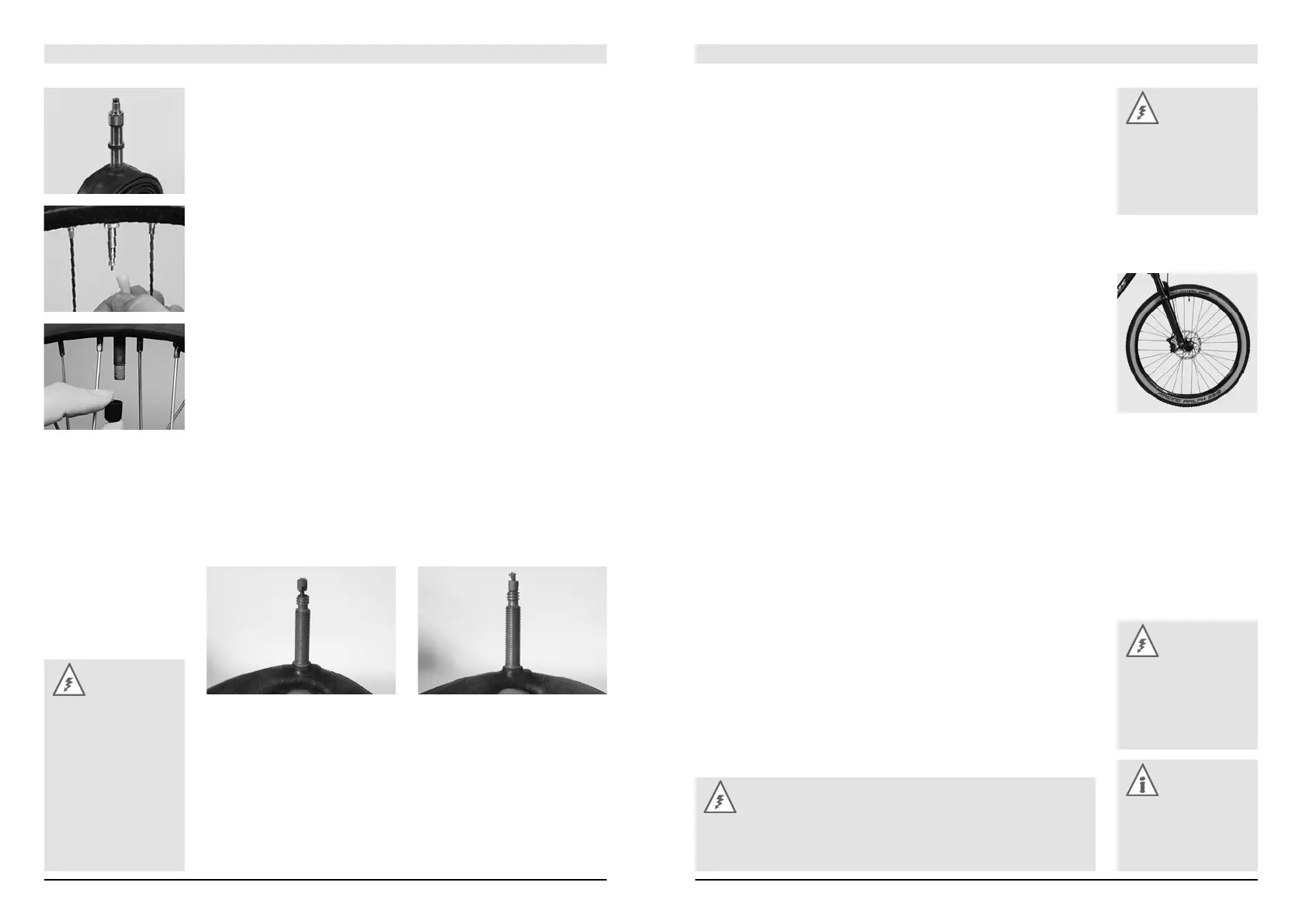
There are three valve types in general use on bicycles:
• Dunlop or Woods valves, the usual valves
• Sclaverand or Presta valves: This type is meanwhile used on almost all types
of bicycles. It is designed to withstand extremely high pressures
• Schrader or car valve: This is an adapted car tyre valve.
These three valve types are fitted with a plastic cap to protect them from dirt.
The car valve can be inflated with a suitable pump directly after removing the
protective cap.
With Presta valves you first have to undo the small knurled nut a little and
press it in carefully until air starts to escape. With this valve type it may happen
that the valve body is not screwed in properly and that air leaks out slowly. Check
the seat of the valve body in its stem.
Tyres with car valves can conveniently be inflated at car filling stations with a
compressed air dispenser. A compressed air dispenser must be used very care-
fully as you may otherwise overinflate the tyre. It might burst! To let out air press
the needle in the centre of the valve by using e.g. a spanner/key.
Danger:
Treat your tyres well, in
particular avoid sharp
edges where possible!
Never inflate your tyres
beyond the maximum
permissible pressure,
otherwise they might
burst or come off the
rim during the ride. Risk
of accident!
Danger:
Always ride your bicycle
with the prescribed tyre
pressure and check
the pressure at regular
intervals.
Danger:
Loose spokes must
be tensioned at once.
Otherwise the load on
the other spokes and
the rim will increase.
Note:
Truing wheels is a
difficult job which you
should definitely leave
to your STEVENS dealer!
Danger:
Do not ride with untrue wheels. In the case of extreme side-to-side wob-
bles, the brake pads can miss the rim and get caught in the spokes! This
normally results in an immediate blocking of the wheels. Risk of accident!



 To Next Page