S - 86 | English English | S - 87
Go for a test ride every time you made a change. Ride your bicycle on different
kinds of surface and check the travel of the rubber ring/cable tie afterwards. The
distance to the wiper is the maximum rear shock stroke you have used. If the
rubber ring/cable tie has moved a few millimetres only, the setting of your rear
shock is too hard. Reduce the air pressure or in the case of rear shocks with steel
coil the spring preload. If this does not help, have the spring replaced.
If the rubber ring/cable tie has moved over the entire length of the tube or if
you can hear the rear shock repeatedly bottom out in the terrain, the suspension
is set too soft. In this case the spring preload/pressure must be increased. If
the setting range with a steel coil is insufficient, have the coil replaced by your
STEVENS dealer.
Some suspension elements have a negative air chamber improving the
response behaviour. Increase the pressure in this chamber also according to the
instructions of the manufacturer.
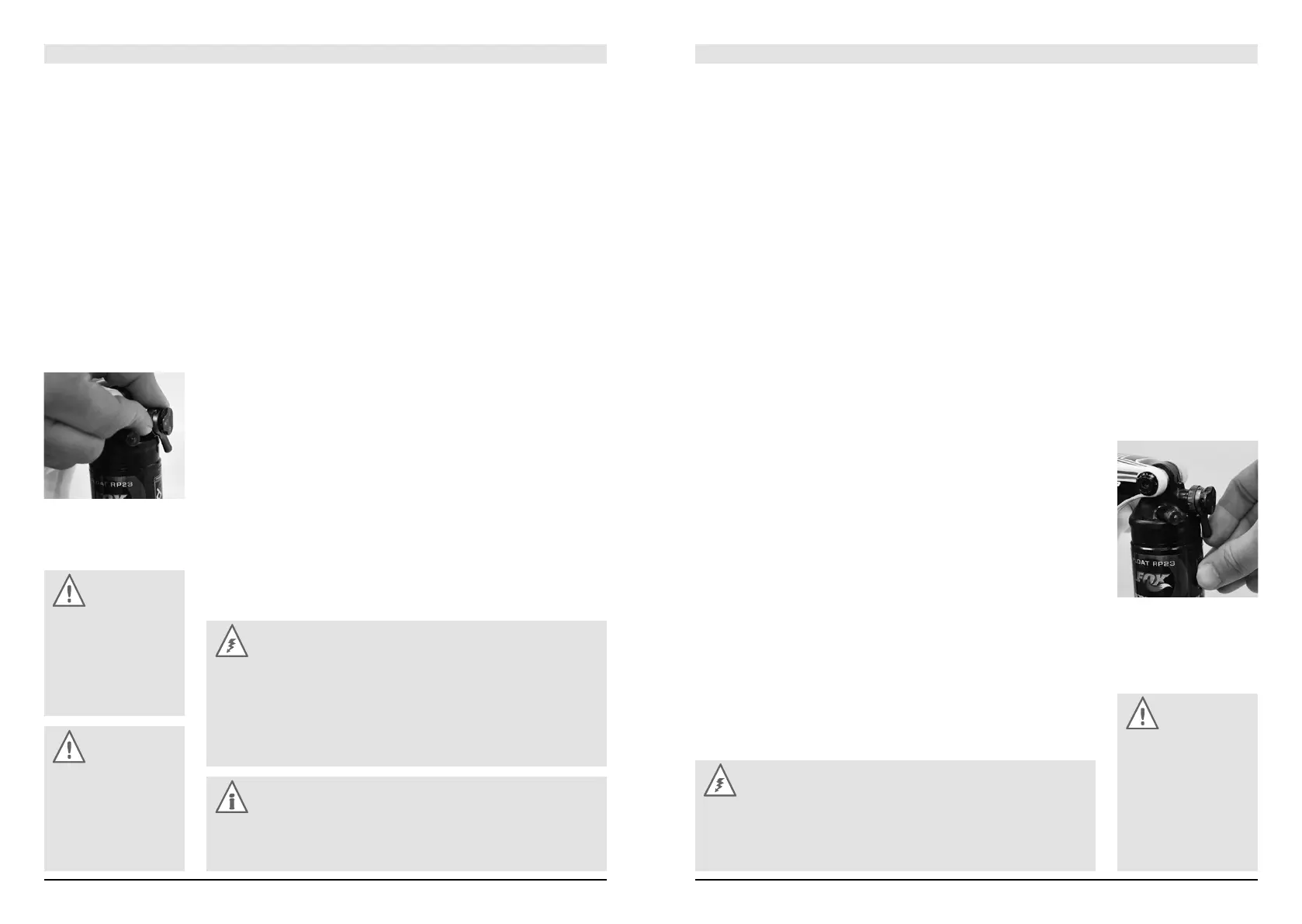
Rear shocks with adjustable damping are fitted with an adjusting knob that
is (mainly) red to slow down or accelerate the rebound movement. Sometimes a
second knob (mainly blue) is available, which is to adjust the speed of the com-
pression movement and/or to activate the lockout function.
Start the adjusting with a completely open damping (rebound and compression
damping “-”). Ride over an obstacle (e.g. a kerb) and turn the rebound damping
in small steps towards the “+” setting. You have found the proper rebound setting
when the rear frame does not cycles more than once.
Adjusting the compression damping requires a great deal of skill and expe-
rience. A weaker damping provides a good response behaviour. Under certain
circumstances this may result in a too strong compression or bobbing of the rear
frame when cycling out of the saddle over obstacles, such as steps. A stronger
damping makes the suspension harder, thus reducing the riding comfort. Always
check a modified adjustment by doing a test ride in the terrain.
If you are not confident enough to adjust the damping on your own or in case
you face any problems, contact your STEVENS dealer and observe the respective
instructions in the operating instructions of the rear shock manufacturer.
The different rear shocks of different manufacturers differ a lot in parts. Make
sure that you have received the rear shock instructions together with the bicycle
from your STEVENS dealer. If necessary, download the instructions and further
information on the following websites on the internet:
https://www.foxracingshox.de/downloads-links
https://www.ridefox.com/fox17/help.php?m=bike&listall=specsheets
https://www.sram.com/en/service
https://www.srsuntour.com/en/home/
Lockout Feature of the Rear Shock
Some rear shocks have a lockout feature which is activated by a button or a
lever. Depending on the manufacturer the operation differs slightly. Make sure to
release the blocking on uneven ground, as the frame or the rear shock may suffer
damage.
Danger:
Full suspension frames are designed in a way to absorb shocks. If the
rear shock is too rigid and jammed, shocks hit the frame undiminished. In
these areas the frame is normally not designed to bear these loads. If your
rear shock has a lockout mechanism, do not activate the lockout function
when riding in rough terrain, but only when riding over smooth terrain
(roads, field tracks).
Note:
Rear shock manufacturers normally include comprehensible instructions
with their deliveries. Be sure to read them carefully before changing any
settings or doing any maintenance work.
Danger:
Do not turn any screws in the vague hope of adjusting them somehow. You
could release the fastening mechanism, thus causing a fall. All manufac-
turers normally mark adjustment devices with a scale or with “+” signs
(for stronger damping/harder suspension) and with “-” signs.
Caution:
Do not ride your bicycle,
if the rear shock
bottoms out. This could
damage the rear shock
itself as well as the
frame.
Caution:
Do not exceed the max-
imum pressure noted
on the rear shock or in
the operating instruc-
tions of the rear shock
manufacturer.
Caution:
A too strong damping
of the rear frame can
result in a sluggish re-
bound movement with a
rear shock that will not
recover when exposed
to a quick series of
impacts. Risk of a fall!



 To Next Page